Previous Shows
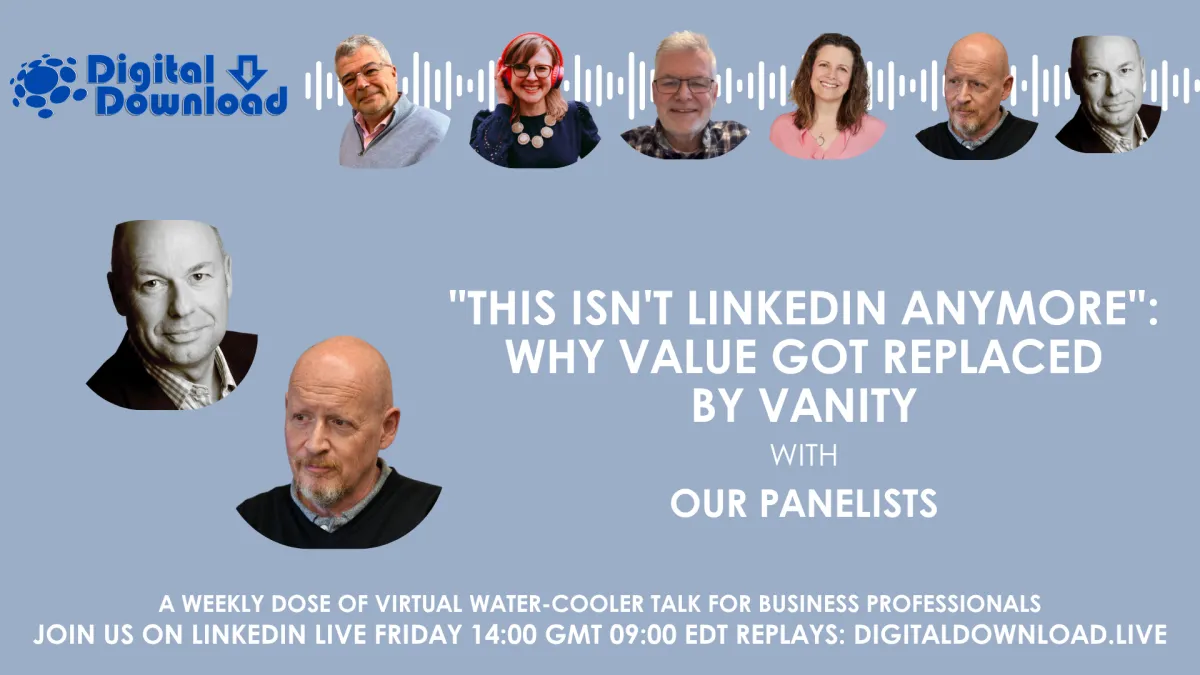
"This Isn't LinkedIn Anymore": Why Value Got Replaced by Vanity
This week on The Digital Download, we are calling out the state of the timeline.
Remember when the biggest complaint on the platform was "This isn't Facebook!"? Today, you scroll through the feed and you have to wonder... is this even LinkedIn anymore?
Content quality has taken a nosedive. We are swimming in a sea of engagement bait, empty platitudes, and people desperately chasing likes while entirely forgetting to add value.
What is actually going on? Are experts suddenly scared to share their knowledge? Have we given up on educating our buyers? Or do people mistakenly believe their insights are top-secret strategies that should be locked away?
I am joined by Tim Hughes, Adam Gray, Helen Mackenzie, Tracy Borreson, and Richard Jones to unpack why the B2B world stopped teaching and started pandering.
We will unpack:
* The Like-Chasing Epidemic: Why professionals are abandoning educational content for cheap, dopamine-driven vanity metrics.
* The "Secret Sauce" Fallacy: Why hoarding your expertise out of fear of giving "too much away" is actually killing your credibility.
* Content Fatigue: Have we simply given up on trying to educate a feed that is drowning in noise and AI slop?
* The Return to Value: How to confidently stand out in a sea of fluff by aggressively helping your audience solve real problems.
If you are tired of the engagement bait and want to know how to actually build influence, join the conversation.
We strive to make The Digital Download an interactive experience. Bring your questions. Bring your insights. Audience participation is keenly encouraged!
This week's Host was -
Bertrand Godillot, Founder and Managing Partner of Odysseus & Co, Co-founder at Azpertilo.ai
Panelists included -
Tim Hughes, Co-founder and CEO of Azpertilo.ai
Adam Gray, Co-founder of Azpertilo.ai
Helen Mackenzie, a very proud Azpertilo.ai partner.
Transcript of The Digital Download 2026-02-20
Bertrand Godillot [00:00:10]:
Good afternoon, good morning, and good day wherever you may be joining us from. Welcome to another edition of the Digital Download, the longest-running weekly business talk show on LinkedIn Live, now globally syndicated on TuneIn Radio through IBGR, the world's number one business talk, news, and strategy radio network. Today on the Digital Download, we are calling out the state of the timeline. Remember when the biggest complaint on the platform was, this isn't Facebook? Today you scroll through the feed and you have to wonder, is this even LinkedIn anymore? Content quality has taken a nosedive. We're swimming in a sea of engagement bait, empty platitudes, and people desperately chasing likes. while entirely forgetting to add value. What is actually going on? Are experts suddenly scared to share their knowledge? Have we given up on educating our buyers? Or do people mistakenly believe their insights are top-secret strategies that should be locked away? Before we kick off the discussion, let's go around the set and introduce everyone. While we're doing this, why don't you in the audience reach out to a friend, ping them, and have them join us? We strive to make the digital download an interactive experience, and audience participation, as you know, is highly encouraged.
Bertrand Godillot [00:01:38]:
Helen, do you want to kick us off, please?
Helen MacKenzie [00:01:41]:
Thanks very much, Petron. I'm Helen Mackenzie, a proud associate of DLA Ignite, and I'm wondering whether if I put a picture of some of my sheep up, I'm gonna get a few more likes than I'm currently getting just now for my posts about procurement and sales being twins.
Bertrand Godillot [00:02:01]:
Pretty likely, by the way, pretty likely. Adam.
Adam Gray [00:02:06]:
Hi everybody, I'm Adam Gray, co-founder of DLA Ignite and Azpertilo.ai. And yeah, this is an interesting topic because this seems to have happened, it feels like we've reached a tipping point. And when a year ago maybe there was very little personal content, now there seems to be very little business content on LinkedIn. And I guess like the political pendulum that swings one way then the other, we've got a similar thing going on perhaps with content. And it would be quite, I think, an interesting chat to try to uncover this and get to the bottom of it.
Bertrand Godillot [00:02:43]:
And I'm sure we will. Tim.
Tim Hughes [00:02:47]:
Hello, uh, welcome. My name is Tim Hughes. I'm the CEO of Azpertilo.ai. Um, I'm famous for writing the book Social Selling and Influence: Using Social Media for Cold Outreach and New Business. And Helen, we always love photos of your sheep. Um, so please go ahead and share some more.
Adam Gray [00:03:11]:
Don't be sheepish.
Bertrand Godillot [00:03:15]:
Yeah, thank you.
Tim Hughes [00:03:20]:
Anyway, I was actually having a conversation with someone today and they put out a blog the other week and it went absolutely manic. And it's because they put a photo of a controversial person on the post. And I said, yeah, if you always put a a picture of a controversial person on the post, it generally will go ballistic. 10 minutes after I put the phone down, as you kind of did in the past, but you don't metaphorically put the phone down, I, I checked his timeline and he put out another post with another, um, um, uh, politically, um, um, um, charged person. So he was obviously, uh, decided to, to start chasing the likes.
Adam Gray [00:04:07]:
Yeah, why not?
Helen MacKenzie [00:04:09]:
Well, I wonder whether, you know, like, one of the things that's interesting about that is how that sits. That feels to me like that's somebody that's potentially a solopreneur or somebody who's got, um, quite a lot of, um, scope around, um, what they can post. But in the business world Um, brands are very conscious about who they're, who they're linking to. So, you know, for instance, one of the, the brands, I think it might be Workday, or had a, had an Indian cricketer as one of their sort of influencers. And I'm assuming that that person would have been fairly rigorously vetted to make sure that that wasn't going to damage the brand of the company that he was being associated with. So as I say, I think that feels all right, but it doesn't feel to me as something that sits within guardrails of a brand and of brand guidelines. So yeah, okay, if it's your business where you're hitching your wagon to somebody quite fondly, then sure.
Bertrand Godillot [00:05:17]:
I'm sure we'll address that during the discussion. So very quickly, myself, Bertrand Godillot, I am the founder of of Odysseus Co. and managing partner and also co-founder at Azpertilo.ai. So I have a foundational question for, for you guys, uh, sorry, for you ladies and gentlemen, um, and that's the following: why do you think professionals are abandoning educational content for cheap dopamine-driven vanity metrics? And I think we started to touch this a little bit with you, Ellen, but I would love to hear what Tim and Adam have to say about this.
Adam Gray [00:06:00]:
Well, we all, we all love a like, don't we? So, you know, ultimately, if you post something and you get loads of engagement on it, I think you nailed it when you said about cheap dopamine-driven. If you publish something which is dry but educational, people may gain value from that. They may read all of what you've posted, but they're not going to be leaping up and down and laughing.
Bertrand Godillot [00:06:28]:
Yeah.
Adam Gray [00:06:30]:
Probably, whereas if you, if you post something which is funny or entertaining or personal or sad or poignant or whatever it may be, there's much more likelihood of people clicking like. And ultimately, I guess it just shows you that the people are out there listening. So I get why people do it, but I think like with all of these things, there's a degree of balance to be struck, isn't there?
Tim Hughes [00:06:56]:
Yeah, there's a comment now from Will Rattray. Politics and business, I always thought that they shouldn't mix. Would you agree?
Adam Gray [00:07:07]:
Yeah, yeah, yeah. I mean, that's a really good, a really good point, Will. I mean, I think that the politics, religion, addiction, even maybe which tribe, which football tribe you're in. The problem is that those are very hard baked into people, and you're as likely to alienate people as you are to bring them on board if they have a different viewpoint to you. So it's quite a high-risk strategy, I think, sharing these things, because the reality is if you vote one way and I vote the other, it's highly unlikely that you're going to change my opinion or me yours. So it's likely to be a divisive conversation. But I think that the challenge with what I'm seeing at the moment is that it all feels a bit like the office party. You know, there are huge amounts of vacuous, shallow content that are being published.
Adam Gray [00:08:09]:
And, you know, it's fine for you to be proud of the fact you've run a marathon, and here's a picture of you standing at the end of the marathon marathon holding up your medal. Fantastic. I've not run a marathon, so hats off to you if you have. But if everything you post is about your training schedule and your marathon running and your position and your ranking and your new training shoe, and it's all about that, the only conclusion that I can draw from that from a commercial perspective is that you're a marathon training coach. And I wonder whether that will help you. Well, I know it won't help you to make your number. It may help move you closer to me, but if I don't understand what you do and how you can add value to my business, there's unlikely to be a commercial conversation and interaction going on.
Tim Hughes [00:08:58]:
Have you noticed some of the— there's been a lot recently of people posting about the fact that they're 5 years at their company or whatever, and it's a standard templated request, post. I've been collecting them because I'm going to run a— put them through AI and find out what the structure, the format is, and the framework is. But, and they're all a bit like during COVID there was loads of people that were doing what I would— what I used to call stand by the bed things where they used to say, we're all getting up at 8:30 and we're all having a collective meeting and we're going to tell everybody in our company about how we're going to kill the day and smash our numbers and stuff like that. And it's like, you know, are you really proud that you've been at the company for 5 years? Because I bet you don't. I bet you're not.
Bertrand Godillot [00:09:58]:
Yeah.
Helen MacKenzie [00:09:58]:
Oh, sorry.
Adam Gray [00:09:59]:
No, no, go on.
Helen MacKenzie [00:10:00]:
I was just gonna say, do you think that some of that, that sort of the way people perceive LinkedIn to be Um, comes from underestimating the power of LinkedIn to, you know, establish connections with people who you might have a— be able to have a commercial relationship with. And that when people see it as this sort of glorified CV professional network, then actually the things you talk about are, are to do with yourself because it's your CV. It's, you know, I'm, I'm a, you know, I don't know, accountants, account sales director, DLA Ignite, um, and, you know, I like running marathons. And it, you know, it feels like that sort of other interests bit at the bottom of the CV. And perhaps people are underestimating the power of the network to actually connect people and, and then, you know, then, uh, then do business with each other, that they're not seeing it in that context. And that's why—
Tim Hughes [00:11:00]:
I think, I think that's probably, probably right, Helen, which is the fact that you're— what you're doing is quite often that the people only have permission to do certain things. So they see things, it's CV thing, therefore, I'm going to post about 5 years rather than talking about something that could actually have an impact. Because whenever, if you talk about an impact, that's a risk, which some people won't want you to take, just as much as you often get salespeople talking about sales, which is actually the last thing that buyers want them to talk about.
Helen MacKenzie [00:11:34]:
Mm-hmm.
Tim Hughes [00:11:36]:
So, um, so let's say, yeah, I think Tove makes a really, uh, good point, which is, which is counter to the— to Will's actually, which is, which is interesting. Always like a counter, uh, point, which is, uh, we were talking about politics and business and she says, really, I think we have the obligation to try and influence politics through business. Like, like now there's a lot of EU alternative companies flourishing because people don't want to support the USA. And there's a— there are a lot of companies that are You know, if you don't want to move your data to the US, then there's a lot of companies that you can actually put your data here.
Adam Gray [00:12:12]:
Yeah, but I think that's a smart post grows out of that. So somebody shares Donald Trump speaking about something, and Donald Trump is a particularly polarizing character. So maybe you love him, maybe you hate him. Most people are not ambivalent or sitting in the middle about this. So he posts something, And you have the option of saying, I love him, he's the only person that's driving stuff forward, or you have the opportunity to say, he's an idiot, I can't stand anything he says. Or the third option is, I think, what Tove is alluding to, which is that you say, what does this mean for your business if this is the new policy which is being implemented? It's likely to have an impact in the following ways, and therefore you maybe want to be looking as she says, closer to home for something here. But I think that the general sense that I get— so I remember when Tim and I started the business a decade ago now. Wakey wakey.
Tim Hughes [00:13:16]:
We started the business.
Adam Gray [00:13:18]:
Yeah, no, no, but when we started it 10 years ago, nobody or very few people posted anything personal on LinkedIn. It was very structured and it was very formal. And the opportunity to break through the noise came from you saying, I teach social selling, I teach social selling, I teach social selling. Here's me having dinner at a really nice restaurant with some colleagues or friends. And it was like a breath of fresh air in amongst all of that stuff. So we encouraged everybody that we trained to put some of themselves, some personal elements into their posting strategy. I think today the problem is that there is no strategy for most people. What they have is they have a post that was successful, which was a post about them and their sheep, a post that was successful, which was them and their motorbikes, a post that was unsuccessful, that was them in their business, a post that was unsuccessful, that was them in their business, a post that was unsuccessful, that was them in their business, a post that was unsuccessful, that was them in their business.
Adam Gray [00:14:21]:
And the conclusion that they draw from that is the only posts that get read are posts that are entertaining. Therefore, my posting strategy needs to be focused on entertainment. And whilst you're not wrong for arriving at that conclusion, the reality is that you need to educate people, A, what you do, and B, how and why it matters to them. And I think that if— I know for a fact that Tim has a very clear structure about what he posts, when, and the kind of content that he posts, because he knows that 3 posts about business, a 4th post becomes a bit dry. Therefore, I'm going to do a post about what my father did when he was young.
Tim Hughes [00:15:06]:
Meeting everyone else.
Adam Gray [00:15:07]:
Yeah, traveling somewhere else or whatever it may be, which kind of releases the tension and shows a bit of his personality. in this. But I think that if you don't have that— well, I don't think, I know that if you don't have that mix, if you don't have a clear purpose for why you're posting stuff— I want you to know that I am the go-to person for CRM systems or whatever it may be. So I need to talk about CRM systems, not about my CRM system and why this is the one that you should buy, but about when you implement a CRM system, here are the 3 things that everybody gets wrong. I've spoken to 100 companies that are changing their CRM systems, and this is what they all said. Stuff which adds value and brings your insights from being in that marketplace to the wider audience. But every now and again, you want people to see, actually, not only do you know a lot about CRM systems, you seem like a really nice person, and I would like to have something to do with you because we share a passion for Manchester United or fine dining or cycling or whatever it may be. And I think that that's ever so important.
Tim Hughes [00:16:16]:
Can you put up Tove's comment there?
Bertrand Godillot [00:16:20]:
There are a few comments.
Tim Hughes [00:16:21]:
Yeah, so Tove basically says, and Tove comes up with a great strategy, I try and mix and match 3 to 4 posts serious business, 2 maybe slightly lighter, and 1 goofy. because we are all human. And if you bring up the next one from Tobe as well, which is where she says the word unsuccessful according to what metrics, which I think is a really important point, because if you're looking at likes, then maybe it was unsuccessful, but maybe it was successful in other ways. What she says, I mean, you might get the impressions, but you won't get the business out of the goofy ones. I'd actually say you will get the business out of the goofy ones.
Helen MacKenzie [00:17:02]:
Yeah, and also I think it's not like B2C, C. So it isn't— I think B2B has got a little bit sucked into the vortex of what you would call influencer marketing. In the B2B— in the B2C space, say on Instagram, where I'm, you know, I've got a, a face cream and I'm, I'm, I'm quite famous and I'm using it, you know, and I, I've got a link in my bio if you want to do it, or TikTok, where ordinary folk are just using vacuum cleaners or, or, or, or, you know, strimmers or, or whatever, pairs of socks or, or jeans, and there's a link in the bottom, they're linked to the TikTok shop and they're earning commission from that. So I think that there's a, there's a bit of a disconnect thinking that that's how you sell is through the personal content, but I do think that the personal stuff makes you memorable. And where we're, you know, when we're— so somebody might read a post, um, you know, one of my posts about, um, buying and sellers and the twins, which is, is sort of my theme. And but they'll probably remember me because I try and record videos on the top of a cliff and it's windy and you can't really hear them very well. And so when I have a call with them They'll talk about that, but then they will go on to the thing that they'd read that they might not even have liked the post when they read it. But that's— I think there's a— it's not binary in the sense that it's one post that's going to get you the sale or one post that's going to get you the conversation.
Helen MacKenzie [00:18:42]:
I think it's a mix, a mix, as Toad says, that gives a sort of rounded view of you as a person. But who's got, you know, who could potentially be quite helpful to have a conversation with?
Adam Gray [00:18:56]:
Yeah, but I think that the— so all of us hope that our post will go viral and the phone will start ringing, but actually that's not the way that the B2B works. But I think the challenge is that your personal posts create the catalyst for people to take action. I.e., drop a like, and then you have a reason for reaching out to somebody. So the fundamental challenge with a business post is that you publish something and it may be seen by 500 people, say, and you might get 5 likes on it, and the 5 likes may well come from your friends and colleagues. So the fact that it was seen by 495 people that could buy your product or service or may be interested in learning more They— you don't know who that 495 people are. So the challenge for everybody is, how do you define that? Yes, you may have had 50 views from Oracle, a company of 300,000 people, or 100 views from Salesforce, a company of 200,000 people. But the reality is you don't know who actually has done it, so you can't facilitate a conversation. But, but if you do a personal post that gets 50 likes, That's great.
Adam Gray [00:20:12]:
There's 50 people that you now have a reason to speak to. But I think that the challenge here is that most people don't close that particular loop, do they? They do a post, they get a degree of success with it, and they go, wow, check that out, I got 150 likes. And they don't say, okay, so how do I catalyze or crystallize those likes into something that may be valuable? So maybe I'll send a message to everyone saying thank you for liking the post. I'd love to have a chat with you. I'm not going to try and sell you anything. I'd just like to hear what it is you're doing. And if you sent that out to all 150 people, 50 of them would say yes. And then you've got 50 conversations.
Adam Gray [00:20:51]:
And if those 50 people are people that you would like to be having a commercial conversation with, at least you're in the room one-to-one with them, and you may be able to turn that into something valuable. And, you know, I've never had a post that's gone properly viral, but I did a post the other day and it got 800 likes on it. Which is really nice, but, uh, none of those people phoned me up and said, I'd like to buy from you. And, and the other challenge is, if you get lots and lots and lots of likes on something, you, you haven't even got time to look at all of the people that have liked your post. So 800 likes is— if I spend 2 days reading people's profiles that have liked it, it's a huge investment of time. Whereas if 20 people have liked it, I can action all of those 20 likes. So I think so much of this is about creating appropriate response and then following up on that appropriate response rather than hoping that a million people saw it, therefore I'm going to have to scale up to sell all of the whatever it is that I'm selling, because actually life seldom works that way.
Bertrand Godillot [00:22:01]:
There's another angle to this that I want— I would like to discuss, which is authenticity. Because as you said, you know, there are— how many, how many, how many posts do we see about, you know, me at the, uh, at the kickoff event, me at, uh, breakfast with a customer, uh, on the show? Um, this seems to be— there seemed to be a Or as you said, you know, me with my dog. There seem to be some patterns that, or at least, you know, trends.
Helen MacKenzie [00:22:35]:
Mm-hmm.
Bertrand Godillot [00:22:36]:
Also trends that sometimes you're tempted to embark on because there is this assumption that, and somehow a reality that if I show myself, then I'll get more, I'll get more likes or I'll get more reactions, let's say, from broader audience. Now, is that broader audience into my target audience? That's a different, completely different topic. And most of the time, you know, it's not the case. But I don't know what's your take on this, you know, how much of this is engineered versus, um, you know, just, uh, being yourself. And I think there is— there's also a challenge, uh, if you really need to give a little bit of yourself, what I call the coffee machine, so that there is an option for creating a connection with people you don't know, you know, just like we would, uh, we would do, uh, when we first visit a customer. We, uh, we go and have, uh, and have some smoothie. you know, a small talk session, probably less in the UK than in France, but we had that. So, your take on that?
Helen MacKenzie [00:24:01]:
I mean, I wonder whether there's a little bit of people seeing what other people are posting and, you know, being a bit reticent to post anything, and then seeing the type of thing that people are posting and thinking, well, that's the sort of thing I could post about. So in a sense, the reason why everybody is posting about their, you know, their charity running thing that they've done, or their— is because they see other people doing that. And they think, well, that's the sort of, that's the sort of appropriate thing for LinkedIn. Or, you know, there's, there's stuff, there's a lot about people's people's children graduating, for instance, you know, very proud moment. Very proud moment. And I said to Tim I wanted to post that it was a very proud moment for me when my son made me a fantastic gin and tonic on Sunday tea time to, you know, to have watching the football. But I didn't post that because I decided I wouldn't. But on the other hand, I think that breeds more posts like that because people look at that And they think, well, it's all right to post that.
Helen MacKenzie [00:25:12]:
I'm not going to get in trouble with the brand police. I'm not gonna, you know, wreck my career by posting something inappropriate. I can put about, about my dog, about my children, about, um, about, uh, you know, my charity work or my running or something like that. And, uh, so I do think there's something around that where people are a little bit nervous or a little bit, um, yeah, a little bit nervous, a little bit apprehensive about what they can put. And when you think about putting something where you're putting it out there, where you've— you're, you're a bit more, I've got an opinion about something to do with my work that I want to share with you, or I've got some insight, I saw this article and I thought it might be interesting. Again, I think people can be a little bit nervous because when you sort of have an opinion and you put that out there, that is actually theoretically exposing yourself, um, in a way where, you know, people might disagree, or might not have been quite the right way to, to express it, and somebody might take the mickey out of the language that you use, or I don't know, what do you think? That's, that's just how I think. I think it's, it's more about a lot of people just look, a lot of people just look, and when they take the step to post, they want to post something that they feel is safe.
Adam Gray [00:26:26]:
Yeah, I mean, I, I think you're absolutely right. Uh, nobody wants to be ridiculed. Nobody wants to make a mistake. And I think that it should be the first step on being more authentic. And yeah, posting kids about your— posting pictures about your kids having graduated is fantastic, and you're very right to be proud of that. But equally, You're very, very pleased, very right to be proud of your children no matter what they do, and, and that shows an empathetic kind of human nature to you. But again, you know, I, I think that— I think some people have, have, uh, have started to post because they feel they need to post, and they feel the post is going to catalyze action. From their audience, which it won't.
Adam Gray [00:27:29]:
You know, if you post a brilliant thing, I'm not likely to phone you up and say, I read your post, that's fantastic, can I spend a million dollars with you? Because actually, that's not how these things happen. So the question people should ask themselves is, in the very top level, what am I posting for? And they might say, well, I want to be visible to my audience. of course you do, but visible for what? And if you can't answer that or haven't thought about that, you should be thinking, okay, if I keep posting stuff to my audience, they are going to put me in a particular box, particular pigeonhole as to how they view me. And you see it from people all the time. You see somebody posting loads of stuff and they're an accountant or they're a coach, or they're a fitness trainer, or they're an evangelist for a tech company, whatever it is, and you know how you position those people. And then there are loads of other people you connect to, and you may see their posts but have no idea what they do. Well, those people are not achieving anything in, in your mind because you don't know what they do. And even if you think, I like this person, if you don't know what they do, when you have a problem that you would potentially hand them money to solve for you, you're not going to think about handing it to them.
Adam Gray [00:28:51]:
You'll think about handing it to the person that you do recognize as being the expert in that space. Now, I think the point is that we all have the ability to, to regularly stay visible in front of people and to maneuver them to a position where they think that you are the person that can solve this specific problem. But you have to tell them what the problem is you solve. You need to show, not tell them that you're an expert. It's like when somebody says, expert in CRM. That's not clever. Don't tell me you're an expert. Show me you're an expert.
Helen MacKenzie [00:29:24]:
Hmm.
Adam Gray [00:29:25]:
Tell me that for companies in this sector, these are the mistakes they always make when they're implementing a new CRM system, because I'll read that and I'll think, okay, I need to be careful not to make those mistakes because those are the mistakes that people normally make. And, and anything that adds value, anything that, that gives me knowledge that I didn't have before I've read the post is valuable.
Helen MacKenzie [00:29:46]:
Do you think some of it, do you think some of it though, Adam, is around what, um, people are being told by their colleagues in marketing is appropriate sort of business behavior on LinkedIn? So for example, um, I, I, somebody in my network reached out to me today and he said, you know, I, I'm posting— we're posting lots of really interesting stuff on our company page, which, you know, I hope you would engage it with. And to which I said, well, that's great, but why— it's a small business, why don't you post that yourself? Why, why has it got to be on the company page? And I think that he possibly is following that, that lead where everything that's thought leadership has to come out on the company page, and then we We share it or we like it, rather than the the thing on the company page actually coming from an individual within the company and it being it being sort of owned by them. And I think marketing are I don't know perhaps there's some marketing people on the session and can put in the in the chat. But I think that's perhaps where marketing have have have been led to believe is the appropriate place to put this sort of thing on LinkedIn. But that's I don't know whether that's part of it, is that that's where they're telling you that the thought leadership goes. It goes on the company page and then we all like it.
Adam Gray [00:31:17]:
Maybe, but I think that marketing have generally got a very campaign-led mindset. We're going to do X, it's going to generate Y leads and depending on how quickly they click the link or go to the website or how many webinars they sit in on will determine how hot a lead they are, and then we'll pass them to sales. So even though every organization wants to have a relationship-based sale with somebody, that— no, they want a sale from somebody, that's what they want. And this is, um, this I see as being a, a major issue that marketing have got this campaign-based mindset where we're going to do this activity and we're going to get something back from it, and maybe that will be something that we can convert into revenue or pipeline. But generally speaking, they haven't got a, this is our position in the marketplace, you know, we've got a tower block in central London with that massive logo on the front of it, and the massive logo cost £50,000 to put on there, Do we think that adds any value? Yeah, it probably does, because people see this big building and they see your logo on it and they think, okay, that looks like a big, trustworthy, safe company for me to spend money with. But when it comes time to their digital marketing or even their traditional marketing, it tends to be very transactional. And, and I think that this is more about flooding the digital world with valuable content, valuable about your business, the knowledge of your people within the business, and the kind of people that your people are within the business, so that every time a prospect goes out and ventures into that space, they see your company looking back at them, and your company looks like a trustworthy place that's full of nice people to do business with. Now, that's— Which is reverse engineer, isn't it? Sorry, Bertrand.
Bertrand Godillot [00:33:19]:
No, no, which is, which, which ties back to the way we build trust, you know, long, long-lasting trust and trusted relationships in, in business, which is, you know, part of it is emotional. So, you know, great, you're a great guy, you know, I can see, I can see you're someone I will get along with quite, quite easily. But that's not enough, you know, that's only one part of the—
Helen MacKenzie [00:33:46]:
Yeah.
Bertrand Godillot [00:33:46]:
And this is probably the reason why, you know, if you if you keep publishing on this type of, you know, on you with your dogs and you preparing, you prepping for a marathon and stuff like that, you probably get this emotional connection going. That's okay.
Helen MacKenzie [00:34:04]:
Yeah.
Bertrand Godillot [00:34:04]:
But you don't get the cognitive part of the story, which is the second aspect, which will, you know, and that's only if you combine these two. that you can think about creating a long-lasting relation, business relationship. So yes, you should be, you should be, regardless of the number of likes, the, uh, no, the reactions, uh, you should be publishing, you should be talking about your area of expertise.
Adam Gray [00:34:38]:
Yeah, if you go to the, if you go to see a surgeon If you go to see a surgeon, do you want the surgeon to be good or nice?
Bertrand Godillot [00:34:49]:
Both, ideally.
Adam Gray [00:34:50]:
Exactly, exactly. And that's the point, isn't it? So, so, uh, if you're a nice guy but you're not very good, I'm not going to come to you. If you're a horrible guy who's really good, I still might not come to you. If you're both, if you're the overlap in that Venn diagram where you are nice and good, then you seem like the doctor that I should be working with for this particular procedure. And I think that that's the key that so many people miss, is that one type of content does not do everything. You know, you need to have content that shares your expertise, not sharing your company, but sharing your expertise. You know, something which is not a sales pitch, but is genuinely a gift to the people that that are engaging or consuming your content.
Helen MacKenzie [00:35:38]:
Yeah, and I like that. I like the, the term gift, actually.
Adam Gray [00:35:42]:
I—
Helen MacKenzie [00:35:42]:
that's just what I was thinking, that was around generosity, I think, which is quite an interesting point, which is like we can all just go along with things and not, um, take the moment to think, well, would this be useful to somebody, and can I take a moment to share it. And obviously, if you're creating something from first principles, it takes a little bit of a while to do that. So you are being very generous if you're creating a post from first principles and you're sharing something. But, um, it's, it's, it is that act of, I've— here's something I found really interesting, and I think my community, people in my community might, might find this useful, so I'm going to share it. I'm not gonna keep it to myself. I'm going to share it. And I think that generosity thing, that gift thing, is quite an interesting point, that actually there's not much of a gift in sharing a post about your dog apart from like making everybody feel fuzzy about the dog because it's lovely. But there is something about a gift of taking a moment to, to share something that you found interesting and you think somebody else—
Adam Gray [00:36:52]:
Yeah, and I think that there were, there were 2 kinds of there are 2 kinds of posts in that area. So one of them is, here's something I found. So I have found this thing which I read and was a real aha moment for me, and you should read this too. So that's one type. But the other type is, here is something that I learned. And I think that that's really important because what you want to be is perceived as the person that is the conduit to all good content. So here's content that I found. Here's a great post from this person.
Adam Gray [00:37:25]:
Here's a great white paper from here. Here's a report from this person. This is a webinar that you should consume because you become my conduit to curated, high-quality entertainment and education. Perfect. But also, you being the curator of this content for me doesn't make you good at what you do. So you then sharing, every customer that I train falls into the following trap, and here's how I have taught them to overcome this. This is what I have developed to help them overcome this. Okay, so I'm sharing some of my IP with my audience so that they don't make the same mistakes that every customer up until that point has made.
Adam Gray [00:38:10]:
That proves that I know what I'm talking about. And that's absolutely crucial. But both of those things are in the good doctor part, aren't they, rather than the nice doctor part? And you do need to have that personal stuff as well, something that says, you know, we're just the same, really. There's no difference between us because we both love goth music or cycling or swimming or whatever these things may be. And that bonding is something that salespeople are so good at doing face-to-face. You know, they're so good at scoping somebody out and working out what they should talk about to build rapport and become a friend to that person. But that tends to be in a face-to-face environment. Salespeople, in my experience, are not so good at doing that digitally in most cases.
Adam Gray [00:39:09]:
Because I think they, like all of us, we do a post, we want the post to deliver the maximum value to us. So it needs to say who I am, what I do, why you should buy from me, and a really strong call to action in it. And then actually what you end up doing is getting nothing from that because people see that as offensive and inappropriate. Whereas what you— this is a top-of-funnel exercise, isn't it? You know, when you do a post, it's an outbound piece of content. It's something that you're putting out there to establish you and make you visible for a particular thing. And to expect that somebody is going to phone you off the back of that and buy from you is wishful thinking.
Bertrand Godillot [00:39:56]:
Yeah, agreed. And there's something that doesn't help either is I just like to— I don't want that we spend the entire, the rest of the discussion on this, but is the, I would say, it's no longer emerging now. It's really all over the place, the use of AI to write content and share content, which adds just another layer on the whole authenticity and the whole relationship, trust-building relationship challenge. So, I'd like to have your views on this, maybe a short comment on this. First of all, do you really see this in your feed?
Helen MacKenzie [00:40:46]:
Yes, yes. And I think what it's doing is it's creating a— again, back to the what are other people posting, what, what should I post? What should the structure of my post look like? I think the use of AI is, is creating, um, the structure of a post, which is that you, you know, that you can't, um, you can't do something, um, with, you know, something— I baked a cake and what it taught me about, you know, uh, B2B sales, you know, that it's, that it's creating a structure to a post which I think people are then seeing and thinking that's how it has to be, and either then doing their own stuff or using AI to create similar. But also that it's, it's creating, um, it's, it's creating a vanilla way of talking about things that, um, again, it's, it's, it's those, you know, I'm just circling back, I'm just checking in, I'm just following, you know, that I think that, that it takes all the, all the colloquialisms out of people's language, all of the ways that you would talk about it rather than how the corporate speak would talk about it. So I think that, that's where I see it, is that it's, it's sort of making everything really vanilla. And again, why would you stop and read it when you look at the first bit and you think, oh my goodness, either somebody's taken time to write this and it sounds like everyone else, or, um, I think somebody's used AI to create this post, and so again, I'm not thinking that that's actually going to add value. I, I don't know what you think, but that's, that's my, my take on what I'm seeing.
Adam Gray [00:42:31]:
Yeah, I mean, I think the, the danger here is that we—
Bertrand Godillot [00:42:35]:
the—
Adam Gray [00:42:37]:
so AI certainly has its place, and it can be very helpful in helping people draft and collate ideas and sift through data. So, you could pour a report that you've just read from an organization, Gartner, say, to pick one at random. You could pour it into your AI tool and you could say, draw me 4 conclusions from this that support the view that this is the current state of play in the world. And it may come up with something which is incredibly insightful that you hadn't spotted, and then sharing that. But I think that there is no harm in saying, I put this report into this AI tool, and I— because you're trying to teach people. So, I put the report into this AI tool, and it told me that these were the things that are really important and really support this view of the world. I think the problem comes when you take your AI and you try to pass it off as being you that's saying stuff.
Tim Hughes [00:43:44]:
Yeah.
Adam Gray [00:43:45]:
And it's a recipe for disaster, particularly if you don't read and edit it. And I think that therein again lies a challenge. We're at this situation now where People are generally, I feel, very disempowered by the world and by stuff. And the challenge is that if AI says it, it must be true, therefore I'll publish this, or I won't even bother reading this, I'll just press publish because it's better than I could write. And then you press publish and who knows what can be being said. And I think that people have a very— they're very good at sniffing this out as well, aren't they?
Helen MacKenzie [00:44:31]:
Yeah. And I do think that back to that point of, um, you know, the 4 things that came out of that report, I mean, I would— that's certainly, that's certainly the way I would, I would do it if I was, if I was short of time and I didn't want to read it myself. But I would always, I would always think that I would look at that and say, does that Does that, um, agree with, you know, does that agree with how I think about things? Am I happy that I'm saying that? Um, because if somebody asked me about that, would I then look at it and think, oh, do you know what, I don't actually think that? I think it's difficult. It's difficult for people because I think that they, again, if they, if they subscribe to the, the points that we've been making, that actually LinkedIn is about sharing expertise, and it's, and it's, it's trying to be authoritative about a topic and, and demonstrating that, then it's, it's often a bit daunting to think of what you're going to say. So AI is a really helpful way of, of doing that. I think that, um, being able to trust that it's, it's okay, but also that it's not going to get into trouble with work is quite a big— is a big thing. And I think that that again is— I, I spoke at the beginning about sort of, um, brand and, and, and, and like, I'd be, I'd be better off not posting because this might not be the way I'm supposed to be saying this about this topic. And I'd— I don't want to get into trouble because I, I need my job.
Helen MacKenzie [00:46:06]:
And, you know, I don't want to, to give them a reason to, uh, to, to put me on the list when when the next round of downsizing comes. So I think that that's, you know, that's where AI feels a bit comforting because, you know, it might be that. But on the other hand, you don't know whether it's going to be compliant or not.
Tim Hughes [00:46:29]:
No.
Adam Gray [00:46:29]:
But I think this is a, you know, throughout the history of digital, people have seen horror stories, haven't they? So people getting sacked because of things that got posted on social media and people being vilified for having made a mistake or quoted the wrong person or called out something that wasn't in fact true. And people have increasingly become disempowered. So a decade or more ago, it was people not wanting to post, then it was people not wanting to post their own content or personal content. And now that's people not wanting to challenge AI. You know, AI says this, I don't think that's right, but what do I know? And actually, you know, I think that the swim lane for everybody needs to be remembering, generally speaking, what kind of content works and what the kind of the the strategy, the purpose of that content is. So, you know, we always say, if you double the length of a piece of content, you'll halve the number of people that will read it. And I think the reality is that we are all time poor, and AI is helping to give us potentially back some time, but we are still fundamentally all time poor. And the problem that we have is that If you, if you share with me a PDF that's got 10 pages, I will not read it, no matter how much I want to read it.
Adam Gray [00:48:03]:
I will not read it because I simply don't have the time, or in fairness, the inclination. So what you need to do is find a way of chopping that up into bite-sized chunks and delivering that to me. A, so I consume all of the bits that I need to consume to get me where you want me to be. But also, it helps to build a habit in me that your content is worth consuming.
Bertrand Godillot [00:48:27]:
Hmm.
Adam Gray [00:48:27]:
And, you know, we always used to see the case that people would do 10 things you need to know about buying a procurement system. And actually, that's the worst possible post. What you should do is 10 posts saying, here's something you need to know when buying, because not only is there a chance that I'll read them, there's a chance I'll remember them. Because we all know if I give you a list of 10 things, you'll remember 2 of them at at best. So give bite-sized chunks and you get into the habit then of reading my content every day. If I share one of those 10 things every single day, maybe you'll read it every single day. And after 2 weeks or 3 weeks of reading it every single day, you'll then automatically read my content every single day.
Tim Hughes [00:49:08]:
Yeah.
Adam Gray [00:49:10]:
But I think that this requires us all to reverse engineer what we want the outcome of this to be. You cannot just post stuff hoping that it'll get what you want to get. You need to think, where do I need to be? What would be the best possible outcome? I want to be the best-known person in the world for achieving, for doing these things, and I'm going to create and post a load of content that supports that view of the world, and I'm going to build an audience that consumes this content and hopefully acts on it to validate that I know what I'm talking about. That's a fairly straightforward strategy. The difficulty obviously is in doing, executing on that, isn't it?
Helen MacKenzie [00:49:54]:
Yeah, and I think, you know, one of the things about the 10 things compared to the 10 posts is that, you know, when you think about when blogging and that became a thing and that was you posted on your website, site and, and did that. You know, people's attention spans were longer because we weren't— we didn't have TikTok and, and, and all of these things that are, that, you know, that, that are making us go faster and, and not showing us long things. So our attention spans are shorter. So I think that you can, you know, you could do something that was longer in, in those days, and now you can't just because people are Conditioned not to have such a long attention span. I think that the one thing I would say is, back to the AI piece, is that when I see a post that is a single sentence on every line and that isn't in paragraphs, I just suspect that that AI has written that. And I think that I just don't really. I mean, unless you're writing poetry, you know, there was a young lady from Lewis who da da da da da da da da. You know, unless you're doing that.
Adam Gray [00:51:07]:
That's a limerick rather than poetry, isn't it?
Bertrand Godillot [00:51:11]:
You know what I mean?
Helen MacKenzie [00:51:12]:
It's, it's, uh, okay, it's a limerick, but it's, um, it's still single-line stuff. And people, you know, that's not— people don't— I mean, I may be very old-fashioned, but people— I would write using paragraphs that had more than one sentence in them. I might make a point with a sentence, In a little post, but I wouldn't do duh duh duh duh duh.
Adam Gray [00:51:35]:
No, and I think that the react— and this is the thing, isn't it? It's the difference between what should happen and what actually happens. So I've broken down my post into a series of lines because it's easier for people to digest that. You look at it and you go, I'm not even going to read that because it clearly isn't written by a person. And I think that part of people's job, if they're going to be successful with publishing content, is they need to learn from the actual results that they get with their audience. So it's no good sitting in your ivory tower saying, well, I genuinely believe that if I write one line, then another line, then another line, then another line, that's the most digestible way for people to consume this. And hopefully if I do enough of that, Helen will buy my product because she's my ideal customer. Because the reality is that Helen isn't engaging with that content because she doesn't like that. Now, she's probably right in assuming that it's AI written, but I think that the mistake that so many people make is that they plow on regardless.
Adam Gray [00:52:46]:
You know, I've got a strategy, I'm not going to test it, I'm just going to roll it out and then that's going to be what I need it to be. And actually, you cannot legislate for how other people are going to engage and like and consume your content. So you have to test it.
Bertrand Godillot [00:53:01]:
And I think that, you know, on that, I think that interestingly enough, the fact that we see a lot of, I would say, not necessarily very educational meaningful, useful content on LinkedIn actually creates a serious opportunity for people who have things to do, uh, things to say, sorry, and interesting expertise to share, um, because that clearly surfaces and, and you will be, um, you know, clearly identified as, uh, as a meaningful contributor in this solo ocean of things that are less meaningful, maybe, and definitely not driving the 2 sides of, you know, how you ultimately build trust. It was a great conversation because we're—
Adam Gray [00:54:09]:
Yeah.
Bertrand Godillot [00:54:10]:
I'm just seeing that we're reaching to the end of our discussion. And I, uh, it's a bit of a pity because we know that we could, we could keep going forever, but we have to stop, very unfortunately. So, uh, thank you to our audience, um, for their participation. We, uh, we, uh, we value that a lot. So thank you very much. Uh, if— watch out, Adam, you need to, you know, you need to raise the button.
Adam Gray [00:54:40]:
Exactly.
Bertrand Godillot [00:54:43]:
You can scan the QR code on screen if you want to get access to our newsletter, or just visit us at digitaldownload.live/newsletter. So you get the insights of the behind the scenes from the show and the upcoming episodes as well. Ellen, Adam, thank you very much. And to our audience, thanks a lot. See you next week. Have a great weekend.
Adam Gray [00:55:08]:
Bye-bye.
Helen MacKenzie [00:55:09]:
Bye.
#ContentStrategy #LinkedInTips #SocialSelling #DigitalInfluence #B2BMarketing #ThoughtLeadership #LinkedInLive