
Previous Shows
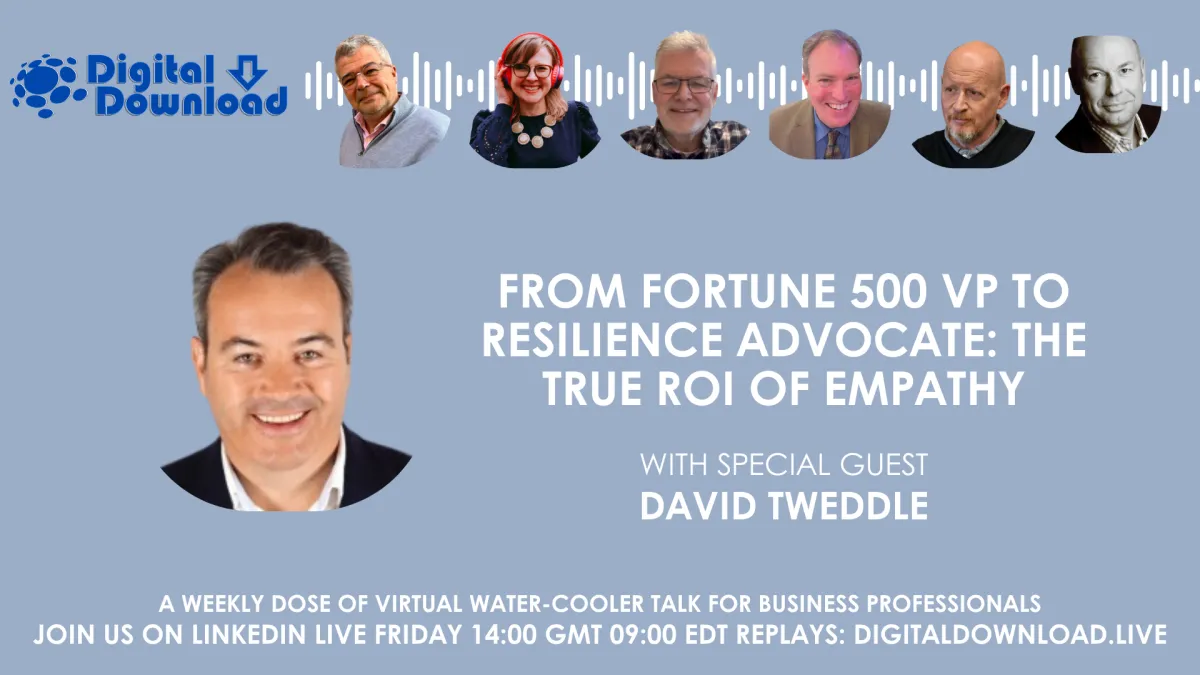
From Fortune 500 VP to Resilience Advocate: The True ROI of Empathy
This week on The Digital Download, we are having a conversation that transcends traditional business metrics. We are talking about life, unimaginable loss, and the true meaning of leadership.
For decades, David Tweddle was a high-performing Sales Vice President driving massive growth for tech giants like Oracle and SAP. But after enduring the profound tragedy of losing both of his sons in separate accidents, David’s path fundamentally changed.
Today, David is a Wellness Ambassador and resilience advocate. He joins us to share how confronting daily grief has made him a stronger leader, and why the corporate world desperately needs to re-evaluate how it supports its people.
We will discuss:
The Lifeline of Listening: Why "active listening" is no longer just a corporate buzzword, but an essential survival skill.
The Cost of Ignoring Empathy: How a lack of emotional support drives hidden revenue losses through absenteeism and "presenteeism".
Duty of Care: Why prioritizing your staff's wellbeing is your strongest strategy for mitigating attrition and sickness.
Compartmentalization vs. Coping: How to integrate senior corporate experience with deep personal resilience.
A New Perspective: How emotional intelligence and trust help professionals stand out in today’s shifting world.
Join us for a deeply moving, uniquely transformative discussion about bringing our full humanity into the workplace.
We strive to make The Digital Download an interactive experience. Bring your questions. Bring your empathy. Audience participation is keenly encouraged!
This week's Host was -
Bertrand Godillot, Founder and Managing Partner of Odysseus & Co, a proud DLA Ignite partner
This week's Guest was -
David Tweddle, Founder at Lumière, Business Consulting and Services, lumiereconsulting.io, and lumierestainedglass.com.
Panelists included -
Tim Hughes, Co-founder and CEO of DLA Ignite
Adam Gray, Co-founder of DLA Ignite
Tracy Borreson, Founder and CEO of TLB Coaching & Events, a proud partner of DLA Ignite
Richard Jones, Richard Jones, Director of Qure 8 Ltd
Transcript of The Digital Download 2026-02-27
Bertrand Godillot [00:00:02]:
Bonjour à tous et bienvenue dans ce nouvel épisode du Digital Download. Oups, good afternoon, good morning, and good day wherever you may be joining us from. Welcome to another edition of the Digital Download, the longest-running weekly business talk show on LinkedIn Live, now globally syndicated on TuneIn Radio through IBGR, the world's number one business talk, news, and strategy radio network. Today on the Digital Download, we're having a conversation that transcends traditional business metrics. We're talking about life, unimaginable loss, and the true meaning of leadership. We have a special guest to help us with the discussion, David Twiddle. David was a high-performing vice president driving massive growth for tech giants like Oracle and SAP. But after enduring a profound tragedy of losing both of his sons in separate accidents, David's path fundamentally changed.
Bertrand Godillot [00:01:06]:
But before we kick off the discussion, let's go around the set and introduce everyone. While we are doing this, why don't you in the audience reach out to a friend, ping them, and have them join us? We strive to make the digital download an interactive experience, and audience participation, as you know, is highly encouraged. Tim, would you like to kick us off, please?
Tim Hughes [00:01:27]:
Thank you.
Tim Hughes [00:01:27]:
Yes, welcome. My name is Tim Hughes. I'm the CEO and co-founder of Digital Ignite. Sorry, I'm not concentrating. And first, and just, I should say that Tracey's apologized.
Bertrand Godillot [00:01:44]:
Yes, she has. She has apologized, and she does. Sorry. Adam.
Adam Gray [00:01:52]:
Hi everyone, I'm co-founder of DLA Ignite, and I'm Tim's business partner. And I think today is going to be a very profound learning experience for everybody that tunes in. Because I think the majority of us cannot even begin to understand this challenge in life. So I'm strapping in for what I'm sure will be quite a difficult hour.
Bertrand Godillot [00:02:18]:
Thank you, Adam. As I said, this week we will talk with David. Sorry for that. He joins— sorry, David is a wellness ambassador and resilience advocate. He joins us to share how confronting daily grief has made him a stronger leader, and why the corporate world desperately needs to reevaluate how it supports its people. Let's bring him on. Whoops, he was on and then back.
Tim Hughes [00:02:53]:
Why aye, David?
David Tweddle [00:02:55]:
Why aye, canny lad?
Bertrand Godillot [00:02:58]:
Welcome, David. David, why don't you start by telling us a little bit about yourself and what led you where you are today?
David Tweddle [00:03:05]:
Bertrand, thank you very much for this invitation. It's very much appreciated. I've been looking forward to it all week. And without further ado, let's get into it. So yes, I was at Oracle. I started at Oracle as a taxi driver and got a burning aspiration to become— to get to move into sales. So I would pass CVs out of the glove compartment, and the rest is history. I became the vice president in Oracle of, of licensed sales.
David Tweddle [00:03:39]:
I went to SAP where I ran their major accounts programs, and in that gap, I ran a European startup which was later acquired by SAP called Clarabridge. So My corporate experience is very, very wide-reaching— channel, direct sales, startup, major accounts, and 6 lines of different business inside a 15-year span in Oracle. Before that, I was an army guy. I did 14 years in the British Army as an electronics engineer, and before that, I just simply grew up in Newcastle as your everyday kiddie. Um, but there were two profound, um, tangential points in my life, uh, which were both— which were actually 5 years apart. The first one was the death of my first son Gary, who we lost in a tragic accident, uh, in Australia. Uh, he died— he worked for Oracle like most of my family. My wife worked for Oracle, my niece worked for Oracle.
David Tweddle [00:04:49]:
I got Gary a job in Oracle in Sydney. Unfortunately, he, he passed away in Sydney. And then I went, uh, 5 years later, my oldest son Craig, uh, he passed away. He lived in Basingstoke, and I had an incredibly traumatic time. The first lesson for anybody on this call is I should have taken a lot more time off after Gary died. I didn't. I went immediately back to work. That was a big mistake, because when the second wrecking ball came and got me, which was Craig, I went down fourfold to, to where I should end.
David Tweddle [00:05:27]:
Serious nervous breakdowns, a lot of medication, a lot of psychiatric help. Not too surprising, and something I'm certainly not ashamed of. I have a problem with, um, but my, my first lesson to anybody is when something happens traumatic, get professional help, get the appropriate medication, and, and have your organization understand where you are. Because I was trying to be something I wasn't, and then when it got me, it just, it just took me down to a point of nigh on suicide on two occasions, which possibly, you know, could have been averted had I have dealt with myself correctly the first time. So that's sort of my history. Now I live in rural southwest France. I fly paragliders, I cycle in the Pyrenees, and I'm a stained glass artist. And I'm a very happy man.
David Tweddle [00:06:26]:
I have learned to cope. You know, I've got these two big black rocks on my shoulders, and over the years I've been having them, I, I've learned to, to move like this and move like that and learn to carry them. So that I can continue an existence and a good life with my daughter and my grandchildren and my wife. Uh, you never put the blocks down, they're always going to be there. The game is the coping strategy in order to be able to carry them. Um, and whilst I was healing here in beautiful southwest France in the Haute-Pyrénées, I had an epiphany, or you know, some thoughts while walking the dog. Where all the best thoughts come, right? Walking the dog. And I, I saw there was an absolute correlation between the tragedy of my journey, losing my boys, and the work I was doing in corporate world, um, in, in sales, pre-sales, consulting, etc.
David Tweddle [00:07:26]:
The two worlds are interlinked. You don't have to have a huge loss in order to be able to understand, um, the trials and tribulations that one can have in the corporate world. But the, but the repair mechanism is pretty much exactly the same. So I've, I've put together an organization where I go and I speak openly about my learnings from the loss of my boys, and I, I try to bring them to the fore of people who are working in the corporate world, and they can, they can benefit from my tragedy. And I am absolutely certain the boys would have no problem with that. So that, in a nutshell, Bertrand, that's, that's me. That gets me where we are to, uh, today.
Bertrand Godillot [00:08:15]:
And thanks for the— thanks for, uh, for, uh, for that, uh, David. We're definitely looking forward to a great conversation. I think it kicked off quite, uh, quite intensively. So let's start with what we call foundational question. Why active— and I think you already touched a little bit on that, but I would love to hear you elaborate on this— why active listening is no longer a corporate buzzword, but an essential survival skill?
David Tweddle [00:08:45]:
What a great question. So when I was at Oracle, I was having a great life, life was wonderful. But I knew as a sales rep, I talked too much. I was like the chirpy Geordie guy, a region in the UK, in Newcastle, who would talk, and I was the comedian, etc. And I didn't listen enough. So I thought, well, how am I going to get better at this? And I joined a charitable organization called the Samaritans, where I would be the last person somebody was going to speak to when they were in a suicidal situation. And I went there selfishly to learn to listen, but actually, once I got involved in the charity, I really started to understand how important it was that we listen as human beings. So I think before I answer the question, I think we need to define what active listening is, because everybody thinks that they actively listen.
David Tweddle [00:09:42]:
And I use 3 statements. If somebody's talking, if I'm talking now and people are hearing what I'm saying. They might be moving things around in the house or making a cup of tea or doing something, but they're hearing David speak. That's not active listening. Then you get somebody who is listening to David speak, and people will listen to David speak, but they will tap away on their laptop or maybe be sending a text or doing something on the periphery. That's just listening. Active listening is absolutely 100% engaging totally with every sense that we have with the person we are communicating with. And active listening is no longer a buzzword but is a critical tool in our armory because we've all got active listening capability.
David Tweddle [00:10:34]:
Because if we do not actively listen then we, we can't possibly help and understand the person we're trying to be in communication with. And active listening also doesn't just mean with my ears, it means with my eyes and my hands and my facial expressions. And if I'm sending a text— so when I was at the Samaritans and I was dealing with somebody who was in a suicidal situation and they were going to jump from a bridge or It was a young kid sending me a text, you know, they only got 5 A*s and the dad wanted 6 A*s, so they were going to kill themselves. Every single sense I had had to be in that conversation. So you hear people say, as a Samaritan, I would talk somebody out of a suicidal situation. That doesn't happen. What you do is you listen them out of a suicidal situation. You just sit down and you shut your mouth and you just listen.
David Tweddle [00:11:38]:
And you use all of these senses that we have, and the key, key, key sense is our sixth sense. I call it empathy. Some people might call it spiritual or whatever, but I believe it's empathy. And you engage with that. And once you develop that relationship between communicating and listening then, you know, people would come off the bridge, people would come off the ceiling, people would put the tablets down. Now, if we can apply the same principles in our corporate world— I mean, how many times have we sat in the boardroom while somebody's presenting and we're tapping away on a keyboard? You know, we're just not— we're sending a message: I'm not really listening to you. What I'm doing here is more important than what you're going to try and tell me. So there's a fine line as well.
David Tweddle [00:12:30]:
You come back a little bit. You cannot possibly go into a 1-hour meeting and actively listen for 1 hour. They'd have to carry you out on a gurney. You would be exhausted. It'd be totally shattered. So it's finding that line. Occasionally you're listening, occasionally you're actively listening, you know, but you, you need to work in the two to show that person that you are engaged. And obviously, you know, if we are engaged and we're engaged properly— again, I'll go back to when I'm talking somebody off a bridge— if somebody's telling me their problems and I start texting, you know, the local football results, there's no way I can help that person in reality.
David Tweddle [00:13:12]:
Well, it's exactly the same in the office, right? If somebody comes to us with some business needs, or somebody comes to us with a challenge that they have personally, um, you know, and they need the corporation to know. We need to be engaged. So actively listening is certainly not an option. It's certainly not a full-time 8-hour thing because you couldn't do it. But we need to be really cognizant of the fact that if we can show the people that we're communicating with that we are truly engaged then we will both achieve our objectives much faster and much more successfully.
Bertrand Godillot [00:13:54]:
Any comments, gents? Any questions for David?
Adam Gray [00:13:58]:
Yeah, I totally get that. And, you know, I think thinking back to what you said during your introduction, about you. How valuable has the move from the UK and the corporate world to a simpler life, you know, paragliding and cycling and walking the dog in the Pyrenees, how pivotal has that been in order for you to process these challenges that you've had and also for you to kind of heal after those?
David Tweddle [00:14:39]:
A great question, Adam. Um, without making that move, I would probably be dead now. Um, I would— I, I think I'd definitely be at the bottom of a barrel or a bottle somewhere, without a question. Um, again, in order to be able for us to, to make a transformation, you need to change a lot of things around you. You know, I needed I went straight back to work after Gary died, back to Oracle as the vice president of commercial sales. And I'd been there for 14 years, yet every time I walked through that door, people were jumping on a telephone or diving for cover or getting a coffee or instantly, funnily enough, being busy, you know. And it was like I was walking into my family, but nobody knew what to say. Nobody knew how to deal with me.
David Tweddle [00:15:30]:
Nobody knew people were frightened of trying to help me. Um, so when I came to France and I was the, the guy that couldn't speak a word of French in, in our town, my life restarted. So my healing process was immediate. You know, I didn't heal immediately, but I very quickly learned I didn't have to be the person who's lost his sons. I didn't have to be worried about the press climbing into my back garden as they used to do, you know. I didn't have to worry about people's— you can see it in their faces, you know, when they're talking to me. Do I say it or don't I say it, you know? Or should I know that his sons are dead or not? And all of those things. So here it never happened.
David Tweddle [00:16:17]:
So I got a beautiful isolation to be able to reconcile myself to work out my coping strategy for these two big rocks on my shoulders. And it was through that coping and recuperation that I got the assimilation of actually the people in the workplace are suffering the same as I was— I was suffering here. There's a correlation. And that was when I started to put it together. So it's been, it's been priceless. Um, the people have been incredible. And the silence, for me, it's helped. Maybe for some other people, Adam, maybe it wouldn't help them.
David Tweddle [00:17:00]:
Maybe they would go nuts if they lived where I live, in the middle of nowhere, literally. Um, but it helped me hugely.
Adam Gray [00:17:10]:
So it's— I mean, I totally understand that because I live in a very rural place, um, although my reason for moving here was not obviously just the same as yours, but you've kind of, you've put together this plan for people to understand their lives in the corporate world. And how, because I guess we're all kind of a product of our environment, so you go to the office every day and it's the same stuff every day and it's the same people every day and they all know you and And these challenges that we're facing, like you said, you know, people don't know whether or not they should mention it or they shouldn't, and, you know, where are the landmines that they might tread on and all of this kind of thing. So how does somebody start to make a change and process the challenges that they have in a work environment without unplugging from the corporate and moving into the middle of nowhere? Because I kind of see that if you do, you've got a fresh start, but in your company you haven't got a fresh start. So, so, so how do people start to do that?
David Tweddle [00:18:18]:
So for me, it was contextualization. It was the ability to see that something needed to, um, something needed to change. Um, I couldn't continue to go back into the same environment because it was it was just too painful. Now, people today have that same pain going into work because they've got maybe a challenging manager, or they've got unachievable targets, or they've got personal issues back home that are really starting to, um, uh, really starting to affect their, their ability to, to work at 100%. So I found contextualization, you know, in things like yoga. So I would finish work at, at Clara Bridge just after Gary had died, before Craig died. I, I started yoga. I lived in Waterloo, so I never saw a tree.
David Tweddle [00:19:19]:
I lived— I just saw, you know, just, just— it was ridiculous. Um, so I, I would go for long walks. I mean, you can find the beauty that I find looking out of this window now at the mountains by standing on Waterloo Bridge and looking across at the lights of the city. It's where you find that peace. But once you find that peace and you contextualize the challenge that you've got, it's never a competition. People always say, oh, Dave, Dave, I'm so sorry that you've lost both your sons. I've had— I've got an issue, you know, it's not as bad as yours, David. Well, that's not true because it is as bad as mine, because everybody reacts the same: fight, flight, or freeze, right? That's the first thing.
David Tweddle [00:20:11]:
We flood with adrenaline and then we get cortisol, right? So that's the physical side done. Somebody who has, I don't know, um, broken a leg and can't play football anymore I, I can make a comparison between that and, and losing two sons. It's not a competition. So if you can find the right place to be able to try and, and heal, as I say, in a yoga studio or on Waterloo Bridge or, or wherever— and that could have been at the bottom of a bottle for me, and that's really important— that could have been— that was that close to being at the bottom of a bottle. Um, that's how we do it. We don't need it. We don't need to be in southwest rural France. You just need to be in your head, and you need to be surrounded by incredible people.
David Tweddle [00:21:03]:
My wife, my daughter, my friends. You know, without those people, God knows where I'd have been. God knows. So yeah, it's, it's, it's not one place on the planet. It's just an environment that you can build, and you can build that environment in the office.
Tim Hughes [00:21:21]:
David, I know that you've talked in the past about the 7 stages of disappointment, so this is about how as humans do we deal with this sort of thing, because I think it's really important because we won't have lived through what you've lived through, but at least what you can do is share and say when your dad dies or your mum dies, which is always the things that's going to happen, this is how you're going to feel and this is how you're going to deal with it. And it really got to me in terms of how you went through those 7 stages and how you dealt with it yourself. But do you want to talk us through those 7 stages of disappointment?
David Tweddle [00:22:05]:
Yeah, certainly, Tim. They were, they were absolutely the, the, the map to getting, to getting well. But as I was going through them, I wasn't aware I was going through them because I wasn't aware of them. I've only become aware of them later on as I've studied what my journey was. So let me give you an example. Um, I was sat in a room in Australia and the police came in and said, your son is dead. You know, this is no longer, um, a rescue mission, it's a recovery mission. So that was one conversation I've had.
David Tweddle [00:22:52]:
The other conversation I had was 6:30 in a— on a Saturday morning here in France, screaming down the telephone, Craig's dead, Craig's dead, Craig's dead. His girlfriend had just walked into the bedroom. So let me tell you, those two points, right, they are the— they are ground zero. It is like a nuclear explosion happens inside of your stomach. Your legs go, you vomit, you might cry, you might not cry, you might— you might laugh, right? Because it's just an emotion. You just— you just dissolve to zero. And at that point, at that zero, that's the start of this, this journey. And at the other end of this journey is something called acceptance.
David Tweddle [00:23:40]:
So 7 stages down is acceptance, where you learn to carry and understand and accept the, the challenges that you had. But in between there, there are some very nasty, tricky times. The first thing is anger, right? Now, this could be a deal. It doesn't have to be David losing his kids. It could be somebody losing a deal at work, or it could be somebody not getting promoted, or it could be somebody getting made redundant. But this is the journey you'll go down, and it's not linear, it's not sequential. You'll go out and back in and out and back in at various bits. So the nuclear explosion happens.
David Tweddle [00:24:23]:
And I assume— I tell people, just imagine that the whole— your whole world has just flattened and you are stood in the center of Hiroshima, for example, and there are small fires all over the place, and there are people beside those fires who are in shock and who have got problems and who don't know what to do because of what happened at my ground zero. So for example, that might be my wife, my daughter, Craig's mom, Craig's friends, etc., right? And all the time you're, you're there, you've— the first thing you've got to do is get away from that ground zero. Move, get out of there. But so many people dwell, so many people stay in that little space and, you know, build a little shrine and stay with the little shrine and, and send heavenly birthdays on Facebook 16 years after somebody's died, you know. No, no, no, no, no, move. Now, when you move, you might be considered to be quite a heartless, ruthless person because I've got to get out of there. Well, that's fine, and you can get out of there, but you don't have to stop at every fire and help everybody else and, and take their pain and try and carry them. What I learned, first lesson: hand out fire extinguishers.
David Tweddle [00:25:45]:
Okay, I went to the doctors, I went to the psychiatrist, I found places of peace, I did a lot of things, I, I, I did a lot of things off my own back, and I had to not try and heal everybody else that was in my world who was— who had their own little fire. So give them a fire extinguisher. And walk off, right? Because the faster you can get out of that ground zero, that shock, the better. Because once you go from shock, you go to anger. So in anger, I learned to cry while driving. I'll never forget that. Clocks by— I think it was Snow Patrol— one song still makes me cry now. And I remember driving and just in floods of tears, right? Anger, and I'm effing and blinding and seeing and being in and every single expletive you can think of.
David Tweddle [00:26:40]:
And it's okay, right? Get it out. Get it out. There's none of this stiff upper lip stuff. We are bursting with adrenaline. Our body's trying to counteract that with cortisol. The human natural reaction is we have to neutralize this. So let's get that anger out. Now, going back to Adam's point, right, maybe that anger is walking the dogs around the forest in the Pyrenees, or maybe that anger is joining a boxing club.
David Tweddle [00:27:09]:
Whatever it is, it doesn't matter, but just find the place to be able to do that. And yes, you probably won't go back to shock, but you'll, you know, you'll have a few tricks. And then the next one, you know, you'll start bargaining or denial. Depends in which order, right? Let's talk about bargaining. No, you We'll come back to denial because I hate denial. Start bargaining, right? And, and bargaining is the would have, should have, could have. Do you know what? If I hadn't got Gary that job in Australia in Oracle, he wouldn't have died. So that's my fault.
David Tweddle [00:27:42]:
It's on me that he is dead. And I'll come back to that. That's part of PTSD. So you'll start bargaining. Oh, find Gary's body and take my body. You'll do all of this. In the corporate world, it's would have, should have, could have. Oh, you know, if the approvals process wasn't so difficult, my deal would have got through much faster and I would have booked it this quarter and next quarter.
David Tweddle [00:28:05]:
Or if the pre-sales team had stepped up and did their job and didn't screw the demo up, then that would have been better. Oh God, if the partner hadn't stepped in and tried to take more margin. It's just should have, would have, could have. Oh, I should have done this. And do you know what? I could have spoke to a higher person in the organization and all of those things, right? Well, that's exactly what I was going through. It's exactly the same, right? I woulda, shoulda, coulda. I still today wish I didn't get him a job in Oracle. The reality is everybody on the other side of that camera is going, David, you know, that's not what it was, but David thinks it is because it's his dad, right? It's just the way it is.
David Tweddle [00:28:46]:
So woulda, shoulda, coulda— let's get that out the way. So we've had some shock We've been angry with what it should have, could have. Then we go into denial, right? We get into denial, and that is where the real problems start to happen. Now, I'll talk about denial in my world, and then I'll talk about denial in the corporate world. So denial in my world was— I mean, we didn't find Gary's body for 7 weeks, right? He was lost in the outback, didn't know where his body was. We had no idea whether we were going to find it. And at one stage I had to leave Australia not knowing what the hell had come of my son. Is he eaten by dingoes? Was he crawling around with two broken legs? We didn't know.
David Tweddle [00:29:28]:
And that's when denial comes in, because you're like, no, no, it's going to be okay, it's going to be fine, you know. And I'll give you one word about denial in the corporate world: forecast. How many times have I lied on a forecast, right? I'm in denial. I know the deal's not going to happen, but I'm going to tell my boss it's going to happen. I'm in denial. I'm in denial when, um, they're saying you've got to get on an airplane, you've got to go back to the UK, you can't stay here. And, oh no, no, give me another day, I'll find them, I'll find them. Denial is the killer, and denial is quite often focused around ego.
David Tweddle [00:30:09]:
Right? Because what we don't want to do is we don't want to damage our ego and our prowess in the office, right? If I go into the office and say, you know what, lads, I've screwed this deal up, I didn't talk to the right person, and I think I've lost this deal, what's actually bothered is my ego, right? So I'll go into denial. Oh yeah, I think, give me another week and I'll get that deal, and I'll put it up, I'll put on upside. I might drop it from commit to upside, but we'll you'll get that deal. All I care about is how I am perceived in the office. But when you've lost your two sons, you are perceived very, very differently, right? You, you go back to ground zero. I keep saying to this thing, you go back to ground zero where you go, I couldn't give a monkey's backside what you think of me anymore, because nothing can ever hurt me, and ever again can ever hurt me like I've been hurt. There's only two things that can actually, um, but, but that denial just blinds you because you become so engrossed in your own importance and the fact that you're right and the fact that, um, you're going to repair this and the fact that actually what is the fire that's going on over there isn't really going on over there. It's Donald Trump all over, right? It's denial, it's denial, it's denial, and it's hideous.
David Tweddle [00:31:32]:
So then you start to move into acceptance and testing. So testing is probably my favorite place in the corporate world, and it's a place I really remember in my tragedy. So I said to you that the ground zero happens, your legs go, you're vomiting, etc. At that second, I remember I thought, Jeepers creepers, I'm never gonna laugh again. I'm never gonna dance again. I'm never ever going to be the funny Geordie boy that, you know, used to be a good laugh. I, I'm not going to be that anymore. I can't be that.
David Tweddle [00:32:12]:
Well, you're going into this testing phase, right, where you start putting these big rocks on your shoulder, this coping mechanism, and you're trying to learn to balance them and you work them and Do you know what? My wife took me to a theater show and I laughed. And honestly, I shocked myself. I was like, shit, I can still laugh. And then you have a few drinks and maybe you dance, and all the time these rocks on my— these things I'm trying to cope with just become a little bit more comfortable and acceptable. And then she put me on a stained glass training course, right, to calm my mental health down. Oh, Well, that worked as well, right? So we're testing all the time, right? We're testing to see what our new life is going to be like. We're testing to see if I can cope with a little bit more of pressure here or challenge there. And all the time you're getting used to these things on your shoulders.
David Tweddle [00:33:10]:
In the corporate world, testing for me is the critical phase of any work that we do, whether it's doesn't matter what division you're in, it's a military thing. Testing immediately starts with an after-action review of what has gone wrong. If you can undertake that after-action review and see what we can stop, start, and continue— it was the same for me, you know. I, I can start laughing again, I can start dancing again, I can continue being me, but I've got to stop drinking, I've got to stop smoking. You know, I've got to do these other things. In the corporate world, when we've had a disaster in our deal, or we've had a disaster in our team, or the customer's gone totally pear-shaped and the implementation's gone wrong, we've got to get to testing as fast as humanly possible. Because it's testing that will rectify— well, not rectify or solve, but it's testing that will enable things to be contextualized, as we said earlier, Adam, and actually dealt with more capably by, by me in this case. So if I had a deal go south, number one, straight into stop, start, continue, what could we do better, etc.
David Tweddle [00:34:25]:
And then when you've got that testing, you're going to come out with some solutions, right? Some new objectives, some new ideas, some new approaches, some new sales campaigns. Actually, these things sprout out, right? And for me, in this world, stained glass testing— oh wow, you know, that's, that's sprung out from nowhere. Paragliding— oh, you know, oh, that's great. So these things that have sprung out from me trying them have really, really helped. And then when you've tested them and you've gone out and you go and deploy them, then you get to acceptance. Now, do I, do I Does 2 hours pass in my waking day where I don't think about the boys? No. Do I still cry at Clocks by Snow Patrol? Yes. Do I cry at Strictly Come Dancing? Yes.
David Tweddle [00:35:16]:
Um, am I chemically different? Yes. But I can cope now. I can cope because I've tested various things that have enabled me to be able to do exactly that— cope. So I know I talked a long time there, Tim. The 7 stages, yeah, yeah, we can associate them to, to anything in our life. It doesn't have to be— and this was the, this was the utopian moment on the walk— it doesn't have to be somebody who's suffering with grief. And I learned this in the Samaritans as well. We all have the right to use the 7 steps because we all have situations that will take the 7 steps.
David Tweddle [00:35:57]:
You don't have to have somebody who's died.
Tim Hughes [00:36:02]:
So, um, so a comment today.
Bertrand Godillot [00:36:04]:
Yes, there's one from Alexandre who says, I'm really enjoying the level of this meeting today, congratulations. So thank you, Alexandre.
David Tweddle [00:36:15]:
Thank you.
Bertrand Godillot [00:36:15]:
We also have Andrew that we don't see in our, in our UI, but Andrew has commented and he says, going out for a walk into a forest and screaming out Truly, Primal Scream works for me. So that's so true.
Tim Hughes [00:36:32]:
So David, um, I remember you telling me, um, and you had a great, uh, story with it, which is that, um, when you're in Australia and in a situation where you were allocated— weren't you a liaison officer from the Australian, um, police or something? Um, and that when you were sat down and said, what we're doing is we're not— we're not— we're now not— it's now not a search, it's now a recovery.
David Tweddle [00:37:01]:
That's it.
Tim Hughes [00:37:03]:
Um, the, uh, liaison officer sat you down and told you a story, didn't he?
David Tweddle [00:37:08]:
He did. Would you like me to recap that?
Tim Hughes [00:37:10]:
Yes, please.
David Tweddle [00:37:12]:
I'm going to set the scene.
Tim Hughes [00:37:13]:
Explain who the liaison officer, what he looked like.
David Tweddle [00:37:16]:
And so I'm going to set the scene. So we get So the guy I got assigned to me was a special forces SWAT guy. He was about a meter tall but about 4 meters wide. He was a Greek guy, shaved head, and he was as hard as nails. And I'm thinking, jeepers, really? Family liaison officer? This guy needs to be, you know, chasing terrorists around or whatever. But this guy He built trust with me to a level I've never experienced, and to the extent that I needed him to carry me— he, he was at the front of the coffin with me carrying Gary into the church because I don't think anybody else could have held me up, and he held me up and took me in. So he developed that level of trust in 7 weeks. So we get called into the room And, uh, I'm estranged from Gary's mother.
David Tweddle [00:38:13]:
We don't get on at all. So she's on that side of the circle, I'm over this side with our respective new partners and suchlike. And all the top brass police come in, and I'm in denial, right? I'm thinking, right, another day, we'll go and search for Gary. I'm sure he's going to be, you know, in a pub somewhere. I'm in total denial, uh, you know, it's going to be— this is going to be fine. So they get us down, and he puts a graph onto the board and it's a very simple cross, right? Time, probability of survival, and there's a cross point, right? And that's 10 days, and that's the point at which they go from rescue to recovery. So we're all sat in the circle and he goes, right, guy— and, and I've got Steve, this guy that Tim's just mentioned, sat next to me, and I've got my wife sat next, sat next to me. And in comes this commissioner guy, because I mean, there was like 400 people, there was helicopters, there was it was on the news.
David Tweddle [00:39:09]:
I had the press chasing me around car parks. This, this, this was, it was unbelievable. And the cop comes in and he goes, we've got to this point, I'm afraid we've got to this point that is, it's going to be recovery. Your son's dead. Well, Like that. And all I can hear on my left hand side is, And that's Steve leaning forward with his big leather jacket on, Southwest, uh, New South Wales Police leather jacket. And he, and he stinks of leather because he loves his leather jacket. He leans right into me, and I'm talking seconds after I've just been told my son's dead, and he said, all right, Dave, now you need to think about the elephants.
David Tweddle [00:39:58]:
And I've got my wife who's just hit the floor on my right-hand side, and I turned to Steve and I those who know me, I'm not small either. So I turned to Steve, and everybody thinks this is going to go a bit, a bit off, and I say, what the f— are you talking about, Steve? Elephants? I've just been told my effing son is dead. And he turned to me and he just said, look, he said, when the elephants are crossing— I said, go on, you can tell me, right? You can tell me because you have earned my trust. You are credible and you've earned my trust, so you're going to get away with this. And he said, right, when the elephants are going across the, um, the plains in Africa and one of the elephants dies in the, in the, in the troop, or whatever they're called, herd, one of them die, the matriarch stops and she says, okay, everybody can Oops, sorry. So all the elephants get around and, and get around the corpse, and they mourn the corpse, and they, you know, they pay their respects, etc. And 24 hours later— and you could set your clock by this— 24 hours later, the matriarch turns and she starts walking off to where the safety is. To where the water is, to where the food is, and where the protection is, right? She's— because she knows where she's going, she's been doing it forever.
David Tweddle [00:41:29]:
So she starts to walk off, and the elephants have a choice. And their choice is they can stay and mourn in that ground zero point, but, you know, doing all their little Facebook 15-year heavenly birthdays. They can either stay there or they can follow the matriarch and leave the corpse. And Steve said, well, now, Dave, you're the matriarch. Your elephants know what they have to do. That was my daughter, my wife, and the rest of my family. And you've got to set off now, and you've got to go and lead this herd. So go in the right direction, take the right people, and your life will be okay.
David Tweddle [00:42:08]:
And he was so right, it was unbelievable. And somebody gave me this picture. I don't know if you can see it, but that's a little row of elephants. Yeah, it was hanging in their house. A guy called John Paul who was at Oracle, and he just— one day I opened, I opened my post and that picture was just hand-signed by the artist. And John Paul just put a note in there and he said, this picture belongs in your house, not mine. And I thought, wow. And that's why it sits there.
David Tweddle [00:42:39]:
You know, again, I'm going to say this back to the corporate world, right? If we can get behind the right people heading in the right direction with all under, under the common message of getting to the objective, we'll be successful. And that's all I tried to do by being the elephant for my family. So Steve got away with that one, and it was much appreciated by, by me.
Tim Hughes [00:43:08]:
Thanks, David. Great story.
Adam Gray [00:43:10]:
Yeah. Wow.
Bertrand Godillot [00:43:13]:
Yeah, that's a great story. And I'm just trying to— I just love the 7 steps and the way you are articulating similarities, or I would say analogy between what you've been through, which is kind of crazy because there's such a gap between what you've been through and what happens in the corporate world. But so When it comes to, I would say, you know, bringing a little bit of this into, of these lessons learned into the corporate world, how do you approach this with your, with the companies you're consulting with?
David Tweddle [00:43:59]:
Okay. So I think there are two big experiences. One is the— what we've talked about with the boys. But the other experience for me was, uh, the years I spent in the Samaritans talking to people on the cusp of suicide and, and, and trying to help them make a better life decision as opposed to a death decision. So, you know, it's, it's never that bad no matter what you think. And I'm pretty much the example of you know, you can still keep going. You can— as bad as it's going to be, you can still keep going. So what I learned, Bertrand, in— and I would take into, uh, back into the corporate world— is the importance of human contact.
David Tweddle [00:44:49]:
So empathy, the development of trust, being able to find that space in the work community where you feel safe to have an opinion, where people aren't trying to beat you down with their ego. And these are all things I did, right? I'm no angel, right? I've done this stuff and I've regretted. But I've seen now, if we can just give people the opportunity to air their view, their opinion, we as a complete team, you know, can, can succeed. We don't need to hide behind this massive superego that I'm a big guy in Oracle or a big guy in SAP or whatever you are. You're just a human, right, with kids. And we all have something to contribute. And I'll go back to when the boys died. When the boys died, people came out of the woodwork that I thought would never speak to me, were never part of it, and they were just the most wonderful fabulous support of people.
David Tweddle [00:45:53]:
And people who I thought would be right next to me, in lockstep with me, disappeared, and I've never seen them since. So what I've learned is to just expect, expect change and be ready for change and be adaptable, right? And again, it goes back into the office, right? Let's be adaptable. If somebody makes a mistake let's not just castigate them, and let's not— our ego, and, you know, you've got this wrong. Let's, let's try and sit down and understand. And on the 7 steps, when we use testing, let's sit down and test what went wrong and let's get it right. But the big, the big one that I talk about a lot as well when I do public speaking, for me, is trust. Because Without trust, without the trust I had in Steve Adams, um, without the trust we can truly build and understand with our customers, we couldn't be successful. You know, he was, he was incredible.
David Tweddle [00:47:00]:
He never was giving me the big 'I am,' you know, SWAT guy with a machine gun and all of this. He just, he was just calm, and he, and he created space He created space for me to either be angry or have an opinion or give a view. And if we can do more of that in the office instead of trying to overtalk each other and be the big person, I think we can all be much more successful. And that's all I've learned really, you know, it's the human things we need to— and I think I've learned that in France as well, Bertrand, your beautiful country. I think You know, people here, if I drove a Bentley down this road, I would be ridiculed. You know, there's no ego here. Nobody cares what watch I wear or what car I drive, or they just care what my contribution to society is here, to make sure the person next door when the power cut happens has got some, you know, is looked after. That's all they care about.
David Tweddle [00:48:01]:
And rugby, quite a lot of rugby. If we can take a little bit of that into the office and not be afraid that it's going to be looked upon as weakness, I think we'll be in a great place. Because people fear empathy, people fear feelings as weakness, and therefore we can't be showing that. When actually, do you know what, if you can just open up and let it, let it flow, we'll all succeed. And that's an opinion, not a fact.
Adam Gray [00:48:33]:
For me, the biggest learning and the most powerful thing that you said was that it's not a competition. So, you know, you, you have gone through a very extreme example of loss and challenge and tragedy in your life, and because that's more extreme than, than me missing my quota by 10%, it doesn't invalidate the fact that I'm still facing a challenge, and how I process that challenge will be at a lower and a less fundamental level than you, but I'll still have to process it basically in a similar kind of way.
David Tweddle [00:49:16]:
Physically and mentally.
Adam Gray [00:49:18]:
Yeah, and I think that one of the things that we, because we get so much news bombarding us every day in the world, you know, no matter how bad your situation is, there's always somebody that's worse than you. But it doesn't change the fact that you're still hurting and you're still stressed and you're still worried and you're still upset and you're still, you know, got these challenges in your life. And I think that that's an incredibly important lesson for everybody, really, isn't it?
David Tweddle [00:49:45]:
It is. It's a really important lesson. Let me give you a little example. Um, after Gary had passed, my wife and I both worked in Oracle. She went— she, you know, people were coming up and, and, and, you know, I'm really sorry, etc. Anyway, she, she went away for a coffee. She came back to the desk and there was a packet of effervescent vitamin C placed on her laptop, just on the, the side of the keyboard. And, you know, she's looking around the office to— and everybody's still hiding from Michelle and I at this time, but She looks around the office and a lady comes over and she says, that's what you need, you need vitamin C, that's really going to help.
David Tweddle [00:50:27]:
Now it's not a competition, right? Vitamin C might have been the right thing, but I think that was one of the kindest things that anybody did throughout this whole trauma because it enabled them to be able to come to us and, and say, I really want to help but I've got no bloody idea what to do or say, but here is, here's an indication of what I possibly think And it was so kind to them. But if I just said to most people, somebody came up with a load of vitamin C, they'd go, you're kidding me, what a bloody ridiculous— it isn't. It's not a competition. It's not a competition.
Bertrand Godillot [00:51:04]:
Yeah, well, David, I think that was one of the most inspiring, inspirational, uh, episodes of the digital download that we ever had. So thank you so much for that. This has been really great. So where can we learn more and where can we find you, David?
David Tweddle [00:51:28]:
Well, um, probably the best landing site for me is at LinkedIn, which is David Tweddle. That's the easiest one. And then it's my secondary business. I'm a stained glass artist, so I have a stained glass website called Lumiere lumierestainedglass.com. Very simple. And I also have a consultant agency, which is just me, where I go and publicly speak like this to try and help people develop trust, be more empathetic, and listen better in the working environment. So A, they will be more mentally healthier, and B, the organizations could be more successful. So that's lumiereconsulting.io.
David Tweddle [00:52:16]:
No website, just an email address. The best website is my stained glass website, and email is very simple. It's, it's all on there, and I'm, I'm on all of the usual LinkedIns, etc.
Bertrand Godillot [00:52:29]:
And obviously it will be part of our newsletter as well. John said thank you for sharing, David, and I I can only add to this. That was really great. Thank you so much. Anything about this show and the upcoming shows you can find on our newsletter. And I apologize for this because this is right in front of you, David. But if you, you can flash the QR code on screen or visit us at digitaldownload.live/newsletter. David, on behalf of the team and from our, and to our audience, Thank you so much.
David Tweddle [00:53:09]:
Thank you, Bertrand.
Bertrand Godillot [00:53:11]:
Trade, trade on. We'll see everybody next time. Next time around this next Friday. Thank you so much.
David Tweddle [00:53:16]:
Thank you.
Bertrand Godillot [00:53:16]:
Bye-bye.
Tim Hughes [00:53:16]:
Thanks, everybody. Brilliant as usual.
David Tweddle [00:53:19]:
Thank you.#EmpatheticLeadership #Resilience #EmotionalIntelligence #EmpatheticLeadership #Resilience #LinkedInLive