
Previous Shows
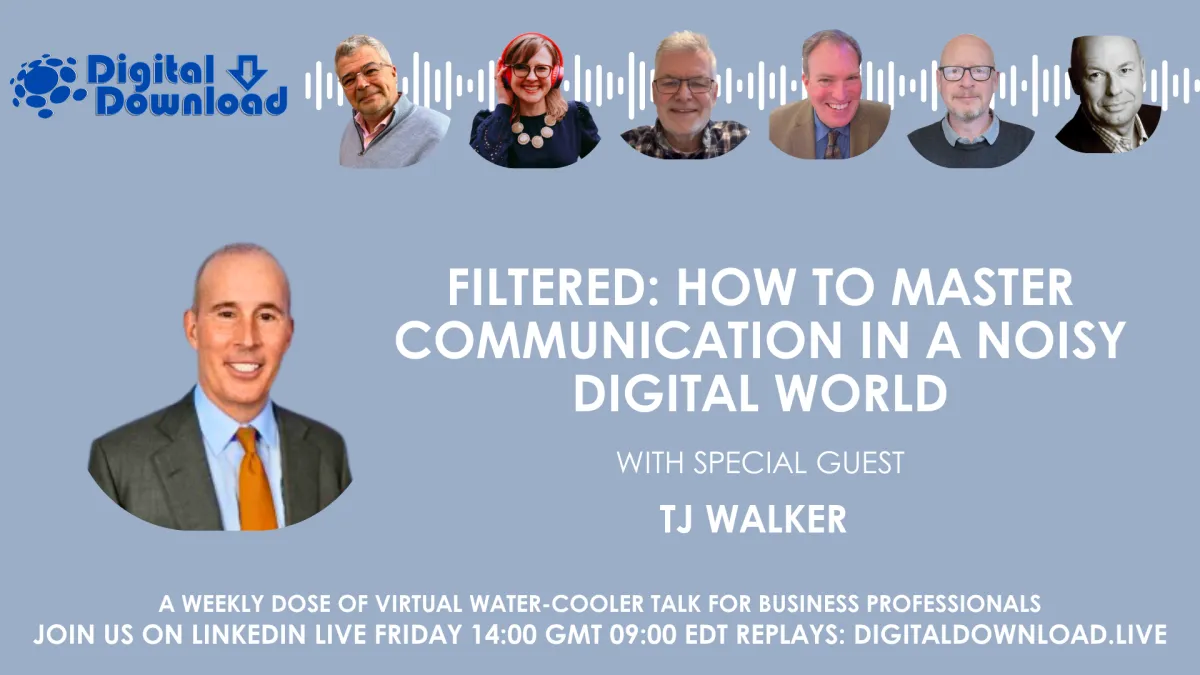
Filtered: How to Master Communication in a Noisy Digital World
This week on The Digital Download, we are talking about the most critical skill for 2026: The ability to filter the noise.
We are bombarded by breaking news, technological shifts, and cultural changes every single day. Most people let it wash over them. Leaders filter it, understand it, and communicate it.
We are thrilled to be joined by TJ Walker, a true legend in the communication space.
TJ is a Public Speaking Expert, Media Training Guru, and Bestselling Author with over 30 years of experience training Presidents, Prime Ministers, and Fortune 500 executives. He is the Founder and CEO of Media Training Worldwide and the host of the new podcast “Filtered with TJ Walker”, where he breaks down daily business and tech news through the lens of personal development.
We will discuss:
* The Communication Lens: How to stop consuming news passively and start analyzing it like a communicator.
* Media Training for the Modern Age: Why “media training” isn’t just for TV anymore—it’s for every Zoom call, LinkedIn video, and client meeting.
* Crisis & Confidence: How to handle the pressure of public communication without melting down.
* The Personal Development Gap: Why technical skills (AI, coding) are useless if you can’t articulate your value.
Join us for a masterclass in clarity.
We strive to make The Digital Download an interactive experience. Bring your questions. Bring your insights. Audience participation is keenly encouraged!
This week's Host was -
Bertrand Godillot, Founder and Managing Partner of Odysseus & Co, a proud DLA Ignite partner
This week's Guest was -
TJ Walker, Founder and CEO of Media Training Worldwide and the host of the new podcast “Filtered with TJ Walker”
Panelists included -
Tim Hughes, Co-founder and CEO of DLA Ignite
Adam Gray, Co-founder of DLA Ignite
Tracy Borreson, Founder and CEO of TLB Coaching & Events, a proud partner of DLA Ignite
Richard Jones, Richard Jones, Director of Qure 8 Ltd
Transcript of The Digital Download 2026-01-23
Bertrand Godillot [00:00:02]:
Good afternoon, good morning and good day wherever you may be joining us from. Welcome to another edition of the Digital Download, the longest running weekly business Talk show on LinkedIn Live, now globally syndicated on tuning radio through IBDR, the world's number one business talk news and strategy radio network. Today on the Digital Download, we're talking about one of the most critical skills in for 2026, the ability to filter the noise. We are bombarded by breaking news, technological shifts and cultural changes every single day. Most people let it wash over them. Leaders filter it, understand it and communicate it.
Bertrand Godillot [00:00:53]:
To help us with the discussion, we have a special guest, TJ Walker, public speaking expert, media training guru and bestselling author with over 30 years of experience training presidents, prime ministers and Fortune 500 executives. But before we kick off the discussion, let's go around the set and introduce everyone. While we are doing this, why don't you in the audience reach out to a friend, ping them and have them join us. We strive to make the Digital Download an interactive experience and audience participation is highly encouraged. Tracy, you want to kick us off please?
Tracy Borreson [00:01:32]:
Yes. Thank you, Bertrand. Good morning everyone. I am Tracy Borreson, founder of TLB Coaching and Events, a proud partner of DLA Ignite. And we are living in a day and age where there is more that we need to filter than we ever have before. So I'm really excited for this conversation today.
Bertrand Godillot [00:01:49]:
Hopefully you get a few clues about this. All right, Tim.
Tim Hughes [00:01:55]:
Yes. Welcome everybody. My name is Tim Hughes. I'm the CEO and co founder of DLA Ignite and I am famous for writing the book Social Selling Techniques to Influence Buyers and Change Makers.
Bertrand Godillot [00:02:08]:
All right, Richard, Good afternoon.
Richard Jones [00:02:11]:
Richard Jones from Curate. A proud partner, DLA Ignite. I make a point of emphasizing my pride this time around because I was chastised for not doing so the last time I appeared on this podcast.
Bertrand Godillot [00:02:26]:
Okay, perfect. So it's well noted, Adam.
Adam Gray [00:02:30]:
Hi everyone. I'm Adam Gray. I'm co founder of DLA Ignite and Tim's business partner. And this idea of filtering content, I remember a few years ago when Eric Schmidt, the founder of or CEO of Google as it was then, said there's more content created in any 48 hour window than there is was from the beginning of recorded history through to 2003. Remember that was before AI arrived on the scene. Now the problem has exponentially increased since then. So this is a challenge that every single person faces. So it would be fascinating to hear how this develops.
Bertrand Godillot [00:03:12]:
Excellent. Well, thank you Adam. And as I said this week, we will talk with TJ Walker. He's the founder and CEO of Media Training Worldwide and the host of the new podcast Filtered with TJ Walker, where he breaks down daily business and tech news through the lens of personal development. And we'll talk about that. Let's bring him on.
TJ Walker [00:03:38]:
Hey, welcome, tj. Hi. Good to see everyone. Thanks for having me.
Adam Gray [00:03:43]:
Hi, tj.
Bertrand Godillot [00:03:45]:
Welcome, tj. Tj, why don't you start by telling us a little bit about you and what led you where you're today.
TJ Walker [00:03:53]:
So, I'm a communications and personal development expert. I have more than 200 online courses with 12 million enrollments from every country in the world, except for North Korea. We're still working on North Korea. But I help people improve their personal personal development skills, especially communication skills, so that they can be more successful in their professional life as well as their personal life.
Bertrand Godillot [00:04:18]:
Sounds excellent. And by the way, it's the first time we. We have you on the show, tj. Last time around, I recall you were. You were starting a quite exciting experiment. You were actually designing your own video clone. Could you tell us a little bit about what happened since?
TJ Walker [00:04:37]:
So it has mixed results. And when I started it, I remember thinking about 1998, when I started my online training career. I did my first online course in 1998. I lost hundreds of thousands of dollars for 15 years, and then they became wildly profitable. So I went into the whole digital clone thing thinking, okay, maybe it'll take off and be an overnight success. Maybe it'll take 15 years. Maybe it'll be something in between. And right now, I'd have to say something in between.
TJ Walker [00:05:11]:
The marketplace still is uneasy about the idea of cloning. It still, frankly, creeps some people out. Now I have a clone that answers to people as I would in a text format, an audio format, and for the last year and a half, until literally yesterday, it did it in a video format. So you saw what looked just like me talking to you, critiquing your backdrop or whether you touch your face when you speak. It could see you and do that. Unfortunately, the platform I was using discontinued video, and they did so in part because people just weren't comfortable with it. They weren't comfortable creating it, I would say, because they don't have media training, but consumers were not interested in watching it.
Adam Gray [00:05:56]:
And.
TJ Walker [00:05:57]:
And so, for example, the platform I use, they also have famous actors like Arnold Schwarzenegger. People like having a conversation with Arnold Schwarzenegger, but they didn't want to see his face. On the screen, looking at them and talking to them, it struck people as too weird. I'm still very optimistic in the future, but this could be one of those things that takes 15 years. I use it primarily now as an add on to my online courses. So early on in my courses I tell my students, hey, this course comes with its own AI assistant. You can ask my clone any question, it will answer pretty much as I do. So it's, it's not a profit center, but it is something that gives added value to my online courses, which presumably makes customers learn more, students learn more, makes them happier, leads them to leave higher reviews, and therefore I get more students.
TJ Walker [00:06:54]:
So there's a back end way of sort of helping my overall business.
Bertrand Godillot [00:07:00]:
Well, thank you for that feedback. Very, very interesting because you, I think you were really on a visionary path for sure. And by the way, I'm glad to have you in person. And any feedback will be more than welcome after the show, of course. And I'm sure it's the case for everyone. Okay, great. So let's go back to our topic of the day, tj, and we'll start with a foundational question. How can we stop consuming news passively and start analyzing them? I know it sounds quite strange as.
TJ Walker [00:07:35]:
A question, but not strange at all. That's my world. That's what I beg people to do. And I think everyone has to come up with something, their own plan that's unique to them, where they realize they have biases. I have biases, everybody has biases. But what you have to do if you want to be an informed, intelligent person in 2026, I believe, is actively seek out two things. You have to actively seek out media sources where there is a broad agreement, not universal agreement, but broad agreement that they are sourced with objective journalists. Number two, you need to find a news outlet that actively seeks out opposing opinions for their analysis.
TJ Walker [00:08:25]:
So you have to do that. Unfortunately, the problem is everybody gets in an information bubble. If you're just following what is on Facebook or your Google News, it's going to pander to you. So if one person, as a joke, right, does a blog post that says TJ Walker has the greatest, thickest, most beautiful hair in the world, and I click on that several times before you realize it, my feed is going to be filled with stories about how TJ has great hair. Well, guess what? I don't have great hair. But it's easy to go down that bubble if you just passively look at what is thrust in front of you on Facebook. LinkedIn Other Social Media platforms. So I think the starting point is you've got to make a decision.
TJ Walker [00:09:14]:
Do I want to be an informed human being or do I just want people to lie to me and tell me, you know, your equivalent of TJ has gray hair? I want the truth. So I look at a broad range of media on a daily basis. I look at the Wall Street Journal, not its opinion page, but the Wall Street Journal. I start typically my day with the New York Times. I also look at cnn. I look at something known as the Drudge Report that maybe not everyone is familiar with, and they have a link to every major news outlet in the world. And I will occasionally look at what's on Fox News, not because I think they give things objectively, but I do want to see how certain segments of at least the American populace is viewing the world. And most important, this sounds sad to say, when we're on social media, I really don't look at news stories that are pushed out by my friends on social media.
TJ Walker [00:10:15]:
Nothing against my friends, but I'd rather go directly to the sources.
Adam Gray [00:10:20]:
So in a world where the news and current affairs seems to be incredibly polarized, where there's very little middle ground, isn't the risk that you become further entrenched in your viewpoint because you have your viewpoint, because you feel it's the correct viewpoint and the truth? Because as an intelligent human being, if you didn't think it was the truth, you wouldn't be consuming it. So you're consuming this. And then you switch to another different counter viewpoint and it's simply offensive because all of the, the, the, the fundamental ethos that you have in the view of the world is, is being undermined by that. Isn't there a risk that this further entrenches you in your viewpoint? Whether or not we're talking about politics or stuff like that, or we're talking about the adoption of AI in the world? You know, I don't believe AR is going to be adopted. Not because I don't believe it's going to be adopted, but because I don't want it to be adopted. And if I keep saying it's not going to be adopted, perhaps it won't be.
TJ Walker [00:11:27]:
You absolutely have to seek out opposing views. Now, I'm pretty pro AI. I'm in AI all the time. But about six months ago, a book came out and I forgot the exact title of it, but it was essentially AI is a Scam. I made sure to read it so I could understand their arguments. This morning or yesterday morning, I Started my day off reading the New York Times, which many in America would argue, I don't particularly agree, but would argue it has a liberal bias. Well, they also have well known prominent conservative columnists. One of them is Bret Stephens, lifelong conservative.
TJ Walker [00:12:03]:
He's in favor of, you know, low taxes, limited government, worked at the Wall Street Journal for many, many years. He wrote a very compelling case as to why the Democrats would make a huge, huge mistake nominating Governor Gavin Newsom of California as the Democratic nominee for president. And he, he made his argument with very specific fact based reasons that anyone who cares about facts had to respect. And it made me really think of things differently because I was sort of in the camp of, okay, this Gavin Newsom guy, he's good looking, he's tall, he has great hair, he's a good communicator, he attacks the opposition forcefully. I was kind of leaning in that camp of maybe this guy would be the strongest candidate for the Democrats. And Bret Stephens really shaped my view on why Gavin Newsom may be wildly overrated. So I think it's important that you actively seek out opposing views and you look at news organizations that are not purely partisan state media or apparatus of a particular party and have opposing views, which I would argue that New York Times does.
Tracy Borreson [00:13:22]:
So, TJ I have a question because all of that makes lots of sense for me, but I also think there's people on the daily who, I don't know if they would necessarily use this language for it, but they're saying seems to be some danger in that in seeking out the opposing views. And so what is, is there a sh. I'm trying to figure out when you decide to do that. Right. It feels like a mindset shift you make before you go and find your news outlets. And if that is the case, then what is the other pre step that happens to kind of like open your mind to believing that maybe you're not seeing everything.
TJ Walker [00:14:08]:
Okay, so how do you open a closed mind? I wish I knew the answer to that. That is perhaps the hardest question I've ever received on any interview or any show. I wish I knew the answer to that. All I can do is, is try to present ideas in an interesting, compelling way and get people to look at things differently. So I position myself as a sane, sensible centrist on my show of filtered. And I try to look at biases where regardless of where you are on the ideological spectrum, you could in fact come to similar conclusions about certain problems in our society. So that's, that's how I try to do it. And being respectful to people.
TJ Walker [00:14:54]:
If you start off with anyone who disagrees with me is clearly an idiot, a fool or an evil person. You're obviously not getting people to open up to you and be responsive to it. But part of it, I think should go back to people's elementary school education, middle school, secondary education, and actually be taught media literacy and be taught how easy it is to be fooled and have disinformation. You know, when you, when you see five different friends saying black is white and white is black on social media, and a week later someone asks you, is white black or black white? You'll now parrot what you've seen on social media. And when people ask you, where did you learn that? You'll say, oh, I saw it on the news. Well, no, you didn't. You just had five friends in different places telling you, white is black and black is white. And that's unfortunately how perceptions of reality get changed.
Adam Gray [00:15:54]:
So as a follow on to that, I, I've got a really. I guess that part of the challenge that we have is that there are so many disparate news channels now, and there are so many disparate, I think it was coined as alternate facts by.
TJ Walker [00:16:12]:
You know, also known as lies.
Adam Gray [00:16:17]:
Absolutely, absolutely. And, and I think that if you were a, if you were a specialist in a particular field, you know, so you're a specialist in media, it's quite easy for you to look at media and say, well, clearly this is correct. Based on my own expertise in this, this is incorrect. And I think most of us are quite comfortable within our own areas of specialism, holding strong views on things. When you step outside that, you, you see things like, yeah, if you need to have light treatment or inject bleach or whatever those things are, that clearly, if you're a medical professional, you'd look at that and you'd go, that's utter lunacy. Part of the problem is that, that there are so many different ways of accrediting people. And I'm not thinking about this just from a political standpoint, from a technological standpoint as well. You know, we're all running businesses.
Adam Gray [00:17:13]:
We want our businesses to be successful. We need to try to get first mover advantage in whatever area that happens to be. So gaining insights about whether or not customer behavior is moving in a particular way or technology is moving in a particular way, getting those insights before our competitors can be hugely beneficial. The problem is that a lot of the people that purport to be expert and have an impartial opinion on this stuff don't. So how do you I, as an average Joe who's trying to make an important decision about something in business or my personal life, how do I know whether or not I am in fact using critical thinking skills or whether or not I am simply being farmed by people that have gone several layers deep in proving accreditations for what it is that they want me to believe?
TJ Walker [00:18:04]:
You have to ask yourself on a daily basis, is some of this news making me uncomfortable and questioning my previously held convictions? If the answer is no, it means your brain is shut. It means you're not seeking out active information. If you're trying to follow a new guru, how about doing a Google search or ask ChatGPT give me the pros and cons on this person. So if you're thinking for example of taking health advice from a former heroin addiction known primarily for having a worm in his brain, maybe take a few minutes and Google what the reviewers say. And the critics say ask ChatGPT or Anthropic Claw, whatever your AI program is of choice and ask them for a clear cut listing of pros and cons and reviews of that. I mean many people already do that before they decide what movie to go to on Friday night night. I think your health and the entire structure of your government and society should get the same amount of attention to reviews as you would give in selecting a movie.
Bertrand Godillot [00:19:13]:
Question on that because no, that's me. Tracy, my turn. You talked about education earlier and I think that's quite interesting because we know critical thinking or self thinking if you.
Adam Gray [00:19:29]:
Want.
Bertrand Godillot [00:19:32]:
I would say probably is result of education. So I think so the question is do you see a difference based on generation on, you know, activating that critical thinking?
TJ Walker [00:19:46]:
Well, I think we live in an age where people of every age preferred confirmation bias. They prefer hearing something that confirms their pre existing views. So for example, I live here in South Florida where there's a huge percentage of people who just want to hear that all the problems in life are from these illegal immigrants hordes transforming America and taking over America and causing massive crime. And they do that when they are at various resorts and luxury hotels where all the staff members waiting on them every day are law abiding immigrants and perhaps people who have not yet gotten their immigration. So there's a huge disconnect. So I think people can be irrational at any age and can be susceptible to hearing flattering lies. I mean that's one of you had written to me earlier about things to talk about today. What's changed in the Media, certainly since I started doing training many decades ago, is it's never been easier to tell lies and convince people and build traction and gain power over people's lies.
TJ Walker [00:21:06]:
I would argue in 2012 and earlier, if you were an American politician at least running for president, and you just nakedly, boldly told lie after lie after lie, the mainstream media, which still had power back then, would eviscerate you. It would destroy your reputation, bring you down so low in polls that party insiders, donors would run away from you and you would have no chance. That all changed in 2016. Social media became so much more powerful that it became possible to be a politician and just spew absolute lies. Do it with confidence, do it in such a way that you appeal to the self interest of a certain base and make them feel like they're victims and you can gain power, gain followers, gain money, and ultimately run things, at least here in the United States. So that is what is hugely different. I used to, frankly. I'm sorry, go ahead.
Richard Jones [00:22:12]:
No, I'm interrupting you.
TJ Walker [00:22:14]:
I mean, in my media training, going all the way back to 1984 was the first time I did media training when I was in college for a politician. A part of what I said in every media training is never lie to the media. They will hate you, they will expose you, they will harm you, harm your reputation. You'll destroy credibility. I unfortunately cannot ethically tell my clients that anymore. Now, ethically, I do tell them, don't lie, but I can't ethically say it will harm your business or harm your career or your political campaign. Because we now live in a different era where if you tell lies that are highly appealing to people and you do it again and again and again with a smile on your face and with authority in your voice, it can actually help your career. I wish that weren't.
TJ Walker [00:23:10]:
I don't advise people to lie, but it simply is true now that quite often whoever is willing to tell the bigger lie wins.
Adam Gray [00:23:24]:
It's ironic that your first media training came in 1984 and now you're living in 1984.
TJ Walker [00:23:32]:
Yes, exactly.
Richard Jones [00:23:34]:
I think one of the things that somebody said to me once was that we used to live in what was generally an honesty based society where most people did and said the right things. And then we shifted to a risk based society where you kind of just did what you could get away with as long as you could get away with it for. And I think that's kind of where we've got with, with the media. You know, you can pretty Much say what you want and, and get away with it because, you know, that's the way the world works these days. You know, honesty has kind of been confined to history and it's, it's, you know, it's a case of, yeah, do it until you get found out. And even then you can probably defend yourself.
TJ Walker [00:24:14]:
You, you may be right. I'm not willing to give up on humanity and the, the democratic extreme experience or experiment, because democracy is based on the whole idea of a free flow of information, of facts getting out, holding people accountable and having some kind of robust debate. I'm not quite ready to give up. I do think there are certain individuals who simply do not have the capacity for shame. Because we did live in an era. I mean, look, politicians have always lied. Richard Nixon famously in the United States, lied a lot. But the difference was he acted embarrassed, he acted ashamed, he acted like he didn't want to get caught telling a lie.
TJ Walker [00:24:58]:
Now we have a situation where various political actors and other actors in the world, whether they're trying to sell their supplements or anything else, appear to have no sense of shame at all, which does make them more convincing liars.
Richard Jones [00:25:15]:
Can I introduce you to Peter Mandelson?
TJ Walker [00:25:18]:
I'm not familiar with who that is, but very lucky, I'm sure every.
Richard Jones [00:25:24]:
He's a prominent sort of British politician who is okay going through all this at the moment. He is a perfect case in point.
TJ Walker [00:25:33]:
But there's always been shading, there's always been putting things in the right light. There's always been omitting. What is different, certainly in American democracy, is just flat out lying and showing no shame. I know I had a lot fewer votes than my opponent. I'm simply going to lie to you and tell you I had more votes. And if you disagree with me, you're a liar and you're guilty of fraud. That really is different. That has not happened at the highest levels of American government before.
TJ Walker [00:26:10]:
And it's worked. And it's not just the politicians, it's the media. As media is fragmented, as we've gone away from just three national news services to thousands of sources of news, we now have people segmenting how they deliver news. And they do this, they put their finger in the wind. They say, what does our audience want to hear? If our audience wants to hear that their candidate actually won, even though their candidate had fewer votes, will simply lie to them and say, yes, the candidate you wanted actually won. That's different. That did not happen in the past in the United States.
Bertrand Godillot [00:26:50]:
So how can we Build. So how can we go back to some sort of confidence in our sources? Basically, because what you are explaining is that the biggest light could be, well, very well communicated, basically with authority and credibility. So how, how can we, as, you know, human beings, citizens, you know, get out.
TJ Walker [00:27:20]:
I'm trying, I'm trying to do my part.
Bertrand Godillot [00:27:22]:
Crisis, basically.
TJ Walker [00:27:23]:
Yeah, I'm trying to do my part, which is why I started my own Forgive the shameless plug. I just said there's no shame any less. So. But I, I'm trying to do my part with my podcast, filtered with TJ Walker, where we typically look at the top six stories of the day, Monday through Friday. And I look at a wide variety of sources pulling stories from the Wall Street Journal, the New York Times, the Drudge Report, sometimes Fox News, sometimes msnbc. And then I give analysis where I often cite my sources and I often try to say, here's the conservative perspective on this, here's the liberal perspective. Here's what I think a dispassionate analysis is. Look for people like that.
TJ Walker [00:28:09]:
Instead of looking for someone where you already know everything they're going to say in advance. If you, if you turn to certain programs, let's just say you go to Sean Hannity, someone I used to debate almost nightly early in his career. If you look at Sean Hannity on Fox News Channel, for example, which is the number one rated show at that time slot in you already know every single thing out of his mouth is going to be. The problem with what happened today is the liberal Democrats are so extreme and they're so taken over by socialists and illegal immigrants that they're trying to destroy America. It just doesn't matter what the issue is. Everything is going to go back to sort of a knee jerk. Here's the enemy. It's not your fault.
TJ Walker [00:29:00]:
It's not the fault of anyone you voted for. It's this group of others that we don't have to debate anymore because we have already determined they're insane, they're crazy, they're radical leftist. Doesn't matter if it's a conservative Democrat or a moderate Democrat. He's just going to say every single Democrat is an extreme, out of control, socialist, Fidel Castro loving extremist. When you hear things like that, that's when it's time for you to say, okay, maybe I'll listen for five minutes, but now I'm going to go other places to figure out what's really going on. That's what I think is needed.
Bertrand Godillot [00:29:43]:
Okay.
Adam Gray [00:29:44]:
Yeah. It strikes me that you're living in the wrong place.
TJ Walker [00:29:49]:
You shouldn't be in Florida.
Adam Gray [00:29:50]:
You should be in Seattle, shouldn't you?
TJ Walker [00:29:53]:
Well, that's a problem in and of itself where people are segregating. They get in these bubbles and then they never have a friend or family member question them or trying to have a debate. Because that is, I mean, that is happening in America. Where you see our big cities, frankly, the places where people are most productive, make the most money, create the most places like San Francisco, New York City, places like that are overwhelmingly Democratic and liberal in their orientation. And you have the most Republican and conservative places in America, places like Mississippi, Alabama, which produce the least. They are the welfare recipients. People from New York and California have to send tax dollars to provide welfare to those states. And meanwhile, you know, the number one place for Trump support, sorry to be overtly political, but it's hard to discuss these things without the number one source of support for Trump are rural areas.
TJ Walker [00:30:59]:
In the south especially, but rural in particular. Anywhere in the country where people make the least amount of money and are most dependent on government subsidies and government health care and government subsidies for their crops and food stamps and the rest. And they're the ones who have bought into this idea that government's always bad because it allegedly only helps other people who have different skin color than they do.
Adam Gray [00:31:32]:
Don't feel for a moment this is a purely American problem, this polarization, because it isn't.
TJ Walker [00:31:37]:
Oh, it's worldwide. There's no doubt.
Adam Gray [00:31:39]:
We see it in pretty much every country. And we see it and, you know, politics is the most visible area in which this is true. But it seems to be true everywhere. You know, we have spent the last decade trying to explain to people that the tools that they have used to sell their products and services are no longer appropriate for the people that they're trying to sell them to, because people don't buy that way. And everybody nods. And then they go back to doing exactly what they were doing yesterday, even having agreed violently with what it is that we've said. And I think part of this is, as you said, a lack of critical thinking skills and a lack of, well, not a lack of ability to listen to this idea necessarily, but a lack of ability to process this idea. So you hear it and you go, well, that makes perfect sense.
Bertrand Godillot [00:32:27]:
But.
Adam Gray [00:32:27]:
And then you get back on with what you were doing before, because there's a comfort to the routine of having done something a particular way, and there's.
TJ Walker [00:32:35]:
A comfort to being outraged. Unfortunately, this is a problem of all the big tech companies Their algorithms are designed in a way to get maximum engagement. The easiest way to get engagement is to say something absolutely outrageous that's going to make someone angry. So certainly before the cell phone came out or the smartphone, it wasn't particularly dangerous or radical for any doctor, any healthcare official, to remind people to get their vaccines. Because if you look at the world before vaccines, if you want to go back 150 years or so, people died at age about 33. I mean, because of things like antibiotics, sanitation and vaccines, the average lifespan of the people in the entire world has doubled. There was simply no controversy about that. These days you have so many people saying, oh, these vaccines.
TJ Walker [00:33:35]:
And I won't even say it now because I don't want to set off algorithms to get this, this show in trouble. But certainly there are people who want to give other views about vaccines and attacking the mainstream medical world and then using anecdotal evidence to convince, unfortunately, huge swaths of the American public, but also people around the world that vaccines are not good and that causes problems. So it's not just the politician getting attacked, it is a mainstream medical official who can be attacked simply for giving what is was standard advice for decades.
Adam Gray [00:34:17]:
But isn't there a date. So you said about attacking mainstream views on these things, isn't there a danger that we assume now this is not a conspiracy theory viewpoint, isn't there a danger that we assume that because it is mainstream, it is correct? So we had in this country, the UK, it was not until the suffragettes came along 100 years ago that women fought for the right to vote, because up until that point, the mainstream view, even amongst many women, was that women are not capable of voting because that's an important decision and therefore that's a men's decision. Really, that's a ludicrous viewpoint and we see that as a ludicrous viewpoint now, but it was the, the standard mainstream viewpoint. And isn't there, I mean, I think that the confusion lies for many people in the fact that you either buy into the fact that the mainstream is always right and then you are spoon fed by your media a particular view of the world which may be serving somebody else's agenda, or you assume that every viewpoint is right, in which case you believe that the earth's flat and that people didn't land on the moon. And it's like, how, how do you differentiate between these two extremes?
TJ Walker [00:35:33]:
Well, clearly the mainstream view can be wrong and from historical perspective it can be wrong. I do think you have to look at things in two different categories. One is basic political values and philosophical values. Whether or not women should have the right to vote is not fair. Fundamentally an issue that science can decide. It is an issue of philosophical debate. I happen to think women should be able to vote, but it's not because of scientific reasoning. Whether vaccines work or not or whether the earth is flat or not is in the realm of science, and science gets it wrong.
TJ Walker [00:36:12]:
But science has a self correction mechanism, and it's called more scientific inquiry. It's called testing. It's called peer review. So certainly there were a lot of mistakes regarding how the coronavirus was handled, but science is the one that corrected us. People like to say, well, you know, everyone was wrong about COVID and it wasn't spread through handshakes. Well, science is the one that figured that out, and it eventually came out. So that is the beauty of science. It's not that it knows 100% what is always the perfect solution.
TJ Walker [00:36:51]:
It's that it goes into every problem asking, how do we test this to find the best available evidence at the time? And it's constantly changing. So I think you do have to look at things from the standpoint of is this a fundamental human value that we could change our view on, or is this something about science? A lot of people who consider themselves liberal and progressive in The United States 20 years ago were not in favor of gay marriage. It wasn't science that convinced them to say, okay, we should have gay marriage, it should be legal. It was a change in values.
Bertrand Godillot [00:37:35]:
So we talked a lot about society and politics. Do you see the same in businesses? And maybe that's. I'm quite sure that Tracy has a complimentary question on that.
TJ Walker [00:37:48]:
Well, I hate to say this, I don't want to be giving advice to people doing horrible things, but there are a lot of business opportunities for people pandering to fear and ignorance. I mean, I would argue the vast, vast majority of the supplement industry is just about pandering to people's fear and ignorance. If you look at, at actual independent scientific inquiry from major universities, there is essentially no evidence that supplements the ones you hear promoted on every kind of podcast actually help humans live healthier lives, there's a lot of evidence that it can often cause kidney damage and liver damage. But if I just hold up this thing and say, here's a vial here in the United States, let's say I'm speaking to a United States audience. Here's TJ's magic pills. The government doesn't want you to have this. The FDA doesn't want you to have it. But take this, and it will allow you to lose 50 pounds overnight and grow a full head of hair.
TJ Walker [00:38:54]:
And you better get it now, because the government doesn't want. In reality, I could have gone to the sidewalk.
Bertrand Godillot [00:39:00]:
What's that?
TJ Walker [00:39:01]:
Are you 995? The reality is I could have. It's different in different countries. The reality is I could have gone to my sidewalk, scraped dog poop off, put it in here, sold it to you. Completely legal in the United States, because I didn't call it medicine. I called it a supplement. You can sell anything to people. Again, I'm not advocating anyone do that, but unfortunately, that's the reality in a huge part of the supplement industry, is they're just selling. I mean, there's literally a guy named Brian Johnson selling snake oil to his followers.
TJ Walker [00:39:41]:
It's just olive oil, but 10 times more expensive than others. And he's. He literally named it.
Tim Hughes [00:39:47]:
Big irony there, isn't there? Yeah, there's a slit snake oil salesperson selling snake oil.
Bertrand Godillot [00:39:53]:
Yeah. Tracy, question.
Tracy Borreson [00:39:57]:
Well, I mean, I'm. I'm the marketer in the room, right? So as you're sharing all these things, T.J. i just, like, I can see how that trickles into how people are now being trained to do marketing. Because we was like, we can just lie and post it everywhere, and then pretty soon. Soon we'll have all the business. And this has started to become. I mean, I don't think people will outright say we're lying, but we're just gonna promote it. But that is happening a lot.
Tracy Borreson [00:40:28]:
And then there's a lot of people, specifically, like, small medium, even solopreneur businesses, who are being taught those things, and then they're trying to do it, but they actually. They have this inner ick factor. So, like, this is what we're being taught to do, and we need to do this because this is what is it takes to be good at sales or good at marketing. And then it's. It's just following this pattern of, like, I can't stand here and tell you that it doesn't work, because it does. Look, look, look, I. There's evidence that says that that can work. And at the same time, one of the things that I love that you said about scientific inquiry and that I love is that if your hypothesis doesn't have an equal chance of being false as it does of being right, then you don't have a good hypothesis.
Tracy Borreson [00:41:19]:
Your hypothesis is biased. And so when we look at these types of things, I think there's many opportunities for us to look at sales and marketing. I will call it information, but I think a lot of people are considering it truth right now and say like, does this match like real scientific inquiry? Does it match like the rest of. I mean, I always think like there's truths in, in science and physics and then we like forget that similar truths are available in these other places. And so it creates an opportunity, I always think, to just like ask the question. But as you already previously said, there's a lot of people who are uncomfortable with doing that because it seems the harder thing to do than the easier thing to do.
TJ Walker [00:42:10]:
Let me inject a little smidge of optimism into our conversation. There is a difference between the business world and presumably most of your clients and the political world. In the political world, it's all about a one day sale. It's election day and you can lie and lie and lie. If you just make people angry about the incumbent or the other person, you only have to really affect them one day and you only have to get a plurality of votes and you win the next day, it's out of business until the next election. Business is different because you're essentially open every single day. So if you sell me a product, if, you know, Adam, you sell me your magic hair growing pills and I take and you say it's going to give me a perfect head of hair, or Tim, you sell yours and it's telling me I'm gonna have a perfect head of hair in 30 days. Chances are 90 days from now I'm not going to buy your pill anymore because the facts will become abundantly obvious to me in the politics.
TJ Walker [00:43:20]:
Once someone's in, they're in for the full term, at least in the United States. I understand there can be a vote of confidence in other places and someone kicks out. So there is that little bit of difference in the business world and the political world because every day in business you're open for business, you're trying to sell every day. And therefore I think it's harder to trick people and to fool people with blatant lies for many, many consumer products and services.
Tim Hughes [00:43:52]:
So to tj, one of the things that I think coming back to social.
Adam Gray [00:43:56]:
Media.
Tim Hughes [00:43:59]:
Social media has changed because if you, if you think about it, social media was the, was the thing that put Barack Obama into, into, into power. But, but you know, that was years ago and people don't really remember it.
TJ Walker [00:44:14]:
So I'm sorry, I didn't, I didn't hear who you mentioned. Oh, well, I, I would, I would differ with that analysis.
Tim Hughes [00:44:25]:
Okay, so nowadays you can actually, so I have a friend of mine who runs a YouTube channel and he, there was an app that he subscribed to which said I can get you um, titles of shows. You tell me the, the show, I'll give you the title and you'll get more engagement. All of the, and of course what the, the title would do is plays on the YouTube algorithm. So you'll see a lot of it. And, and you know there's, there's loads you, and you get it on Facebook and you go on YouTube, you know where you'll get titles like these are the two things you can do to get thick hair. And one of them will make you really scared or one of them will make you really angry. So they're, they're, they're clickbait titles. He basically had it for a month and it did make the views go up on, on YouTube.
Tim Hughes [00:45:27]:
But he decided to stop using it because he decided he wanted to create his own titles rather than create click clickbait titles. Do you think that there should be, you know, in, in, in a world of, you know, should we be using apps where we're going to get clickbait and we're running for, and we're running for clicks and views, or do you think that we should be taking a step back and actually saying actually no, I don't want to do that and if I get less views and less clicks, that's okay.
TJ Walker [00:45:56]:
So I mean the problem with clickbait titles is millions of people are using clickbait clickbait titles and they're just not working much. The second problem is the people you attract leave after three seconds. So there's very little benefit to any business. Even if you're having an advertising model, you can't really monetize that audience. So I don't think it's that simple. You mentioned Barack Obama. It is true he was given credit for using social media effectively, but he ran in 2008. The iPhone only came out in 2007.
TJ Walker [00:46:33]:
So there was just so few people actually used it heavily back then. People were still relying on so called mainstream traditional media to get information about candidates. And the one fact that came out that helped Obama the most was the simple fact that the Republicans in power, the economy was losing 750,000 thousand jobs a month in November of 2028 in the United States. So I would argue any Bernie Sanders, Jesse Jackson, you or me, even though you're not a US Senate, anyone would have beaten the Republican nominee. In 2008 simply because of the fact of the absolute hemorrhaging of jobs in the US economy. So I think that was a clear cut case where the facts so overwhelmed that people do vote their pocketbook when they see 750,000 jobs losing. So sorry for that minor quibble but that, that and really 2012 were the last elections where I think social media wasn't dominant.
Bertrand Godillot [00:47:47]:
So you mentioned earlier tj that you know you could go and ask your your favorite AI assistant to to provide you with the pros and cons on the topic. Is that really the truth?
TJ Walker [00:48:03]:
Yeah, I mean that's something I usually trust the answer. So I you shouldn't give total trust to anyone AI LLM because it does still hallucinate although I use it daily and it seems to be getting better and better and better. You could also use a combination of Google Claude and OpenAI if you want to chatgpt because you can also ask for sources if you want to know. Okay, there's a new doctor. I'm going to give me an honest assessment of whether this doctor is respected in the community. If you ask ChatGPT, it'll give you an answer instantly. If it gives you five sources of people in the community who've sued them for malpractice for cutting off their the wrong limb and you then click the link and it takes you to yet another mainstream local newspaper that says yes, Dr. Walker is horribly negligent because he cuts off the wrong limb.
TJ Walker [00:49:03]:
You know, not to use Dr. Walker. So I think it can be a great fast way of starting the research. But I wouldn't rely exclusively on that. But I use it all the time for buying certain products. I may look at Apple, excuse me, at Amazon reviews, but sometimes the product isn't there. And if I want to know is this more or less okay, I might ask ChatGPT and if it comes back and says hey, there's really sometimes it'll say there's just not enough data. I can't recommend for it or against it.
TJ Walker [00:49:38]:
That's useful. Sometimes it will find a lot of different negative reviews, Yelp other places and just saved me so much time. So I don't buy something that's going to fall apart. I do find that very useful.
Bertrand Godillot [00:49:54]:
We have a comment from the audience. Tim, you want to read this please.
Tim Hughes [00:49:58]:
Yes, content may be king, but attention is the new currency. Clickbait Awareness is much easier than loyal followers that constantly consume.
TJ Walker [00:50:12]:
I mean a couple of things there. I don't think content is king because the world is full of content that no one looks at. I mean, the average YouTube video has, I've heard, as low as three views. So content alone isn't king because all of us are drowning in a sea of content. It only matters if you do get attention and someone wants to look at it, read it, view it, listen to it and consume it and perhaps process it and use it. That's what's king is that engagement, which is nice that you actually are taking questions from your audience now. It's showing that, that you are walking the talk. That's great.
TJ Walker [00:50:51]:
You do have to engage. And the second part of that, if you could flash that up because there was something I wanted to say about that question.
Tim Hughes [00:50:59]:
Clickbait awareness is much easier than loyal followers that consistently consume.
TJ Walker [00:51:05]:
Okay, so I don't know that I completely buy that because if, if you for example, just title this show Sydney Sweeney shows all that's clickbait, I really don't think we're going to all of a sudden get millions of views because the algorithms are smart enough to say, okay, is this, Is the content really matching the title? And if not, you'll be punished. So A, I don't think it's that easy to simply use clickbait and B, if you do use clickbait, it's extremely hard to monetize it. Because if, if all you want to do is is clickbait, maybe you can get the so called programmatic advertising which gives you a very low amount of money, small amount of money. You can get a few scraps, but you can't build a real media business around it. You're not going to get people to buy your advertising or marketing service just because you use clickbait and 2 million people watched a particular video. You would be much better off having 10 people watch your content on a daily basis and three of them becoming regular clients than having a so called viral video promising Sydney sweetie half naked and having 10 million people. Chances are none of them would hire you for marketing or advertising or PR services.
Tim Hughes [00:52:35]:
It's interesting that so, so thank you Mike for the comment. Really appreciate that. I'm just going to point out the fact that that's coming from Facebook, which we don't often get people commenting from Facebook.
Adam Gray [00:52:46]:
Thanks Mike.
Bertrand Godillot [00:52:49]:
All right tj, this has been really great. Where can we find you? Where can we learn more?
TJ Walker [00:52:56]:
If you go to tjwalker.com that's my website. I am on pretty much every online platform, whether you're on Coursera, Udemy, any of those platforms you will find hundreds of my courses that relate to communication skills and personal development skills on Apple, Spotify and your favorite podcasting platform. You can find filtered with TJ Walker. So I would urge you to check out that show because the very same things we talk about here today are things I do talk about on a regular basis because it is done either live or same day as typically five days a week. And it's news with a different twist because we are looking at top news stories but then filtering it. And I just committed a media training blunder there. I hit my microphone. Apologies.
TJ Walker [00:53:47]:
We're filtering the news through the lens of personal development skills. So I might analyze the content of what a president or a prime minister says, but then I'll also comment on their style and how they did it and how you can improve. So it's a combination of a news show filtered through the lens of personal development skills. So you're not just going to be depressed after hearing the news. You're going to learn specific skills of how you can improve as well.
Bertrand Godillot [00:54:18]:
Excellent. So we'll, we'll watch it if you want to know more. By the way, we now have a newsletter, as you know, where you will find all the details on today's episode.
TJ Walker [00:54:27]:
And you got a QR code, aren't you Fancy.
Bertrand Godillot [00:54:30]:
I'm gonna do that.
Adam Gray [00:54:31]:
Right?
TJ Walker [00:54:31]:
Yeah. Scan that. I'm gonna do that.
Tim Hughes [00:54:35]:
2026 TJ.
TJ Walker [00:54:38]:
Yes. That's nice. I'm. I'm holding up my camera to it.
Tim Hughes [00:54:43]:
And it was saying a bit it would go.
Adam Gray [00:54:45]:
Someone scanned it.
Bertrand Godillot [00:54:46]:
Yeah. And we get all excited.
TJ Walker [00:54:49]:
Great. Thank you.
Tim Hughes [00:54:50]:
Somebody's actually scanned it.
Bertrand Godillot [00:54:53]:
All right, so the alternative option obviously is to visit us at digitaldownload.live/newsletter with that. Tj, thank you so much.
Tim Hughes [00:55:02]:
Thank you, tj.
TJ Walker [00:55:04]:
Thank all of you. Great to be back with you. Much appreciated.
Bertrand Godillot [00:55:08]:
Each other next week. Thank you very much. Bye Bye.
TJ Walker [00:55:11]:
Thanks.
Tim Hughes [00:55:14]:
Thanks everybody.
#CommunicationSkills #PublicSpeaking #MediaTraining #PersonalDevelopment #Leadership #Filtered #LinkedInLive