Previous Shows
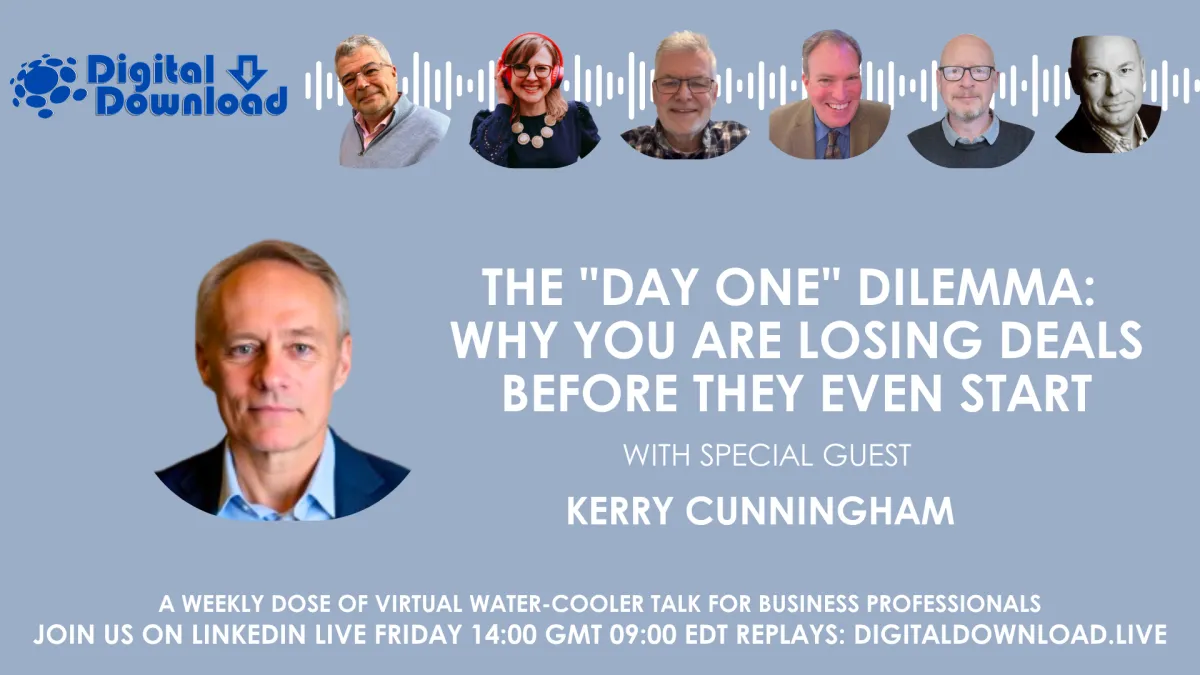
The "Day One" Dilemma: Why You Are Losing Deals Before They Even Start
This week on The Digital Download, we are diving deep into the data that defines modern buying behavior. We often hear that buyers want to remain anonymous and avoid sales calls at all costs. But new research suggests a shift: B2B buyers are actually engaging with sellers earlier than before—about 6 to 7 weeks earlier, to be precise.
Is this good news for the cold caller? Absolutely not.
To unpack why, we are joined by Kerry Cunningham, Head of Research & Thought Leadership at 6sense. A former Vice President at Forrester and the co-author of the legendary "SiriusDecisions Demand Unit Waterfall," Kerry is one of the most respected voices in B2B revenue strategy.
We will be dissecting the "2025 B2B Buyer Experience Report" and its startling revelation: while buyers are coming to the table sooner due to the complexities of AI and economic pressure, the game is often already rigged. The data shows that in 95% of cases, the winner was already on the buyer's "Day One Shortlist."
Join us as we discuss:
The "Point of First Contact" Shift: Why are buyers suddenly engaging at 61% of the journey instead of 69%?
The AI Factor: How is the rush to buy AI solutions forcing buyers to seek human validation earlier?
The "Day One" Reality: If 77% of deals go to the pre-search favorite, is "lead generation" dead?
The Psychology of the Buyer: With his background in psychology, Kerry explains why experienced buyers (who have done this 8-9 times) are decisive but risk-averse.
Brand vs. Demand: Why your reputation is the only asset that gets you on the shortlist.
If you are relying on catching buyers "in-market," you are likely already too late. This episode will explain what you need to do to be the favorite before the project even exists.
We strive to make The Digital Download an interactive experience. Bring your questions. Bring your insights. Audience participation is keenly encouraged!
#B2BBuying #MarketResearch #SalesStrategy #SocialSelling #LinkedInLive #Podcast
This week's Host was -
Bertrand Godillot, Founder and Managing Partner of Odysseus & Co, a proud DLA Ignite partner
Our guest this week was -
Kerry Cunningham, Head of Research & Thought Leadership at 6sense.
Panelists included -
Tim Hughes, co-founder and CEO of DLA Ignite.
Adam Gray, Co-founder of a DLA Ignite
Rob Durant, Founder of Flywheel Results, a proud DLA Ignite partner
Transcript of The Digital Download 2025-12-05
Bertrand Godillot [00:00:07]:
Good afternoon, good morning and good day, wherever you may be joining us from. Welcome to another edition of the Digital Download, the longest running weekly business Talk show on LinkedIn Live, now globally syndicated on TuneIn radio through IBTR, the world's number one business talk news and strategy radio network. Today on the Digital Download, we're diving deep into the data that defines modern buying behaviors. We often hear that buyers want to remain anonymous and avoid sales calls at all costs. But new research suggests shift B2B buyers are actually engaging with sellers earlier than before. About six to seven weeks earlier, to be precise. Is this good news for the cold caller? Absolutely not.
Bertrand Godillot [00:01:01]:
To unpack why, we are joined by Cary Cunningham, head of research and thought leadership at 6Sense, a former vice president at Forrester. Kerry is one of the most respected voices in B2B revenue strategy. But before we bring Kerry on, let's go around the set and introduce everyone. While we are doing this, why don't you in the audience reach out to a friend, ping them and let them join us. We strive to make the Digital Download an interactive experience and audience participation is highly encouraged. Tim, would you like to kick us off, please?
Tim Hughes [00:01:40]:
Yes, thank you. My name is Tim Hughes and. Welcome. And I'm the CEO and co founder of DLA Ignite. And I'm famous for writing the book Social Selling Techniques to Influence Buyers and Change Makers.
Bertrand Godillot [00:01:54]:
Thank you very much, Tim.
Adam Gray [00:01:55]:
Adam. Hi, everyone. I'm Adam Gray. I'm Tim's business partner, also co founder of DLA Ignite. And I cannot say how excited I am to be here today because this is what we've all been waiting for, this conversation.
Bertrand Godillot [00:02:09]:
Don't talk to me about it. Yeah, absolutely, Rob.
Rob Durant [00:02:15]:
Good morning, everyone. I'm Rob Durant. I am the CEO of U.S. operations for the Institute of Sales Professionals. And the ISP has one goal, to elevate the profession of sales. I'm really interested in what Kerry has to say today because I think there's going to be a lot of overlap.
Bertrand Godillot [00:02:38]:
I'm not sure. Right. Excellent. Thanks, Rob. And myself, Bertrand Godiot. I am the founder and managing partner of Odysseus and Co., a very proud DLA Ignite partner. As I said this week on the Digital download, we'll speak with Kerry.
Bertrand Godillot [00:02:55]:
We will be dissecting the 2025 B2B Buyer Experience Report and its startling revelation. While buyers are coming to the table sooner due to the complexities of AI probably and pressure, the game is often already rigged. The data shows that in 95% of cases the winner was already on the buyers Day one shortlist. Let's bring him on.
Bertrand Godillot [00:03:36]:
Kerry, good morning and thank you for, for making this with us. We know this is a pretty early call for you this morning, pretty early.
Kerry Cunningham [00:03:44]:
But I, I like it. I'm very happy to be here. I love following you guys on LinkedIn and seeing all of the things, things that you talk about advancing the conversation. So really appreciate the time.
Bertrand Godillot [00:03:57]:
Okay, Kerry, let's start with by, by having you tell us a little bit more about you, your background and what led you where you are today. Great.
Kerry Cunningham [00:04:06]:
So I've been in B2B pretty much all my adult life which is, you know, you can tell a pretty long time. And so I spent a lot of time actually right on the, the border between marketing and sales running a third party teleservices organization in the Bay Area in the, in California. And that was for 17 years. So worked with probably more than 100 or so tech companies during that period of time left we had an exit from that company left the and I spent the next few years in academic research in Real Research Labs and then I came back and got a job at Serious Decisions as a research director there. Spent eight years with Serious Decisions Forester and then jumped over here to Sixth Sense a little over four years ago and have been running a research and thought leadership practice here at Sixth Sense during that period of time. That's me.
Kerry Cunningham [00:05:10]:
I absolutely there's nothing that, that I like more than discovering something that other folks haven't been seeing or looking at. And fortunately I've gotten a chance to do a lot of that over the last few years.
Bertrand Godillot [00:05:24]:
And we do have a lot of questions for you Kerry, today, I'm sure. But I'll start with a foundational question. You talk a lot about the day one reality. You know, 77 of deals go to the pre research, the pre search favorite. Does that mean that lead generation is dead? That's my first question.
Kerry Cunningham [00:05:50]:
Yeah.
Kerry Cunningham [00:05:53]:
Lead generation is so this is a, it's a bit of a tricky question.
Kerry Cunningham [00:06:00]:
Lead follow up lead management.
Kerry Cunningham [00:06:07]:
Lead conversion optimization and all that is dead and has been dead for a long time. We just didn't know it. And when you look at, when you look at the conversion rates of leads and but when I was at Serious decisions of Forrester, my initial job for a couple of years was to help people try to optimize their lead conversion processes. And you know what my buddy Terry Flaherty and I discovered is that you can't that the very best you can do is God awful at best. That, you know, you can get people from a 1% lead to closed one deal conversion rate to two, you know, or one and one to one and a half if everybody does everything right. And then what invariably happens after you go through that process optimization is that you gradually leak back to where you were before because people don't like all the process and things you have to do to optimize. So that led us to think maybe we're just doing the wrong thing. If you, you can't get a process to produce at a reasonable rate, maybe it's not the right process.
Kerry Cunningham [00:07:20]:
And that got us thinking about something else. Now there's something else that we were thinking about is like, what is the right unit of measure? Because at the end, if you just think about this in a kind of scientific way, the lead was our unit of measure. Okay, how is marketing doing? They're producing leads. Okay, that's what we measure. How are we converting? Right. It's not the right unit. That's what the problem was. The right unit is more like a buying group that represents their organization in their quest to identify some sort of solution for.
Kerry Cunningham [00:07:54]:
For whatever their business challenge is. And so when you back up and you start looking at the buying group and whether there's evidence of multiple people from an organization demonstrating interest at the same time, then it starts to get really interesting. So if you have. One of the things that we would continually see is that our clients would not only have a lead, but from an account that would become an opportunity. But they had multiple leads. Now they didn't know that they had multiple leads. And in many cases.
Kerry Cunningham [00:08:32]:
The second or third lead that an organization got from the same buying group would be discarded. And we called that, my friend Terry made this term up, but we called that second lead syndrome. That you get a first lead from the account. Awesome moves through BDR calls and all of that stuff. The second lead comes in and now sudden, suddenly you have a really big incentive problem because the BDR is incented to produce new meetings for sales. They can't get a new meeting with an account that sales is already working. So they see that second lead or the third or the fourth, and they think, well, crap, I can't get paid for that. That's a duplicate lead.
Kerry Cunningham [00:09:13]:
Meanwhile, you've got a buying group that's saying, hi, I'd like to buy something. We're interested. We're looking at you and your competitors and you're going, yeah, we already heard from.
Kerry Cunningham [00:09:25]:
So that had been going on and has been going on and still is going on in B2B, all over the place. And that's why our lead generation didn't work. Right. Because we're discarding virtually all of the signal. We're misapprehending what the signal is. So when we started looking at all of our clients, what we would see is just time after time after time. The average number of leads that you get from a buying group that's in market is 1 and a half to 2 and a half leads from that group.
Kerry Cunningham [00:09:58]:
Now, what we also understand is that a buying group is about 10 people. So does that mean the other 10 people aren't looking at your stuff as well? No, the other seven and a half or eight people are there anonymously and they will never fill out a form. All right, so the other thing that everybody was trying to do was optimize or maximize the number of people who will fill out a form. The problem is you. You can't actually get more people to fill out forms because you keep chasing them down and trying to get them to talk to you when they don't want to. So all of the things that we've done to optimize conversion rates were entirely the wrong things to be doing and actually made the problem worse. Because, I mean, everybody who's on this call, everybody who's listening to this right now, would probably put themselves in the bucket of people who say, I never take phone calls from people I don't know. Right.
Kerry Cunningham [00:10:49]:
So, you know, all of those things together, that's kind of what we saw over the course of a couple of years. We're like, okay, we're just. We're actually doing it wrong. So, yeah, you can generate leads, but if that's what you're trying to do in order to pass leads off one at a time, that's going to fail spectacularly the same way it does and has, you know, for the last 15 years. But there's a way of looking at all of that interest that you're generating. The people that you're coming to your website, the anonymous folks, people who do fill out a form to see your webinar to attend an event. If you can look at those things holistically and say, oh, shoot, here's an account where we have six people demonstrating interest, whether they're anonymous or not. And here's an account where we have one.
Kerry Cunningham [00:11:29]:
Well, where should we go spend our time? And that's really what we need to do. So there's very long answer to A very simple question, but that's kind of what.
Bertrand Godillot [00:11:39]:
That is. Absolutely great. Perfect. So one of the things that you're stressing on into the. There's already, you've already covered a lot, to be honest. That's one of the things that you're focusing on is that, you know, we tend to think that. Well, I think the previous study you were mentioning that customers come to market, they basically give you a call, they call, they call the salesperson 70% into the journey, into their journey, of their buying journey. And this has changed quite significantly since your last study.
Bertrand Godillot [00:12:19]:
So.
Bertrand Godillot [00:12:21]:
How do, how do you explain that?
Kerry Cunningham [00:12:24]:
Yeah, so in the past, what we saw very consistently, in fact, we.
Kerry Cunningham [00:12:31]:
Very, you know, we call this the point of first contact constant, which was. We jumped the gun on that one a little bit. So what we saw for a couple of years straight was that buyers incredibly consistently would say we first engage with sellers about 69, 70% of the way through our buying journey. And then this year we got the data back and that number was 61 and not 69 in various parts of the world. It varies a little bit, but it came down everywhere. And, you know, so having, you know, called it a constant for a couple of years, we had a little panic attack and then dug into the data to find out what was going on. Now, everybody's first idea was, well, they're using chat, gbt, large language models to do their research, and that's, that's going to be accelerating things. Well, we asked a bunch of questions this year about how buyers were using those things.
Kerry Cunningham [00:13:27]:
And.
Kerry Cunningham [00:13:29]:
To our chagrin.
Kerry Cunningham [00:13:31]:
That didn't explain every. Everybody was using LLMs. 94 of buyers are using LLMs. So that's great. The problem is when you look at the 94 who are using LLMs in their buying process, their, their point of first contact was at 61%, but the 6% of people who were not using it were contacting sellers at 55% through the journey, even earlier. So what that told us was LLMs cannot be responsible for the shift earlier. And we put it in regression models and all of that. It just didn't account for any of the difference.
Kerry Cunningham [00:14:07]:
Same thing with every variable that we had. We couldn't, we couldn't account for, we could account for less than one of those 8% percentage point difference in what we had. So we, we worked with our partners and put together a couple of hypotheses and, you know, we just looked at, like, what's really changed over the last year or so. One is that it's not just that buyers are using LLMs, but we expect that there's going to be AI inside of whatever it is that we're going to buy, and we have to evaluate it. We either really want it or we really don't.
Kerry Cunningham [00:14:47]:
You know, and this, it came out of a conversation, actually. One of our partners was saying, you know, I just came back from this meeting where we're evaluating new attorneys, and I needed to know that I wasn't gonna be paying 300 an hour for chatgpt. So. And I thought, you know, I think that everybody is. Is having to do that. And we haven't evaluated AI inside most of the things that we buy yet. And so that's a thing that's changing. Let's.
Kerry Cunningham [00:15:16]:
Let's ask some questions about that and find out. The other thing, of course, and I apologize for this on behalf of our country, but is tariffs and the global economic uncertainty and all that's been going on. So we went back out, did another survey and asked people about that. We also asked them about their buying journeys, and when they engaged that, our initial data was validated in the second survey. But what we also found was that buyers, when we asked them, did the economic uncertainty change the timing of your interaction with sellers? They said yes, overwhelmingly yes. Made it our buying process shorter. And we engaged with sellers earlier because of economic uncertainty, which I can explain in a second. And then also because we had to evaluate AI inside whatever we were buying and we hadn't done it before.
Kerry Cunningham [00:16:17]:
One, we're in a. We're in a hurry to get this done because we could lose our budget. Things aren't going great. We want to spend our budget. I want to get this new tool in, new platform or whatever so that we can. It can help us get to our goals. And we've got this other thing that we have to evaluate that we haven't done before. So let's hurry up and get there so that we can go find out, you know, what, what the AI is doing and whether it's okay and which one we like.
Kerry Cunningham [00:16:42]:
So those two things combine both compressed buying cycles and compressed. Further compressed the point at which they want to talk to sellers. Because while buyers can get most everything that they know or they need to know about vendors from either their experience, which is really where they get most of it, or from websites and peers, they can't get. How are you using AI? Because it's not in your website, it wasn't in your product last time we bought it or evaluated it. And my peers don't know about it either. So I'm going to have to talk to sellers about that. So that's driving that earlier. But what was really fascinating was we literally asked did you put your short list in order of preference before talking to sellers? 94 again said yes, we put our short list in order before talking to sellers.
Kerry Cunningham [00:17:36]:
So they compressed everything including coming to that preliminary decision about which vendor they wanted to buy from. So.
Bertrand Godillot [00:17:48]:
You.
Tim Hughes [00:17:49]:
Kerry, thank you so much for coming on and talking about this. One of the things that you've also done this year is also got given more detail in terms of it's not just 70, the 70 or the 60 as it is now. You've actually broken that down. So my understanding is that you've broken that down as saying because we've. Taking a step back, we've always had this notion, haven't we, of the. There's 5% of organizations that are in market and 95 of organizations that are outer market and pretty much all of the SAS.
Tim Hughes [00:18:26]:
VC driven business that's happened in it over the last 10 years has had that as an assumption. And what you were saying is that there was. And if we just pick those off, 2% of people are in a purchase decision, 4% of people are in a decision, 17% are in consideration, 17% are in awareness and 60% are basically what you call sleeping targets.
Kerry Cunningham [00:18:52]:
Yeah.
Bertrand Godillot [00:18:53]:
And.
Tim Hughes [00:18:53]:
And the other assumption that we've made is that when buyers go out, what they do is that they read our content and they. And they inform themselves about the solutions. So there's two things that play is here is one is they're not actually going out and informing themselves because they actually already know who they want. And we have this 34% of the, of the pro of the buying process where as far as the client is concerned, they are look that there's an awareness establishing a shortness short list. Sorry. They're updating their knowledge, they're debating requirements. But if you phone them, they're not actually in market because nobody wants to be a piece of meat in a CRM.
Kerry Cunningham [00:19:39]:
Right.
Tim Hughes [00:19:40]:
Not until they're 70% of the way through the process that they actually contact the salespeople and they declare here I am and I'm buying. So there's this situation where as a salesperson we have an ability to influence the account except we don't because we go about it the wrong way.
Kerry Cunningham [00:20:00]:
Right? Yeah, that's exactly it. And so. And you've got all those numbers, right. I just want to caution everybody, I.
Tim Hughes [00:20:06]:
Was reading it Off a slide.
Kerry Cunningham [00:20:07]:
Yeah, no, you got them exactly right. And I would just caution everybody, you know, the best thing to think about is roughly 60% of your audience is just not in market. Even your, even your best target accounts, they're not in market. Now, about a third of your audience is probably in early stages of a buying journey where they're, they're seriously looking around, but they're really nowhere near actually buying yet.
Bertrand Godillot [00:20:31]:
Yeah.
Kerry Cunningham [00:20:31]:
And then that 5% that we talked about, well, you know, we see 6% in the data. It's going to be plus or minus a couple of points. So it's right around there. Those are the only ones who are really at the sharp end of the stick where they're really ready to buy. If they're at that sharp end of the stick, they've already decided. That's what we were just talking about. Right. They're largely.
Kerry Cunningham [00:20:50]:
There's not much you can do at that point.
Tim Hughes [00:20:52]:
And you said that those people mainly have had eight purchases. The younger people I've seen on the webinar you did said some of them have done six purchases, but they've all purchased before. And therefore they know Steve at Salesforce or they know Peter or IBM and they kind of know what they want to buy.
Kerry Cunningham [00:21:11]:
Yeah. So they're.
Bertrand Godillot [00:21:12]:
That.
Kerry Cunningham [00:21:12]:
That's right. And so think about what's happening. And you know, you've got a. The average buying groups, 10 to 11 people. Within that 10 to 11 people, in most cases, you've got four or five probably really significant decision makers. And those four or five people have on average, across you know, broad categories, have done evaluations in whatever category they're involved in. Now, if they're a decision maker in a category of solution now, they've been through eight buying processes in that category in their careers. And so the only things that they need to be educated on are like, what's changed since two years ago when last I looked at this category? And mostly what they're doing in that buying process.
Kerry Cunningham [00:21:59]:
And you know, and I think when everybody looks at their own experience, you'll see this, that the buying process is not about education from scratch. It's about how do I get the vendor that I think we should buy over the line. And you have some people in the buying group who are much more motivated than others. The ultimate decision maker who owns that department, maybe the director level person who's really going to be the one whose skin is in the game for this. They've, they're really motivated for this. They're going to enter that process with preferences and biases based on their personal experience. What they're trying to do is get the rest of the buying group to say yes.
Adam Gray [00:22:41]:
Right.
Kerry Cunningham [00:22:42]:
And that's where I think we B2B marketing has not done. I mean we just, in the past, everybody would say, well, we just don't have cycles to make content for all of those people and to help and all of that, you know, and okay, that's how, that's, I think why, you know, when you see from the LinkedIn research, for instance, that 40% of buying processes roughly end without buying something because the buying group can't agree, it's because we're not helping our primary buyer Personas convince the rest of the group that they ought to one, that the business case is strong and that this is the right vendor. And I'm sure everybody who will hear this has been through this where you say, you know, I really want to buy $0.06, for instance, but the CFO wants this other vendor or doesn't want to pay this much or whatever. And so the primary buyer person says, all right, well screw it, I'll just, we'll try it again next time around. You know, let's, let's not do anything. I don't want to bring that, you know, one of those other vendors in. Yeah, not going to do anything right now.
Bertrand Godillot [00:23:46]:
Yeah.
Kerry Cunningham [00:23:48]:
And that is where substantial number of buying processes end. And I think a lot of that can be prevented.
Rob Durant [00:23:57]:
So Kerry, if I hear you correctly, 5%, 6% up to 40%. What you're not describing there is demand generation. What you are describing is demand identification.
Adam Gray [00:24:15]:
Right.
Rob Durant [00:24:16]:
That dramatically changes the way marketing operates and the way sales operates.
Kerry Cunningham [00:24:24]:
Yeah.
Rob Durant [00:24:25]:
Are they changing?
Kerry Cunningham [00:24:27]:
Yeah, so I think not so much changing. What's changing is our understanding of it. So, you know, when you think about.
Kerry Cunningham [00:24:38]:
Most categories of B2B solutions, whether it's software services.
Kerry Cunningham [00:24:47]:
The demand for that category of solution, it either exists in a business or it doesn't. And what both marketing and selling can do is help help potential buyers realize the demand that they have. Understand that, you know, there's solutions to this problem, that the solutions are economically viable, they're doable in their business, those kinds of things. But so there may be demand that's latent, that marketing and selling can help surface and apply some rationale to, but you're not creating it for anything other than brand new categories of solution where. And again, you've probably been involved in some of these. I have early in my career where.
Kerry Cunningham [00:25:36]:
There'S a business problem, but People have no idea that you could solve this business problem. And so in a sense you're creating the demand for that category. But the business problem has to exist. And you know, I've worked with hundreds of tech companies who had solutions to problems that didn't exist and you know, they don't last very long.
Adam Gray [00:26:00]:
I found, I found your report this year really fascinating and it surfaced some things that were.
Adam Gray [00:26:08]:
Shocking. You know, the fact that 80% of.
Adam Gray [00:26:15]:
Times the.
Adam Gray [00:26:18]:
Seller that is selected is the one that's the first on the list. And you said in the webinar, a really good first question to ask when a prospect approaches you is you found anyone else already and if they say yes, actually you're probably not going to win the deal. And that 95% of the time.
Adam Gray [00:26:36]:
The winning bid comes from somebody that's on that short list of four and a half, five companies. So that I found shocking.
Adam Gray [00:26:47]:
But largely much of the data and the research underlined stuff that we knew from last year. And although there were shifts, clearly we've moved from 70% to 60% and now we've got some visibility as to why we've moved from too earlier in the buying cycle. But you began the conversation by saying lead gen just simply doesn't work anymore. You know, BDRs, you know, basically they're not, they're not doing any, that whole part of the business isn't doing anything. So that comes as no shock to us because that's a drum we've been banging for a while. Comes as no shock to you. It comes probably as little of a shock to sales leaders. However, every company is still structured in that way, right? So why have we ended up in that this ludicrous situation where companies invest huge amounts of mind share and effort in doing something that they know in their heart of hearts doesn't work anymore.
Adam Gray [00:27:47]:
How can we change that?
Kerry Cunningham [00:27:52]:
So I Hope everybody in B2B gets to hear that question and that I answer it in a way that is, that is good enough to help people understand this. So you're exactly right. That is the situation we have. And I'm having these conversations with people every day. We're doing these demand gen lead production things. We're following up with BDRs even though we now know that that's not how it works, that you literally cannot cause a buyer to engage with you at a time other than what they were going to do anyway. And think about this. Let's say that you sell software for Oracle or SAP or whoever it might be, right?
Kerry Cunningham [00:28:44]:
You sell A human capital management software system. Companies that are in your audience go out into market and they look around and they're in market for 6 months, 8 months, evaluating you and your competitors.
Kerry Cunningham [00:29:03]:
And they've decided to buy it and they come to consensus about which one they like and who's second, third, fourth. Is there any chance that if you're first on that list at the end of that period of time, that they're then going to ask themselves, now, which of these vendors has called us? Oh, our number one vendor hasn't called us. Well, let's move on to number two, then.
Kerry Cunningham [00:29:30]:
I mean, it's absurd, right? You. If you're the. A brand that your buyers are evaluating and you. And you're on their list, they're going to get in touch with you. And the fact that you're calling them can do two things. One, if you're calling and emailing and you're providing content and experiences that help them prefer you, that moves you up the list. If what you're doing is saying, can I get a meeting? Can I get a meeting? You ain't going to get the meeting. And you're just annoying people, right? And that's it.
Kerry Cunningham [00:30:03]:
Hopefully your buyer won't take that into an account when they're, when they're looking at who's first on their list, that they're looking at the application, the solution, and that's how they decide. Right? But if you're annoying and your competitors are helpful, that's not going to help you be on the top of the list. So I think that kind of everybody going through that little mental exercise for themselves would be good. Now, I've heard plenty of marketing and sales leaders saying, yeah, I only bought from this company because they had such a great. And I'm like, one, you're full of crap. I don't believe that for a minute. But even if that's true, that's unusual and you shouldn't make decisions that way in business, Right? That's not. That's not good.
Kerry Cunningham [00:30:44]:
Don't tell people that, right?
Kerry Cunningham [00:30:47]:
So why do we keep doing it? Because it's the only thing that we have in place, and it's the only thing that's. That's measurable in a nice, easy, direct way. So I, in something I wrote on LinkedIn a while back, I called it the only door problem. Like, there's been one door to your business, only one way to get in. And so that's the way people have been coming in. And so you think that's the only way people can get in. What if we close that door, how are they going to get in? Well, you open up some other doors, your buyers will walk around to the back of the building and knock on that door or do whatever they have to do. Right.
Kerry Cunningham [00:31:20]:
So that, that actually is one of the biggest mental model problems people have with this is just that's how it worked. And for the people who are in leadership in those companies or if they're on the boards of directors or of the VCs or wherever funding those companies, those people made their fortunes and made their fame in a world in which they thought that.
Kerry Cunningham [00:31:42]:
Calling and emailing people incessantly was how they got it done. What was actually working is that was the only door and they had a good product. And so people were coming through that door in droves. And yeah, if you're out being very aggressive in market and you're the biggest presence in market because you're out there being aggressive, nobody's going to miss you. If you're a small brand, great. If you're a small unknown brand, you have to be more aggressive in getting people to know you. But just asking them for a meeting is not the way to do it. And that's what everybody's been doing.
Kerry Cunningham [00:32:18]:
But the other thing is it's just so easy to measure leads and it looks like it would be the right thing. So leads coming in, I can count, I can see a conversion rate. It's very simple. I can put it on one slide, I can see a number go up and down all the time. And I don't have to think about how complex this actually is, that it takes nine months and 10 people or 12 or 15 people to buy something from us. And there are complex of influences, many of which we don't have any control over. Well, I don't want to think about that. How many leads did we get? You know, that's really where we are.
Kerry Cunningham [00:32:53]:
And I think it, it's very difficult to get and I've been talking about this same thing for eight years now. It's difficult to get people to move off because it's just so easy and clean. I've got a conversation with somebody this afternoon who a hundred percent knows that the lead based world doesn't work but does not have a defensible.
Kerry Cunningham [00:33:18]:
Approach to take and say here's a direct thing, I can tell you that I'm going to improve. And when you tell people, you know what, we're going to watch for engagement from our target accounts and when engagement goes up, we're going to do this. And that's. And this. And this is the, you know, that's actually right. But it doesn't sound good for people who think that, that B2B creates demand and that a lead is the indication of that.
Kerry Cunningham [00:33:41]:
This is a. We've got some pretty deep cultural issues in B2B to take care of here. It's going to take a little while still.
Rob Durant [00:33:48]:
Kerry, you were saying the buying cycle is nine to 15 months. And I'm thinking, yes, but my quarterly earnings report is quarterly.
Kerry Cunningham [00:33:58]:
Right.
Rob Durant [00:33:58]:
It reminded me of what I tell my marketing students. There are basically two buckets of advertising that you can do. You can do direct response, buy now, and you can do brand awareness. Buy at some point in the future when you're thinking about buying. The challenge is that brand awareness does not allow us to tie every nickel of ad spend to every dollar of revenue that it generates. Are we in a similar situation here with our sales process?
Kerry Cunningham [00:34:34]:
It's the same. Yeah. So, you know, another shocking stat, Adam, I thought this might be where you're going to go. What we saw. So what we see is that buyers have a preliminary winner before they talk to sales, that that vendor wins 77% of the deals. So 23 get flipped during that sales process. And that's not nothing. That's the difference between success and failure.
Kerry Cunningham [00:34:58]:
You know, so, so that is important. And so as we're saying, sales role is different from what we thought. I mean, that's big. Now. We used to think it was 100%. It's 23. Right. So 23% of deals get flipped during that period of time.
Kerry Cunningham [00:35:12]:
Chances are they get flipped if there was a very close one and two going into that period of time and two did a better job, or maybe there was three very close, whatever that is. But we also asked the question, did your preference change during the sales process? And the answer there was yes, 42% of the time. So you've got buyer preferences changing, you know, nearly half the time, but their decision only changes about half of that time. So what, what that tells you is. And by the way, another fascinating thing, this is probably too many numbers for you to take. Another fascinating number is that we ask people, you know, what would have caused you to change your decision once the sales process started. And on that list was a selection that said internal stakeholder pushback.
Kerry Cunningham [00:36:10]:
And buyers only selected that 2.6% of the time. So, in other words, almost nobody believes that somebody in the buying group is going to go rogue after the time we start Talking with sales, in other words, the buying group is extraordinarily aligned before talking to sales and they know that if they change their opinion, it's going to be changed based on something we've already agreed would change it. They've already got that figured out. So that, that's why they don't talk to sellers until late in the process. They want that clear and done and aligned. Now we can go talk to sellers now. If, if our decision changes, we're all going to know why it changed. We're going to agree on the fact that it changed and that happens.
Kerry Cunningham [00:36:53]:
But though many of your people involved will say, yeah, but I like number two, at the end of that process, we ended up buying number one because, that's what, you know, we agreed we would do. But through the process I came to prefer number two. So next time around that, for that by that particular person, number two is on the top of the list and not number one. Now that is, that doesn't work with today's incentive plans. If you're still in that company two years later or three years later or whatever, that's going to be really great. And that's how sales reps build books of business and how they continue to improve over time. You develop these relationships, you nurture these things over time and you develop your book of business that becomes profitable and great for you and your company. And that's why that can happen.
Kerry Cunningham [00:37:45]:
Because you are changing minds much, much more often than you're changing decisions in the short term. So the seller is in a way as much of a brand asset as anything that marketing does. So now we've got marketing driving decisions and sales driving brand and reputation.
Rob Durant [00:38:12]:
It's flipped.
Rob Durant [00:38:14]:
That just goes to show how similar the solutions actually are. And it speaks to, in my mind, the buyer thinking good enough is good enough. We're not looking for the perfect solution. We're not looking for the optimal solution. We're looking for the solution that doesn't get us fired.
Kerry Cunningham [00:38:37]:
That's the, I think that's the one. And especially when you get into periods of time like now where there's a lot of economic uncertainty, everybody's decision making becomes more conservative. Small C, where you know, we just. I want to do something that's, that is least likely to cause a supply problem. It causes buying groups to get bigger, typically. Because I want anybody who could come back and, and put blame on me about this to be involved in the decision making process so that they also were part of the. Yes. And then I want to make sure that I'm, I don't need the best thing.
Kerry Cunningham [00:39:17]:
I need the thing that is least likely to bite me in the ass if it doesn't go well.
Bertrand Godillot [00:39:24]:
So, Kerry, if you are a new entrant, say you are a new entrant in a category.
Bertrand Godillot [00:39:33]:
How on earth can you get on the shortlist?
Kerry Cunningham [00:39:39]:
So that is a, it is a problem. Obviously. It's a problem, right? So buyers put four of the five vendors they'll evaluate on the short list on day one, and they buy from one of those right now 95 of the time. Last year it was 85. And that's, I think, you know, a direct influence of economic uncertainty.
Adam Gray [00:39:58]:
All right?
Kerry Cunningham [00:39:58]:
So if you're a new vendor in a space, you need to do something that's much, much better and different than what the existing players do.
Kerry Cunningham [00:40:08]:
And. Or you need to have a lot of money to throw at the problem, both money and experienced sellers. So if you're a, you know, and this, this is, this is actually the, at the root of a lot of the problems in B2B SaaS anyway is that the companies that are startup companies that do well generally have startup mythologies about the unicorn deals that they pulled in, the miraculous efforts that brought in that quarter that put us into orbit.
Kerry Cunningham [00:40:49]:
And those things can happen, right? If you get the right founders, if you get the right funders, if you have the right product and it goes viral, then those things can happen. It's almost certainly not going to be what will allow you to scale whatever those things are that get you noticed in market and get bought. The first number of times you can't scale it. But what you see in SaaS, everybody trying to scale that, and it doesn't, you know, it doesn't work because if.
Tim Hughes [00:41:21]:
You'Ve got a founder, so you've got a founder that's well known, that doesn't scale, you'll get some, you'll get some traction from it. Yeah, but it's not something where you can just keep cranking the handle, is it? Because you can't make the founder work any faster.
Kerry Cunningham [00:41:36]:
Right. Yeah. And there are probably only so many people in the world who really cared about your founder in the first place. And you know, you, you, you draw from that well, and then you're kind of done drawing from that well. And also you have to prove it right. You have to. Once you've, once you've made those sales, you actually have to be. Help your customers be successful.
Kerry Cunningham [00:41:56]:
And that's often not the case. So it is very hard for a New entry. Now, if you're in a new category, then you're on a level playing field and maybe you're the only one in that category. And that's often where the big startups come from, is new category addressing a need that was previously unaddressed or addressing a need in a very different way. You know, cloud computing, AI, inside stuff is, are examples of where you're either, you're doing something so completely different that you're the only one doing it. And so your problem then, you know, again solved by founders, by funders, by, by PR and things going viral. But those are, those are kind of white swan events, if you will. They're not, they're not things that happen every day and they don't happen in most companies, obviously, because most companies never succeed, you know, so, you know, those are not things you can count on.
Kerry Cunningham [00:42:53]:
And, you know, then you have to just get back to the.
Kerry Cunningham [00:42:59]:
The fundamentals.
Tim Hughes [00:43:00]:
I mean, it's a bit like I know a CRM vendor that did a, an influencer event where they asked loads of people on LinkedIn, you know, it was a link, LinkedIn takeover. And that's one of those things where you can do it, you can do that, but that doesn't scale.
Tim Hughes [00:43:18]:
You know, you actually need to have a way, you need to have a methodology and a process that you can use, which is where you, which is an ability to crank a handle, isn't it? It's a, it's a way of how can I actually crank that faster?
Tim Hughes [00:43:32]:
Yeah.
Kerry Cunningham [00:43:33]:
The other thing that, that it requires is patience and time, which, you know, we're not particularly good at in B2B generally. But, you know, the best way to be on the short list next time is to get evaluated now. And even if you're the fifth vendor on that list with vanishingly small chance of being bought now, if you can get yourself evaluated now, then you can get yourself onto those short lists next time around. And it's, you know, I talk with a bunch of my kind of marketing friends about this. Getting a reputation and being known and understood through advertising and normal marketing is possible. It's very expensive and you have to be very good at it because people's memories of what they see digitally and all, it's just, they vanish. But if I spend months evaluating you, I'm never going to forget that that happened. You know, it's not going to happen.
Kerry Cunningham [00:44:32]:
Right. And now you're advertising. I actually see it and notice it because I know you. It reinforces a good feeling that I had when I evaluated you and I keep you on the top of the list. So there's where I think if you are a brand new company, you do have to beat the bushes hard, get into evaluations even if it's way too late to actually win because that's your really only chance of having scalable processes later on.
Bertrand Godillot [00:45:02]:
So that's probably one of the doors. Sorry, one of the doors that you were mentioning, one of the alternative doors.
Tim Hughes [00:45:09]:
So one of the things that Rob said about.
Tim Hughes [00:45:13]:
About in quarter we get a lot of people basically saying that if we can't, if you can't show that you're going to generate a lead this quarter, I'm not interested.
Adam Gray [00:45:24]:
Yeah, right.
Kerry Cunningham [00:45:28]:
Yeah.
Kerry Cunningham [00:45:33]:
A lead this, a lead that you get this quarter that responds to you is somebody who's been in market for six or eight months and what they're responding to is I've already put you on the short list. I did that a long time ago. And if I decide to respond to your BDR SDR now, it's because I've already. You're already there. And you may be at the top or the bottom, but that thing that you're doing to cause me to interact with you is not the thing that's causing me to interact with you. You, you know, you're. And, and so this is something I'm talking about with both marketers and sellers all the time. You know, your current quarter campaign did not cause your current quarter pipeline unless you have a two month sales cycle.
Tim Hughes [00:46:17]:
It's not because it, because I know I've discussed attribution with you on, on, on LinkedIn before and, and it's about how do we connect? You know, is, do we actually have a cause and effect?
Kerry Cunningham [00:46:31]:
You know, there is a cause and effect. It's just, and this is, this is why this is such a difficult sell, to be honest with you, in boardrooms or whatever, because it's a really diluted effect with a big time lapse, you know, so it literally, I put you on the short list six to nine months before I become an opportunity for you. If you don't win the first six to nine months, it doesn't matter what you do in the last free essentially. And that, that last campaign that you're running and right before it became an opportunity, it's got nothing to do with it. It just happened to be there and it, but that's what's hard in B2B to get people to understand is that buyers are going to touch your company. If a buying group is going to buy from you. They're going to touch your content, experiences, BDRs. There's going to be a thousand touches or something.
Kerry Cunningham [00:47:25]:
You know, cross, there's going to be some. So many touches across those years and plus influences from prior years. We want to be able to say this thing did it, that thing did it, just unfortunately doesn't work that way. And every, every, every time we say, let's put money, more money into that campaign, it generated more leads. We are funding a lie. You know, it's just, it doesn't.
Bertrand Godillot [00:47:52]:
So we were investing in the 23% instead of focusing on the 77, right?
Kerry Cunningham [00:47:59]:
Well, yeah, essentially.
Adam Gray [00:48:02]:
So you said you used the word holistic earlier. You know, about going back and looking at this, the whole process, in a more holistic way. And it strikes me that every single organization that we talk to has the same challenges. You know, they have campaigns that are flatlined. They've got email address that are worth nothing, that they can't harvest any value from. They've got pipelines that are empty. And when they have got stuff in the pipeline, it doesn't close or doesn't close when it's supposed to close, because simply they have no way of generating meaningful conversations with people that are going to buy today, tomorrow, next year, whenever it may be.
Bertrand Godillot [00:48:42]:
Yeah.
Adam Gray [00:48:42]:
And it strikes me that everybody is on that plane and the plane's going down. And the, the opportunity is for organizations to look at this process and say, you know, actually we're starting from the wrong place. If we try and fix this, we've, we've built this, this kind of.
Adam Gray [00:49:04]:
We, we've built this dream that if I do A enough times, I get B, and if I do B enough times, I get.
Bertrand Godillot [00:49:11]:
See.
Adam Gray [00:49:12]:
And actually, none of that works, A, because of the complexity of this, but B, because actually, for 15 years we've been hearing the buyer has changed, the buyer has changed, the buyers changed, and the sales process has not changed to reflect that. So, so is the win there for organizations that say we need to completely reimagine how we go and engage with buyers and what our expectation of those buyers is? So we forget this. I'm going to reach out to you today with a telephone call which lands at a lucky moment, and then you buy from me? Well, actually, that's, that's, that's a fantasy.
Kerry Cunningham [00:49:50]:
Yeah.
Adam Gray [00:49:51]:
So. So it is the win there for organizations that say we need to junk that and start again from scratch.
Kerry Cunningham [00:49:57]:
It is. And you guys are very discreet about not talking about your particular business of what you do for folks. But I think it's incredibly, incredibly important that companies and sellers be present in the market with the people you'd like to sell to, participating in their daily lives.
Tim Hughes [00:50:13]:
Right.
Kerry Cunningham [00:50:13]:
This is, this is what, this is something I talk about a lot and I think you know, well to six times is horn like we do a lot of things to support the people that we want to sell to, doing their jobs and having a better experience of their careers. You know, CMO communities, BDR communities, you know, women in market, women in revenue communities. Lots of things that we do that are, that are very indirectly related to what we do. We just are supporting the communities. We're there for the people that we want to sell to, improving their lives. And I think everybody has the opportunity to do that on social media and using your presence to help educate the audience, help, you know, bring something to the work lives of the people you want to sell to that isn't just can I get a meeting? And you know, I think we all want to live in that world that looks like that where we're doing that. But we get so caught up in the day to day. But yeah, are they a lead and did I get a meeting? We have to be able to do the.
Kerry Cunningham [00:51:16]:
Longer tail work of understanding who our audience really is, understanding what matters to that audience, both directly related to our solutions and not. And then participating in the lives of that community of practitioners of whatever it is in such a way that we're top of mind for them, that they would like to buy us. Like I use the term that we, we need to motivate buyers. Reasoning that's really what marketing is for. But sellers do it also. How do I get them to want to look at our numbers and say they're good?
Bertrand Godillot [00:51:50]:
Right.
Kerry Cunningham [00:51:52]:
If we say our solutions are highly comparable with our competitors, how do I get them to look at what we say about our solution and think, you know what, that's a little bit better. Even though it's exactly the same. Why? By being a brand and people that they want to do business with.
Bertrand Godillot [00:52:10]:
Right.
Kerry Cunningham [00:52:11]:
And I think that's where we get, we get lost. Or maybe we're not lost. We were never on that path. But I think that's something that you know, and a lot of stuff's not expensive, there's time involved. But you know, it's, it's. We're not talking about you. You can throw great big parties if that's what your audience likes. So $0.06 throws great big parties because we sell to marketers.
Kerry Cunningham [00:52:32]:
Right. So marketers like A big part.
Bertrand Godillot [00:52:34]:
Right.
Kerry Cunningham [00:52:35]:
It's good. That's, it's a good brand match. But if you sell to engineers, maybe that's not what they want. If you sell to, and I shouldn't deal in, in those kinds of generalities, but whatever it is that your audience.
Kerry Cunningham [00:52:46]:
Wants for their work lives, you should be participating in helping provide that.
Kerry Cunningham [00:52:53]:
You know, that can be very granular down to. Hey, did you see this piece of content?
Bertrand Godillot [00:52:59]:
All right, Kerry, thank you so much. I think we could speak, we could speak for hours, but it was really good. Where can we learn more? Where can we find you?
Kerry Cunningham [00:53:10]:
LinkedIn, of course. Yeah. So lots there. And then 6Sense.com/science-of-b2b. That's what we call our, our little research and thought leadership practice. And we have absolute tons of content there and no forms. So you can access that content without telling us who you are.
Tim Hughes [00:53:45]:
The webinar that you did was it a week or so ago, we're doing this on the 5th of December, 2025.
Tim Hughes [00:53:53]:
Was, I mean, Adam and I talked about it afterwards. I mean it was probably the, the one. If you're going to watch one webinar, apart from this one, of course.
Tim Hughes [00:54:03]:
It'S, it's, it's watching that webinar and you walking through over an hour with your colleague about what, that.
Tim Hughes [00:54:12]:
What that research has done, step by step. I mean, it's, it was just, it was just fantastic watching it. So thank you so much.
Bertrand Godillot [00:54:22]:
And you know, and, and all of the details on that.
Bertrand Godillot [00:54:34]:
That's a, that's a good team. But if you want, if you want the details, the URLs, etc and the insight, you can screen the QR code on screen or visit us at digitaldownload.live/newsletter because everything will be in there. Kerry, on behalf of the panelists and everyone here, thank you so much for joining us today.
Bertrand Godillot [00:54:58]:
Thank you so much.
Adam Gray [00:54:59]:
Fantastic.
Bertrand Godillot [00:55:00]:
See you next time. Bye bye.#B2BBuying #MarketResearch #SalesStrategy #SocialSelling #LinkedInLive #Podcast