Previous Shows
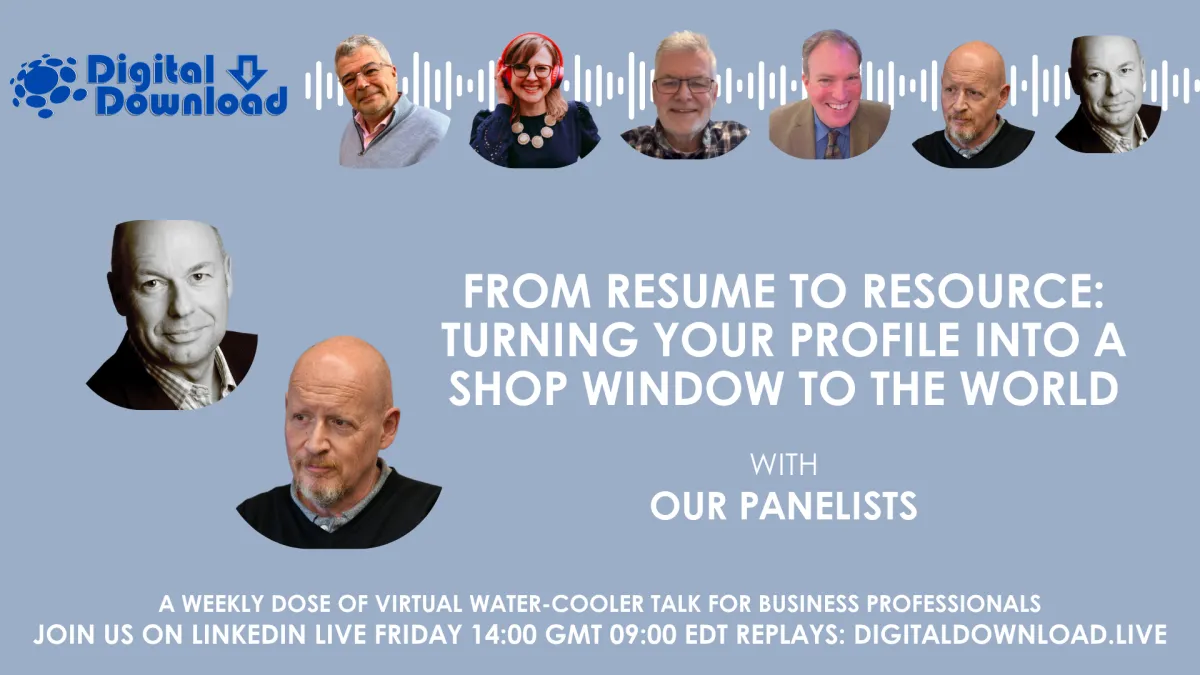
From Resume to Resource: Turning Your Profile Into a Shop Window to the World
This week on The Digital Download, we are continuing our deep dive into the mechanics of modern business development.
In our last session, we drew the map of the "Ecosystem Strategy." Today, we are focusing on the asset you use to travel it: Your Digital Profile.
Most professionals treat LinkedIn like a CV. They list their job titles, their internal quotas, and their past awards. But here is the hard truth: Your buyers do not care about your quota. They care about whether you can solve their problems.
I am joined by Tim Hughes, Adam Gray, Tracy Borreson, and Richard Jones to discuss how to turn your profile from a "look at me" resume into a customer-centric "Shop Window."
We will discuss:
The "CV Trap": Why listing your internal achievements (like President's Club) actually scares prospects away, and why your Experience section must focus on the client's success, not your own.
The Visual Hook: How to use your banner as a personal billboard that creates an immediate emotional connection (e.g., "Part-time Globetrotter") rather than just stating a job title.
The Storyteller's Advantage: Why the first three lines of your "About" section are the most critical real estate on your profile, and how to write a "Hook" that forces the reader to click "See more".
The Featured Content: How to use the Featured Section to visually display your expertise—white papers, videos, and posts—just like a prime retail display.
The Trust Factor: Why "Recommendations" are the currency of trust, and why you should be actively trading them to prove you are who you say you are.
Stop being a stranger with a resume. Start being a familiar resource with a shop window.
We strive to make The Digital Download an interactive experience. Bring your questions. Bring your insights. Audience participation is keenly encouraged!
This week's Host was -
Bertrand Godillot, Founder and Managing Partner of Odysseus & Co, a proud DLA Ignite partner
Panelists included -
Tim Hughes, Co-founder and CEO of DLA Ignite
Adam Gray, Co-founder of DLA Ignite
Tracy Borreson, Founder and CEO of TLB Coaching & Events, a proud partner of DLA Ignite
Transcript of The Digital Download 2026-02-20
Bertrand Godillot [00:00:28]: Good afternoon, good morning, and good day wherever you may be joining us from. Welcome to another edition of The Digital Download, the longest-running weekly business talk show on LinkedIn Live, now globally syndicated on TuneIn Radio through ABTR, the world's number one business talk, news, and strategy radio network. Today on The Digital Download, we We are continuing our deep dive into the mechanics of modern business development. In our last session, we drew the map of the ecosystem strategy, and today we are focusing on the asset you use to travel it, your digital profile. Most professionals treat LinkedIn as a CV, um, they list their job titles, their internal quotas, and their passwords. But here is the hard truth: your buyers do not care about your quota. Bertrand Godillot [00:01:35]: They care about whether you can solve their problems, and we'll talk about that. But before we kick the— we kick off the discussion, sorry, let's go around the set and introduce everyone. While we're doing this, why don't you in the audience reach out to a friend, ping them, and have them join us? We're having fun here. As you know, uh, audience participate— we strive to make the digital download an interactive experience, and audience participation is highly encouraged. Tracy, would you like to kick us off, please? Tracy Borreson [00:02:04]: We are having fun here. This is why I come here at 7 o'clock in the morning my time. Um, hello everyone, I am Tracy Borreson, founder of TLB Coaching and Events, a proud partner of DLA Ignite, and I just love me a good theme song, so this is going to be a fun day. Bertrand Godillot [00:02:22]: Thank you, Tracy. Adam Gray [00:02:23]: Uh, Adam, Hi everyone, I'm Adam Gray, co-founder of DLA Ignite, and, uh, delighted to have Tracy Borison, a proud DLA Ignite partner, and Bertrand Goddet, a proud DLA Ignite partner. We're proud to have you as partners as well. Um, a theme song! Who knew that was going to happen, eh? Fantastic, absolutely fantastic. Tracy Borreson [00:02:47]: And we have— you guys, all we were told was that Bertrand had a surprise for us today. That's a good surprise. Bertrand Godillot [00:02:55]: Uh, really great, really great. So, Tim? Tim Hughes [00:02:58]: Uh, yes, uh, thank you, uh, welcome. Uh, my name is Tim Hughes. I'm the CEO and co-founder of DLA Ignite and famous for writing the book Social Selling: Techniques to Influence Buyers and Changemakers. Uh, and Bertrand, do you do requests? Could we hear it again? Tracy Borreson [00:03:20]: Play it on the outro as well. Bertrand Godillot [00:03:22]: We, we could do it again, but I'm— let's keep it for— let's keep it for the end. We've got— maybe we've got another one, but maybe we've got another one just before we, we, we, we finish up. Um, okay, thank you all. So, um, we're gonna do a bit of whiteboard today, but before we do that, um, I do have a foundational question, of course. So why listing your internal achievements like President's Club actually scares prospects away, and, and why your experience section must focus on your client's success, not your own. Who wants to take this one? It's pretty easy one to start, to be honest. Tracy Borreson [00:04:07]: Oh, because no one wants to be sold stuff. So if you're like, look at how good I am at selling, people are going to be like, ooh, I don't want to be sold stuff. Adam Gray [00:04:17]: I think it, I think it's more basic than that, isn't it? You know, we've got, we've got a load of things vying for our concentration and sucking up our time. So if I've got the choice between investing my time reading something that teaches me something or supports a viewpoint that I have or gives me new insights that I've not had before, that seems like a good investment of my time. If I read something which just tells me what you've done, where you've been, what you've won, it's like, how does that help me in any way at all other than being 5 minutes of my life I'm never getting back? And I think that the challenge is that, that we kind of come from this background where we have been programmed to believe that if I tell you more about how great I am, maybe you'll start to believe it. But today, that's not the way the world works. Bertrand Godillot [00:05:15]: Okay, good, good stuff, by the way. Tracy Borreson [00:05:18]: Like, one of the things that came up in our last whiteboarding session too was about showing people things that they can identify with so they can, like, start a conversation with you. And I think a lot of those achievement things don't really sound like conversation starters. Whereas like I get people all the— my, my about section talks about belonging and how I never felt like I had one place to fit in, so I went and fit in a whole bunch of different places. And I get people all the time that are like, oh my gosh, this is the same experience that I had. So then like all of a sudden you have something in common, whereas like a list of achievements doesn't really give you that opportunity. So I think there's lots of reasons. Bertrand Godillot [00:06:05]: Sounds like a great start. And by the way, thank you, LinkedIn user. We, we prefer to have names. What a start! Thank you so much. Okay, let's get into, into the whiteboard then. As, as you must remember, we've got— you've got you on, on one end of the, of the story, of the street. You've got your target on the other end. There is a closed door in there. Bertrand Godillot [00:06:34]: That's, you know, what happens usually, and I'm not going to go back to the basics we covered the other day, but what we know is that your, your target, they do have a profile, they do have friends, and they do publish content. And on your end, there— and on your end, you've got the profile. I don't know if we can see it, but that is very serious profile. This is probably what this is. It is— Tim Hughes [00:07:03]: I like the hands are like— the hands are like this. Bertrand Godillot [00:07:05]: It does have a tie. And what we know, and I'll just, uh, make sure that I recall that number, is that 76% of your visitors will stop at your headline. So they will get your invite, look at your name, just below your name, your invite, your, your headline, your profile headline. And 76% of them will not go any further, probably because you are, uh, very serious. So can we make that diff— how can we make that slightly different? We said we want to be approachable. Just, just before you continue, Bertrand, uh, Adam Gray [00:07:54]: yeah, I just want to quickly say that, that LinkedIn obviously at the moment is not collecting stuff from broadcasts effectively into our, our software here. So, uh, it's Wolfram Gronert that left that comment, but also we've got a couple of comments from Andrew Schlesser, one of them saying good morning, and then, then a jokey comment about when the album of that, uh, theme song be out. So hello everybody, thank you. I'll keep an eye on everyone's profile and see any other comments that we've got. Bertrand Godillot [00:08:22]: Hopefully we're working on it, we're working, but 76% we said, uh, of your visitors will read the headline and then they will make up their mind. And most— about these 76% have made up their mind and they won't go further, uh, probably because— so the question is, is this because you're too serious? There are probably things on your profile that we need to discuss. So, um, I'll start with making you a little bit more approachable, and that is probably step number one. Is your, uh, your photo or your picture, depending on which part of the world you're joining us from. Um, anything you've— any experience, anything you would like to share on this? Should we look all very corporate? Tracy Borreson [00:09:18]: I think there's— I think historically when you think about it from a resume point of view, you probably think you want that like standard corporate headshot that photographers have been selling a lot of us for a very long time. Um, but even if like— I love the pressure chest test just to be like, if someone saw this picture of me, does it look like how I want people to feel when they're in my presence? And if it doesn't, if it looks like it is like putting up a block or it's putting up a façade, then it's not what you want it to be. So while in conversations like this we might use general words like welcoming, there's different perspectives of that that everyone has. So I just, I just always like to say, like, is that picture saying about you what you want the world to know? And if it's not, then perhaps Try a different one. Tim Hughes [00:10:22]: Um, I've, I've always, um, said that it needs to— that, that, you know, you— we've all been for meetings or we meet someone somewhere and you go, I wonder what they look like. So you bring up their LinkedIn profile and then— and it's a picture of them with a, um, crash helmet on or something like that, which— and you go in the coffee shop and there's no one with the crash helmet on. So it's, it's, it's what if, if you were going to look for the person, what— have a photo so I can recognize who you are, so I can see you across the room and go, oh, Adam, we're meeting today. And, and not one of you lying in a gutter on a Friday night, um, with a, with a kebab. Adam Gray [00:11:05]: Is that not an appropriate photo? Tim Hughes [00:11:08]: No, no, it's not. Bertrand Godillot [00:11:08]: No. Tracy Borreson [00:11:10]: What if people are meeting you and you look like that? Bertrand Godillot [00:11:15]: Okay, so we are clear, we're clear on your photo. Adam Gray [00:11:20]: Um, I think, I think though that on, on the topic of photo, you know, it's so often we see people that have had corporate photos of them taken where they look very smart and, you know, a little bit of makeup and hair's been done and, you know, they're beautifully posed against the background. And when you meet them in reality, you realize that the person you thought they were going to be is not the person that's in front of you. Not just in terms of how they look, but if you— I always think that it's really nice to get a photo of somebody when they're not actually posing for the camera, you know. So maybe they're talking, they're presenting something, or they're talking to somebody, or they're concentrating on something, because then you get a sense of the person rather than just how they look. And I think that, that every element of this should be managing the expectation of the person that's looking at it. You know, you look like you're really good fun because the photo is of you smiling. Okay, well, that's a really good start, rather than you look like you're really, really serious, and then when I meet you, actually, you're quite light-hearted and entertaining. So I think marrying those two up is really important. Bertrand Godillot [00:12:30]: Okay, so authenticity is the key here, I guess. And, and probably, you know, if you don't have a prof— a pro photographer, maybe you can ask your, uh, your, your, your loved ones to take a picture of you. Might be more, more useful. Um, okay, so secondly, we said that Tracy Borreson [00:12:49]: most people— actually, sorry, can I add one more thing about the photo? Because this is something that drives me nuts. When the photo of you is from like 30 years ago Tim Hughes [00:13:02]: Yeah, this also Tracy Borreson [00:13:03]: plays into the, like, if I meet you in real life, can I match that up with you? I think it's really important for the age to match, and I know that that's particularly difficult for women as we age, um, to be like, this is what we look like now, except it just breaks that— the trust when it doesn't match, right? So Um, just wanted to, to slide that in. Bertrand Godillot [00:13:31]: And by the way, it's the same for us, Tracy, don't worry. Okay, so the second, the second piece that we discussed already, because we know that people stop, uh, most of them stop here, actually two-thirds of them stop here, is about your headline. So what should be in your headline? Should that be all about, you know, what you're doing, especially if you're in sales? Um, how great you were, how great you are, how great you were, all of your exes? Um, any, any recommendation? Tim Hughes [00:14:12]: No ex-girlfriends or boyfriends. Tracy Borreson [00:14:14]: I mean, you could include that, but I think we're talking about like ex-Google. Bertrand Godillot [00:14:18]: Yeah, exface— Yes, yes, exactly. Adam Gray [00:14:22]: I think the thing that is really important here is that you said 76% of people, when they look at your profile, they never go beyond the headline. And the problem with saying "Head of Sales at" or "Head of Marketing at" or "Head of whatever at" is that it tells me in 5 seconds that I don't need to connect to you or talk to you. Because I'm not looking for somebody in marketing, I'm not looking for somebody in sales, I'm not looking for someone that's— Tim Hughes [00:14:53]: nobody gets up in the morning and says, I want to talk to a salesperson. Adam Gray [00:14:57]: But, but even if it's somebody in finance, say, it's like, I have no interest in speaking to a CFO, for argument's sake. So if somebody that's a CFO says CFO at, why would I need that person in my network? So I think that the key thing here is to pique their interest enough that they think I'll read on a little bit. And, and this idea that, well, you have to tell them in 5 minutes— or in 5 seconds, rather— what it is that you do. Most people don't know what they need. They don't know how to build a strong network. So telling them that they don't need to connect to you immediately is not a good plan for anybody. Tracy Borreson [00:15:37]: I think it also, like, there's a important piece of the puzzle from the reverse side of it too. So if you are just— let's say this is your first exposure to anything like this and you just assumed because LinkedIn auto-populates your last title into your headline, if you don't have a headline, that, that is what people do. One of the things that, that feeds from a LinkedIn algorithm point of view is search. For salespeople. So if a salesperson is looking to connect with CFOs because they have a fintech product that they're selling, then you've just made it very easy for them to find you. Um, and so I think from a, like, not sales point of view, we— there's benefit in looking at your headline as well, because who do you want connecting with you on this platform? And if it happens to be a salesperson, What do you— what kind of gate do you want that salesperson to go through? Do you want them to care that you could have played Quidditch for England? Um, maybe if, if they're like, oh, what, quit Quidditch, is that a real thing? And then they like— it creates opportunity for like the thinking in the conversation instead of it just being like, this is my title. And salespeople can really easy take that to try to target you. Tim Hughes [00:17:09]: There's another piece of, um, advice that people give, which is bad advice, which is what people tell you to do is to stuff your headline with keywords. Um, and, um, because there's a belief— Bertrand Godillot [00:17:22]: and pipes and pipes between— um, yes. Tim Hughes [00:17:24]: So, so, so for example, it will say, Adam Gray [00:17:29]: um, uh, author, Tim Hughes [00:17:32]: um, 'keynote speaker,' 'ex-Facebook,' 'ex-Google.' And the thing is, is that when you get this long string of, of all these things, your eye doesn't read it. So you're— so you've got this ability, you know, 76% of people don't read any further. Well, pretty much what you've done is you've stuffed your summary title with so much stuff that nobody will read any further. And, and the mistake that people make is that the way that, um, the way that LinkedIn, uh, searches and the way that Google searches, it sees LinkedIn as basically a, a, a complete string of text. So if you do have things that people— you want people to search on keywords, you can put them anywhere in your profile. You don't have to stuff them in your title. So just unshare that. Bertrand Godillot [00:18:20]: Okay, I'll take, uh, I'll take the, uh, the LinkedIn user comment here, uh, because I think it does make sense in, in, in what we're just discussing. Uh, it may be the difference between a negocentric from a centric presentation to one showing up, showing how you help others achieve their objectives. Um, very true. Adam Gray [00:18:40]: Yep. Bertrand Godillot [00:18:41]: Of course. Yeah. Good, good comment. And that leads to the next step because we said, okay, so we now have a, a, a photo and a headline that makes us— that both of them make us approachable. So let's now have a nice— how do we get to the point where— because we, we discussed that last time around— to the point where we have a nice, uh, an attractive, um, you know, window to the world. That's it. That's how it looks, by the way. Not sure it's the best representation, but that's, uh, uh, How do we make that happen? There's one ingredient here that I'd like specifically to discuss, which is your banner. Bertrand Godillot [00:19:37]: So the visual part of your— the first visual of your profile. So do we have anything to, to provide as a recommendation on, on, on the way you organize your banner? Tracy Borreson [00:19:51]: I'm sure we have lots of things. Bertrand Godillot [00:19:54]: Yeah, who wants to say— I'm a bit surprised, to be honest. Adam Gray [00:19:59]: I mean, it should be, it should be pretty, you know, it should be something which is eye-catching and it should be something that is personal to you. You know, Tim and I, uh, earlier this week were doing a presentation for an organization and we used some profile, uh, headers from another organization. Basically, although each of the 4 that we chose were, were different background images, they were all corporate images, which just makes you look like a clone. And it's like, what— why would you have that image up? Well, because my boss told me to. Whereas a good background image is something that's important to you, something which reflects who you are. It might be that it's a, a quote or a place that matters to you, or a shot of you doing something out hiking in the hills, but something that relates to who you are as a person, because it's more real estate for you to put your personality into, isn't it? Tim Hughes [00:21:02]: The mistake that people make is that they think, um, when I'm talking about they, um, marketers and sales leaders think that a person's LinkedIn profile belongs to, to the company. And it doesn't belong to the person. And as we said really early on, authenticity is the key. So whenever people come along and say you must need to use this, this, this banner, which is a corporate one, all that does is it pushes the customer further away because we're back to the— oh, we know if I— if, if someone sends me a connection request and they've got a banner and it says Salesforce, we know the first thing that's going to happen when they send us after connection request is they're going to say, do you want to buy our CRM? So we don't accept. So, so, um, you know, anything to do with the company corporate or anything like that pushes the customer further away. Tracy Borreson [00:21:55]: I know, just, just to add on to that, from the photo point of view, is that like, there's a lot of companies now that will have like a consistent color behind their employees' profile photos as well. And Again, I think from a marketing perspective, people think that that means consistency. Um, but I had this experience where there was this like white paper that was posted, had all these comments on it. And I'm like, oh, like, what's up? The people must be interested in this. But it was all people that had the same yellow background in their picture. And then I was like, oh, this is just like the employees. 'liking it.' That doesn't really mean anything. And then I moved on, right? So the consumers are getting wise to your quote-unquote marketing tactic, um, and it's much more effective to just let your people be people themselves. Tracy Borreson [00:22:55]: And I was at— I was at a networking event yesterday for like the different universities and colleges that were in— that are in Calgary, and I had a couple people asking me about LinkedIn banners, and I was something that shows you— this is why in Calgary, the number one banner that people have on their LinkedIn profile is a picture of mountains. Because we are very close to the mountains. But it's— and I say, like, you know what, if that— if you love the mountains, put a picture of mountains, and anybody else who likes mountains will like you. Because they're like, oh, we have mountains in common. So now I've seen that, now I have like opened the door to being open, at least, um, to seeing what else there is about you. And it doesn't have to be as complex as we make it. Um, I'd also like to say from a like solopreneur point of view, so like people who are solo consultants or running their own business, that a lot of times they feel like they need to make their profile like very businessy. So it like tells people everything they need to know about my business. Tracy Borreson [00:24:06]: Um, and it's just not helpful. It does the, the same thing as the like Salesforce banner. People are just like, oh, this person is trying to sell stuff or run a business on LinkedIn. So now I put my guard up instead of letting your guard down. Um, so anytime you can use any of the visuals, you're profile picture and your banner to help people bring their guard down into like the human zone, then that is a good approach. Adam Gray [00:24:37]: But, but also on, on that point, you know, people write that, you know, you're a solopreneur, they write something and, and talk about we, us, as if they're part of this huge conglomerate. I'm— I was just thinking, my son and I are watching Better Call Saul at the moment, and you know, it's this one guy that's a lawyer that answers the phone in a high-pitched voice saying, "Hello, Saul Goodman, how can— how may I direct your call?" And then, "Hello, it's Saul here," you know, and it's like, sooner or later you are going to disappoint somebody. They're going to come to your office and they're going to see it's you in your spare bedroom, so you might as well set that expectation at the beginning. And, and make a, a positive out of what you consider to be a negative. You know, you're my most important client, therefore you are going to get first call on my time always is an incredibly attractive thing for a buyer to hear, isn't it? Rather than you're one of a million people that we work with and you'll have to join the queue like everyone else. Bertrand Godillot [00:25:44]: So I was, I was saying that these two actually, well, these three work together, or at least these two. Adam Gray [00:25:53]: Yeah, great. Bertrand Godillot [00:25:55]: So that banner headline goes hand in hand and should be, uh, potentially the banner should be the visual representation or a visual proof of what you're claiming on your headline. Although it's going to be difficult for you, Tim. Tracy Borreson [00:26:10]: I mean, with AI now, as a— Tim's mom fighting with a lightsaber, right? I feel like it's easy enough for Adam Gray [00:26:16]: Tim to put himself— yeah, what a great idea, an AI-generated shot of Tim on a broom playing Quidditch. Tim Hughes [00:26:25]: I actually have one. Bertrand Godillot [00:26:27]: We'll work on it. We'll, we'll even have a song for it. Tim Hughes [00:26:31]: That would be great. Next time around, next week is Quidditch week. Bertrand Godillot [00:26:36]: Yeah. Okay, all right, let's, let's, let's move on. Um, what else we said last time around which it would be great to have on your, on your, on your profile when, when you, when you've got visitors? We talked about your, your featured content, and I'll put deliberately two types of content here. So your featured content, how should you select that? Is it based on, you know, it was the, the most attractive, the, the most reaction generator, uh, the, the one that, that, that got most reactions? Is it something that you would like your visitors to read first? Is it 100% professional or should that be a little bit of a personal personal mix as well. Are we on Facebook? Are we exhibitionists if we do that? Uh, whole bunch of questions, and you're, you're, uh, you're welcome to pick it— to, to pick the one you want, you want to answer to. Adam Gray [00:27:51]: Yeah, so I, I feel really strongly about this. I, I think that, uh, let's assume that you create a reasonable amount of content and a reasonable number of things and you're selecting some pieces to go in that featured content box, you know, the, the bits that are going to be seen by people. And I think that one of, one of the mistakes that people make is they think after the fact what they could have done but didn't. So, you know, I'm targeting technology, I'm targeting, uh, uh, cloud services or, uh, uh, cybersecurity or whatever. So if I know the, the vertical that I'm targeting, it would make sense to make that featured content at least reflect some of what that— all those organizations do. So when they look at my profile, they see stuff that demonstrates that I understand what their challenges are rather than stuff that is generic or stuff that is unrelated. You know, so if you were a cybersecurity company and you came to my profile and you saw a load of posts about pharmaceuticals, you'd think this is a pharmaceuticals expert, not a, a cybersecurity expert. So I, I think that part of this is about reverse engineering stuff, making sure that if you're going to install some parts of your profile, if you're going to write some things, you might as well write those things specifically for the industries that that you're targeting so that it looks like you know what you're talking about. Adam Gray [00:29:26]: And at least if that's one of the things that determines whether or not you'll take a call with me, there's a chance that you'll take a call. There's no guarantee, but there's a chance you'll take a call if I put those things up, whereas there's no chance you'll take a call if I don't. Mm-hmm. Tim Hughes [00:29:43]: Yeah, Tracy Borreson [00:29:45]: yeah. I, I just to add Adam Gray [00:29:49]: Things that Tracy Borreson [00:29:51]: reflect your unique perspective as well. So one of the things that we often talk about in terms of content is that you're not just like generating content to generate content, you're generating content with a point of view. And so having that featured content speak very clearly to the problems that I'm here to solve, but also your unique way you do that, your unique perspective on that. Um, and I'm not talking about like, uh, white paper or a like product spec sheet, but like your, your perspective, your conversations, like how, how, how are you looking at it? Because one of the most effective things from a marketing point of view is for people to be able to align with your perspective. But if you're not sharing your perspective, then people can't do that. And so if your featured content is like, 'This is cybersecurity and here's my stance on AI,' right? Then people will be like, 'Oh, what's your—' and it's actually a perspective. Then what's your— they can read it. They can see if they align with that. Tracy Borreson [00:30:54]: And if they don't, I think from a marketing point of view, people think that that's risky because then people will say, 'What if they don't agree?' Well, if they don't agree and you got into a sales cycle with them, you're going to waste so much time in what you think is a sales cycle that most likely not going to lead anywhere because not only do you have to get them to buy something, you have to convince them first. Instead of saying like, this is what I think. Oh, you agree with what I think. This is how I help. Would you like me to help you do that? Um, it's a much easier sales conversation. So, um, the— that clear content with a clear point of view, I think, is one of the things that is important. Tim Hughes [00:31:34]: Yeah. Adam and I ran a, um, a workshop the other day, and, uh, one of the exercises we got people to do was to send a connection request. Um, and at the end, um, one of the people came up to me and said, I sent a connection request, the person looked at my LinkedIn profile, and they didn't accept the connection request. Now, um, so, so, so part of your profile is about— is a— is about getting the next step, which is what you want to do is connect with people. If we put ourselves in the buyer's shoes, what we do is that as a buyer is we look at someone's LinkedIn profile and it says, I've just been to President's Club. Well, they're just going to sell me something, you know, um, or the banner is Salesforce or HubSpot or whatever the, um, other CRMs are available. Um, they're just going to sell me something. The featured content, as, as you said, uh, Tracy, is a great way of saying, this is how I help people, this is how I serve. Tim Hughes [00:32:32]: This is, this is why I'm central to the, uh, to my community. This is— and while words community and serve quite often in sales are seen as being not salesy enough, that actually is what your buyer is looking for. They're looking for somebody that's going to help them. Um, and I'm, I'm actually gonna— I'll be salesy for a second. So we have clients where, uh, buyers are walking across social media speaking to the salesperson, and then that salesperson is closing multi-million dollar deals. You know, if you're— if you're— here is a great opportunity to position yourself, create a conversation, and for people to go, that person could help me. And the featured content is a, is a great way of doing that. And my final point is, please, please, please, you know, professional is seen as being— and dull is, is professional. Tim Hughes [00:33:26]: Don't be dull, you know, show your personality, not in a, um, you know, just, just show the person that you serve them and that you can help them. Bertrand Godillot [00:33:38]: We have a, we have a comment from Jackson. Excellent, thank you, Jackson. Uh, all right. All right, so now my favorite. Let's move— let's move on a little bit. But good, good, good points on the Pomsi chart content, intention, etc., which I think is, uh, is obviously key. So here we go. What's that? That's what I call, that's what I call the coffee machine. Bertrand Godillot [00:34:21]: Can we talk about the coffee machine and why we need a coffee machine? Or why I believe we— I'll tell you why I believe we need a coffee machine, because the first thing you do when you meet with a customer the first time is that you go and have a coffee and you have a chat. Adam Gray [00:34:39]: Yeah. Bertrand Godillot [00:34:40]: So I just think we, you know, it does make sense to have a coffee machine on your profile. Tim Hughes [00:34:49]: Um, and what do you mean by having a coffee machine on your profile? Bertrand Godillot [00:34:51]: What's your coffee machine? Well, mine is baking bread. This is what I do when I have some free time, and I have countless connections in my network who share the same passion, you could say. Um, and obviously that creates, as, as you said, Tracy, initially, you know, that creates a different level of, uh, that at least creates something we've got in common. In common. It doesn't mean— it doesn't mean we're gonna make— we're gonna do business together, but we've got that in common. Um, and that is typically what I would call a digital, a digital coffee machine. Adam, anything to do with guitars? Adam Gray [00:35:36]: Oddly, yes. And I think, you know, your, your point about the coffee machine is a really, is a really good one, because if you say to somebody, do you fancy meeting up for a coffee to have a chat? I'd like you to tell me about what it is you do. That's quite attractive. I'd like to meet up with you for a chat so I can tell you what I do and pitch. Is very unattractive. And, and it's this kind of step-by-step incremental development of a relationship. You know, you don't meet somebody and marry them. It takes time to develop a relationship. Adam Gray [00:36:11]: And it's the same in business. You know, very, very rarely, if you're selling something which is expensive, important, strategic, that might sink your career and/or the business if you get it wrong, nobody phones up and says, I'd like to spend 'a million dollars on a CRM system.' Nobody phones up saying that. Absolutely, you have to build the trust, build the relationship, and get to know somebody in order that they're prepared to put their trust and their future in your hands. Bertrand Godillot [00:36:47]: Should we talk headsets? Tracy Borreson [00:36:47]: Well, okay, and so I think this is also where we get to, like, even though we talked about authenticity in the first 4, I think there is an opportunity for people to keep it safe in the first 4, right? Like, I still control my headline, I still probably have some kind of professional photo, whether it's like— I like the free, like, flowing ones too, but like, it's probably been captured as part of an event or something, right? Um, featured content, I have full control over When we get to this coffee machine component, I think a lot of people start to worry about what their coffee machine is and that it has to be like scary and deeply vulnerable and, and these types of things. And one of the things that I always encourage people to look at as part of their— like, every human has a portfolio of individual preferences that you can share or not share. You don't just have one. And so what is the thing in your portfolio that feels easy to share? Like, I have art, right? Like, art is one of mine. And I also have nerd things. So like, anybody who can identify that I have Loki over my shoulder is like a friend immediately. These, these are the types of— that feels easy. For me. Tracy Borreson [00:38:16]: It feels easy for me to go out and, and share art and share nerd knowledge, right? It doesn't have to be something that's so personal that it feels hard for you to show up and do it. It should be something that feels easy for you to show the world. And even on that, like, so with Adam, for example, he has his guitars. I don't play the guitar, so you might be like, oh no, I don't care about guitars. But I do love music. So then seeing somebody who has guitars makes me think they like music and the guitar is their instrument of choice. Bertrand Godillot [00:38:54]: Okay. Tracy Borreson [00:38:54]: But then that still allows me to make an assumption about somebody. Everyone's going to make assumptions regardless of what we hope they're going to do or not. And so then I've actually made an assumption that gets me closer to that person. I assume you like music and I like music, so I assume we have something in common about liking music. It may not be the same kind of music, it may not be the same instruments, we may not have the same experience in it, but like there's a something. And so this is the point of the coffee machine, is that it's just a something, right? Dogs are great, mountains are great. Like this, this— it doesn't have to be like super strategic or overly complex. It's just a piece of you that you feel is easy to show. Adam Gray [00:39:41]: I think it's also worth saying that, uh, you need to steer clear of things that polarize people. So if you're talking— if, if your thing that's important to you is religion, or is politics, or is some world affairs— yeah, stuff, stuff where people have incredibly strong views around their belief system isms for things, those things are probably best avoided, particularly, particularly the way the world is at the moment where views are so polarized that, that I assume that because you subscribe to a different viewpoint to me, then everything you stand for is bad. But, but, but we'll all have, you know, like, like you said, you know, you've got the mountains, you've got the, the, the Loki memorabilia, I've got guitars, Tim's got travel, Patron's bread. These are things that, that at the very worst that happens is people go, I don't really care about guitars. Okay, well, that's fine, you're allowed to not care about guitars, but nobody will hate me because they play the saxophone and hate the guitar. Tim Hughes [00:40:46]: I think that, yeah, just, just to add my point, so whenever we meet somebody, we always try and find something that we have common— there's some commonality. So if we think about the way that we— when we meet somebody in a, say, a network working environment? How far did you travel? Where did you travel from? Um, all of those— we ask those questions because we're trying to find that element of, of commonality. If, if we like guitars, like travel, or, uh, like nerdy things or, or whatever, that immediately gives that commonality, which means we're taking that step down the, the path of knowing, liking, and trusting somebody. And And the thing is, is that what we remember is— we don't— I won't remember Adam's name. I will remember, there's that guy who plays the guitar, what's his name? Um, and, and I remember those things. And that's what you want, is you want yourself to be remembered for, for the right reasons. Um, and, and, um, the fact that I know that I have this commonality— we don't, we don't ever say I have commonality with them. We just know that it's a, it's a feeling inside us, um, and, and then we'll remember him or her and we'll go out and search for that person based on what that, what that is. Tim Hughes [00:42:03]: So it is so important that, uh, don't overthink it, but it is so important that we have that on our, um, on our profiles because this should be working hard for us. This is, this is, should be selling for us— selling in inverted commas when we're asleep. And, and having that commonality and having all of these things that we've talked about, people come across and go, that guy looks okay, or Tracy looks really— Tracy looks really interesting. I think I'm going to connect with her because she's not going to try and sell me anything. I might learn something from her. You know, we, we, we connect to people nowadays. Social media has changed. We don't connect to people particularly for friends and family, what we do is that we connect to people because we want to learn from people. Tim Hughes [00:42:50]: It's, it's about an information thing, you know. I connect to Brian Solis because I know my life is going to be better for it. Bertrand Godillot [00:42:59]: So does that mean that if we do all of this stuff, we get into the 24% that get acceptance? So you, you pass the, uh, you pass the exam, and, and then in the third, that gets, uh, you know, at least, um, you know, that your, your target will open, or your target network will open your profile and potentially accept your invite when it gets to that. Are we saying that these are the mandatory stuff that you should be looking for, or at least that you're increasing your chances if you do that? Adam Gray [00:43:33]: Yeah, absolutely. Yes, you, you— I think it's worth saying you can't guarantee that someone's going to look at your profile. They might look my profile and say, I don't like bald men. They might look at Tim's profile and say, I don't like bald men, and they might look at yours, Patron, and say, he's not bald, therefore I'll connect to him or read more of his profile. It's kind of like you can't legislate for how somebody will behave, but you can put your best foot forward, can't you? You can, you can project the thing that you want people to know about you and make yourself look as interesting, friendly, helpful, kind, approachable as you can possibly be, so you're maximizing the chance that they'll read on. Tim Hughes [00:44:09]: And, uh, and as, um, at the, the workshop we did, the sales leader said he has a direct correlation, direct correlation between, um, how central somebody is to their network— so how essential a salesperson is to the, to the, to the customers and the network they serve and the amount of business they sell. Bertrand Godillot [00:44:36]: Yeah, it does, uh, does make sense. I think we've got an example, uh, Tim, Adam, Adam, I think you have an example you want to share. Adam Gray [00:44:46]: Yeah, I can certainly— let me do, Bertrand Godillot [00:44:49]: let me do that for you. Adam Gray [00:44:50]: Ah, fantastic. So, uh, we are quite closely associated with the ISP the Institute of Professional Sales. Uh, we're a partner of theirs. They have accredited our social selling, uh, program. We deliver webinars for them, and we are part of their infrastructure, and we're doing some consulting with them at the moment. And Ashley is one of their account managers, and what's interesting about him is that he's, he's demonstrated phenomenal bravery in this. So he's a very good account manager and he's a very skilled salesperson, but before we had worked with them, his profile looked like everybody else's profile. I think it's fair to say, isn't it, Tim? You know, it was, it was instantly forgettable. Adam Gray [00:45:43]: Nothing about it you'd look at and go, I don't like him, but you'd look at him and he would just be one of many people that appeared that way. So he has absolutely taken on board this idea. So it's a friendly photo of him, you know, his face as it appears there is exactly as he is. You can see the kind of person he is from looking at that photo. A nice interesting background image, fantastic headline, "Better in conversation than on paper," because it's, it's self-deprecating, it's, uh, there's no arrogance in that at all. Tim Hughes [00:46:18]: I, I smile every time I read it. I smile. Adam Gray [00:46:20]: Yeah, absolutely. Tracy Borreson [00:46:22]: I, I just think— so this is my first time seeing this profile, and I'm like, oh, me too. Tim Hughes [00:46:29]: Yeah, yeah, yeah, yeah. You immediately drawn to him. Adam Gray [00:46:32]: Yeah. And I think that, that's, that's kind of the key thing, isn't it? You know, this is removing rather than putting up barriers. And his whole profile continues in this, uh, in this vein. You know, he's got a great About section which tells about, you know, if things have panned out differently, what he would be doing with his life. His work history tells a really interesting story, and it's a story. It's not a selection of bullet points about where he's been, what he's done, what he's achieved. And his, uh, his featured content shows him doing what it is that he does and the stuff that he's interested in. And what's great is it gives so many touch points, doesn't it? Tim Hughes [00:47:11]: Yeah, I mean, I— there's the, there's the photo of him standing up on the stage, which I think is important, um, because it shows, um, it shows a gravitas. Yeah, the conclusion that I jump to when I see the photo of him up on stage is that, that he is— he's good— a good communicator standing Bertrand Godillot [00:47:37]: up. Adam Gray [00:47:38]: Yes, so anybody watching, certainly connect to Ashley. He shares some great content. He's a really lovely guy and he won't pounce on you and try and sell you something if, if you don't want to be sold it. But looking at his profile, it's a great example of what a good profile Tim Hughes [00:47:53]: should— uh, so can you open up some of the, the job, um, because the, the great thing about this is that we, we've not really talked about this part of your, your profile. But a lot of people, what they write is about their objectives or, Tracy Borreson [00:48:15]: um, Tim Hughes [00:48:15]: um, he's— yeah, he's, he's saying here about how he helps people. Now there's nothing wrong, you know, this is, this is the— this is in effect where you can sell, um, because this is where your, um, your job description— if you're in sales, well, I, I sell to people But selling is about helping. Tracy Borreson [00:48:37]: And I think one of the things that I love about the DLA Social Selling program is about how do we make our profile our story, right? Like, how does it— is this a story? And it's very different to read. I, and I don't know, I think there's, there's not a lot of people who will read like all of your experience. Like, I have all of my experience on my profile. That's a, a big investment from somebody. I'm not expecting them to read it. But as Tim mentioned, it's great for keywords. But one of the things I love to use it for is like, what is the thing that was important to me in this job? Like, most of us do a lot of things in a job, right? And you can write a list of all those tasks and it might serve you from a keyword point of view. But what mattered to you? How did you help somebody? What was the thing that you took from that job and you built on in your next job. Tracy Borreson [00:49:29]: When you look at this as like your— the story of your experience instead of a resume, because that's specifically what we're talking about today, there's a different way that you, in doing that exercise, start to identify with your experience. It allows you to speak about it differently. It allows you to see the things that are your unique perspectives that can enable you to create content in a more profound way. There's a lot of benefits of looking at our profile as our story, Tim Hughes [00:50:02]: um, Tracy Borreson [00:50:02]: and instead of just a list of things. And this is— you can continue, you could do that. I did it all the way through all of my experience and my volunteer experience and my school stuff. I like took it and like did it. Adam Gray [00:50:15]: I think that's, that's really important. So I've just pulled up Tim's profile and I think, you know, some of the advice you'll get is that if it's more than 5 years old, there's no point in having it on there, which is utter nonsense. Because Tim's first job was working in the kitchen at the Royal Oak public house in Upton Snodsbury. And I think what's really funny is that, that yes, in our first jobs, we learn a lot about how the world works and how to navigate the, the, the kind of the corporate or the, the working environment. But I think what's really interesting is every one of these you put on gives you a potential touch point. So, you know, Tim's biggest ever client might come from somebody that said, oh my gosh, you used to work at the Royal Oak, I used to go in there every Friday night. And then all of a sudden you're like, you've got this connection a long way back, so you, you must be a good guy. And, and I think that often this is this is overlooked. Adam Gray [00:51:16]: And, you know, Tim had a dreadful first job, I had a dreadful first job, we all had a dreadful first job because that's the nature of first jobs. And, and I think that, that, that's a bond that everybody shares, isn't it? Tim Hughes [00:51:30]: One of the examples that Adam always gives is that, you know, is to be, is to be authentic when you write and to, and to, to be brave. So that may be you say 'When I did this job, it was the first time I was actually a, a leader. I just got promotion and it was really scary. I didn't— I hadn't been trained, you know, and it, you know, this happened and this happened and this— but then this happened and, and then, you know, I went on this training course and, and, or whatever it was.' And, you know, classic story, which is, which is, you know, something bad happens and, and I turn it around and, and, and because people will read that and go, that's exactly what happened to me when I was first line manager. Um, I got just thrown in the deep end, and, you know, and, and I, I now feel a connection to you. Um, so it took me, it took me 6 months to convince my partner to write on her, uh, uh, profile the fact that, um, she got made redundant from IBM. Now, lots of people get made redundant The only difference was that she was work— she was working 3 days a week because she had a 4-year-old and a 6-year-old. She— her husband at the time had a stroke at 39, and she was his full-time carer. Tim Hughes [00:52:51]: That, that immediately everybody— now, the fact that you've got a 4-year-old and a 6-year-old, anybody who's got children will go, I, I empathize and sympathize with you because you've just been made redundant. She was the person that was the basically the breadwinner. That, as you can imagine, has a— but that is a great story about where I go, buddy, how did you— what did you do? Uh, and, and that's how you bring— what you're trying to do is bring people closer to you and, and, and have that commonality rather than pushing them away saying, I just want to pitch to you and sell to you. Bertrand Godillot [00:53:24]: Yeah, yeah, that was a great, uh, session, uh, today. Thank you, uh, thank you, thank you, team. Thank you, Tracy, Adam, and Tim. Don't forget that we have our newsletter, so if you want to get some feedbacks on this session and insights on our next session, uh, please, uh, flash the QR code on screen or visit us at digitaldownload.live. And I will not leave you, uh, without a little bit of a dance. So have a great weekend everyone and see you next time. Tim Hughes [00:54:05]: If, if people are gonna dance, can we see— can we get pictures? Adam Gray [00:54:08]: Ready for your daily download, the digital Bertrand Godillot [00:54:13]: world is spinning fast, we've got the insights that will last, the Digital Downloads on the air. Essential info we love to share. Yeah, the digital download, the digital downloads right here. Thank you everyone, goodbye. Tim Hughes [00:54:40]: Thanks everybody, bye.
#PersonalBranding #DigitalInfluence #BusinessStrategy #ProfileOptimization #B2B #DigitalTransformation #LinkedInLive