
Previous Shows
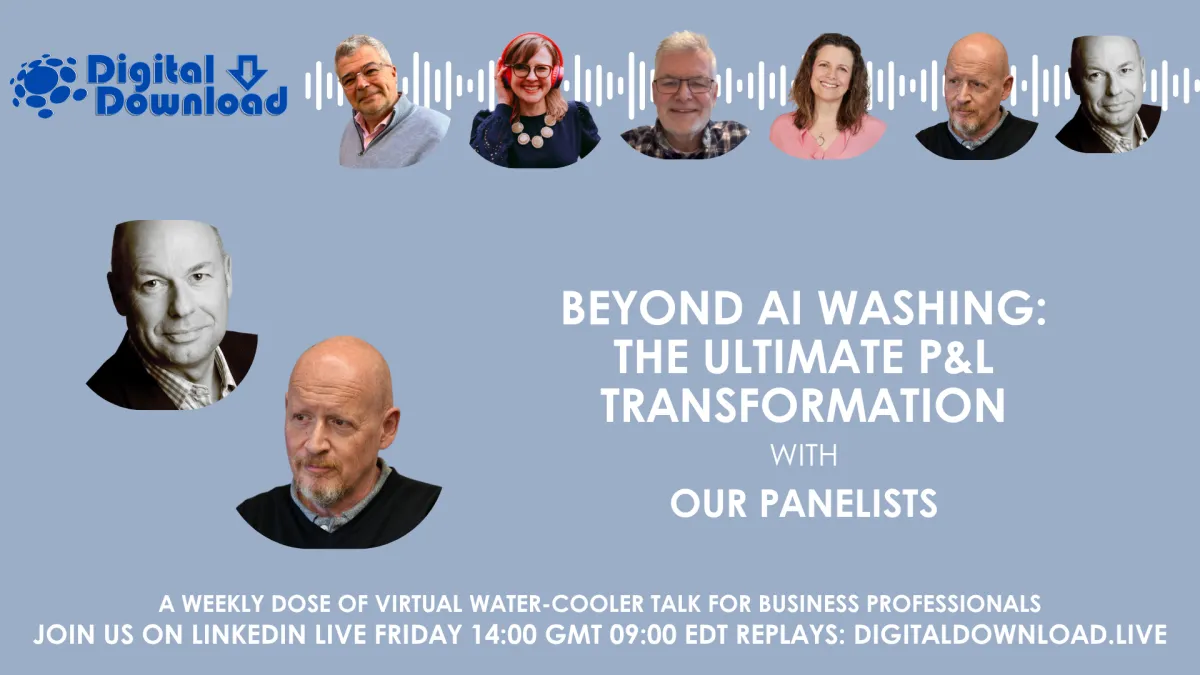
Beyond AI Washing: The Ultimate P&L Transformation
This week on The Digital Download, we are calling out the biggest budget hypocrisy in modern business.
Everywhere we look, budgets are being cut. Marketing, pay freezes, headcount—the pressure is everywhere. Except in one place: AI. Everyone suddenly has a budget for Artificial Intelligence.
The problem? Most of it is just "AI Washing." Companies are implementing basic customer service bots and summarizers just to accelerate their cost-cutting. But incremental savings aren't a growth strategy. There is another way—a way that unlocks limitless opportunity.
I am joined by Tim Hughes, Adam Gray, Tracy Borreson, and Richard Jones to discuss how to trigger The Ultimate P&L Transformation.
We will unpack:
* The "AI Washing" Epidemic: Why buying a few AI summarizers is just cost-cutting in disguise, not a true digital transformation.
* Capital Efficiency > Cool Tech: Why you need to stop pitching the "magic" of AI to your leadership and start talking about EBITDA and company valuation.
* The 90% Friction Drop: How utilizing a dedicated AI teammate to slash content creation friction unlocks your field teams to do what they do best.
* The Dual Financial Shift: How this strategic pivot lowers your Cost of Service (operational overhead) while driving massive Downstream Revenue Acceleration (more high-quality meetings).
If you want to know how a 12-month AI strategy can optimize your entire P&L rather than just patching up a budget cut, you won't want to miss this.
We strive to make The Digital Download an interactive experience. Bring your questions. Bring your insights. Audience participation is keenly encouraged!
This week's Host was -
Bertrand Godillot, Founder and Managing Partner of Odysseus & Co, Co-founder at Azpertilo.ai
Panelists included -
Tim Hughes, Co-founder and CEO of Azpertilo.ai
Adam Gray, Co-founder of Azpertilo.ai
Helen Mackenzie, a very proud Azpertilo.ai partner.
Transcript of The Digital Download 2026-02-20
Bertrand Godillot [00:00:01]:
Bonjour tout the Digital Download. Oops, sorry. Good afternoon, good afternoon, good morning, good day, wherever you may be joining us from. Welcome to another edition of the Digital Download, the longest running weekly business Talk show on LinkedIn Live, now globally syndicated on tuning radio through IBGR, the worst number one business talk news and strategy radio network. This week on the Digital Download, we are calling out the biggest budget hypocrisy in modern business. Everywhere we look, budgets are being cut. Marketing, pay freezes, headcount. The pressure is everywhere except in one place.
Bertrand Godillot [00:00:48]:
AI. Everyone suddenly has a budget for artificial intelligence. The problem, most of it is just AI washing. Companies are implementing basic customer service bots and summarizers just to accelerate their cost cutting. But incremental savings aren't a growth strategy. There is another way, a way that unlocks limitless opportunity. We're going to have a discussion about that today. But before we go into the discussion, let's go around the set and introduce everyone.
Bertrand Godillot [00:01:28]:
Helen, do you want to. And by the way, while we do that, why don't you in the audience reach out to a friend, ping them and have them join us. As you know, audience participation is highly encouraged. Ellen, do you want to kick us off, please? Yes.
Helen MacKenzie [00:01:45]:
Thanks very much, Bertrand. I'm Helen Mackenzie, a proud associate of DLA Ignite and I suspect soon to be a proud associate of Azpertilo.ai soup as well. Football's not coming home. But as Bertrand said, we may be battling it out tomorrow night for third place. But what's not in third place is this one. But what it, what is not in third place is that whole discussion about AI. I've had calls this week where it's been mentioned, so it's on everybody's lips. So really looking forward to the discussion today.
Bertrand Godillot [00:02:23]:
Excellent. Well, thank you very much, Helen. Adam.
Adam Gray [00:02:27]:
Hi everybody. I'm Adam Gray. I'm co founder of Azpertilo.ai. And yeah, this, this idea that we'll just stick an AI badge on it and everything will be okay is rather naive, I think. You know, we've been there before with many new technologies that have promised to revolutionize everything. And I think that people need to think very carefully about how they're implementing AI and are they actually implementing AI or are they just playing around at the fringes?
Bertrand Godillot [00:03:04]:
Good question. I'm sure we'll, we'll have plenty of time to discuss this. Tim.
Tim Hughes [00:03:09]:
Thank you. Welcome everybody. Thank you for tuning in. My name is Tim Hughes. I'm the CEO and co founder of Azpertilo.ai. I'm also famous for writing the book Social Selling and Influence Using Social Media for Cold Outreach and New Business sales
Adam Gray [00:03:28]:
Book over your shoulder?
Tim Hughes [00:03:29]:
Yes, on my. Over my shoulder, yeah. And it's interesting, there's been, I, I've been doing a lot of research recently. You may know, or maybe you don't know that we released a new product recently called as and it's been interesting talking to people saying, you know, are you using AI? And a lot of people are saying, well, I always get a standard stock answer. There seems to be some stock answer that everybody down is downloading off, off the Internet, which is of course we are. And what that often is is what we've got is an AI front end to our CRM system. So we're able to write natural language commands to CRM, which isn't exactly a AI from my opinion. For me, I kind of feel it's more AI washing than AI itself.
Tim Hughes [00:04:16]:
But welcome everybody and thank you, Bertrand, for another interesting episode.
Bertrand Godillot [00:04:23]:
Thank you so much. And myself, Bertrand Godillot. I am the founder and managing partner of Odysseus & Co, and a co founder at Azpertilo.ai. Let's start with a foundational question because, because you've started to uncover that a little bit, Tim, but how do you, how would you define AI washing? And what is the biggest red flag that company is doing it? Who wants to take that, that one?
Adam Gray [00:04:53]:
Well, I'm, I'm, I'm happy to, to, to start.
Bertrand Godillot [00:04:56]:
Go for it.
Adam Gray [00:04:59]:
I think that one of the things that, that we see when we look at particularly across the SaaS world world is that product X now available with AI and there is an element of, of AI involved in all of these things. Of course there is. And, and that's trying to bridge the gap between if it is a CRM system as, as Tim suggested, if it is a CRM system which is incredibly clunky and awkward and time consuming and unnatural to use, you've now got an interface which makes it easier to use. But that's not AI that's like saying I'm going to put, you know, faster tires on my car and turn it into a racing car. Well, actually it doesn't turn it into a racing car. It turns into a car with faster tires on it. And you know, I think a lot of this, the AI labels that are placed on things are placed on those things in order to access that, as you said, Bertrand, at the very beginning, the fact that there are no budget cuts really when AI is involved, because every organization is looking for that, that magic source that they can sprinkle on what it is they're doing to make it more profitable, more effective, whatever. But I think that, that this, you know, we're going to stick with the same CRM that we know, we're going to stick with the same email marketing software that we know, or we're going to stick to the same processes and have an AI agent for them.
Tim Hughes [00:06:31]:
Is
Adam Gray [00:06:33]:
it's just wrapping something in a shiny new shell rather than fundamentally asking the question, is this effective? And I think we all know from experience that nine times out of 10 when we go to a website, we are not looking to contact and engage with the AI agent on the website, even if in some cases they're quite good. What we're looking for is the phone number to find a person that we can have a conversation with. And I think that the idea that we can remove people from this equation and AI is good enough because it saves money, fundamentally doesn't put the customer front and center of what it is that organizations should be trying to do.
Helen MacKenzie [00:07:18]:
And I mean, I think I wanted to come in here about the phrase washing because it sort of came in green washing and, and that sort of, that sort of terminology. And you know, when you think about that, I always think about the so what? Question, which is so what? So I'm using AI. So what if it, if it's an efficiency thing. So if it's. That's a bit of stubble you've got there. Petrol,
Tim Hughes [00:07:51]:
he's actually got sandpaper that he's using to.
Bertrand Godillot [00:07:56]:
It is extremely hot here. That's why.
Helen MacKenzie [00:08:00]:
So if you're using AI, if you're using AI for efficiency, you know, so what? So it's, it, it makes us faster. Fair enough. You know, I can become, I can learn how to cut and paste using control and X and control and V or control, you know, like that will make me faster. It doesn't make me more effective, it just is. It's just an efficiency question. And really, you know, the wash, the washing comes where you're just focusing on efficiency, I think, because doing things faster just feels to me like, you know, I don't have a paper ledger that I do the accounts in anymore. I use, I use, you know, I use a financial system to do that. So, you know, for me, I think that's, that's one of the big questions around that.
Helen MacKenzie [00:08:48]:
And what's interesting is it is something that people are being asked so they are having to respond. So I was speaking to somebody this week where they were telling me that one of their potential customers was asking them how they were using AI. So their product has AI in it, It's a tech product, but also as an organization, how are you doing that? And I think that that was interesting in the sense that people are trying to get a feel for, for, you know what using AI actually means, that sort of litmus test. If I'm just using it like a macro on a spreadsheet, or I'm just using it like, you know, some smart shortcuts on my, on my keyboard, then that's not really using AI, is it? But I think the washing thing is, is, is interesting in that when you get to the end of it. So, so what does it, does it make a difference? And if it doesn't, other than making a speed faster, then you know, it isn't really having an impact. So that's where I think washing is. It's, you know, getting out the lines. Not quicker than, than doing something transformative in getting my clothes clean.
Helen MacKenzie [00:09:58]:
How about that?
Adam Gray [00:10:01]:
I guess to a certain extent it's like the whole self service thing, isn't it? You know, when you go to the supermarket, you've got a choice of going to a checkout which has got somebody working there, or going to the self service part where you are doing the checkout assistant's job and the company is benefiting rather than you from that. And I think that often this AI, the addition of AI without any clear purpose other than, well, we need to have some AI involved in this, never puts the customer at the center of it. It never gives a better experience to the customer. It never, it is, as Bertrand said, it's a cost cutting exercise rather than a value increasing exercise. And I think that, that, that doesn't mean that AI can't be the value increasing exercise, but when you make it the interface, you know, at the end of the day that the old saying people buy people, you know. Absolutely. That's the, the interaction between me the seller and you, the buyer, or me the buyer and you the seller absolutely needs to be human to human. The bit that comes before that is the bit that doesn't need to be human to human.
Bertrand Godillot [00:11:14]:
Okay, great. That was a good starting point. Is, is there any magic in AI, you know, because is, is it going to be the, the, you know, because there's, there's a lot of. We all know that our dream is to do nothing. So is that the promise?
Helen MacKenzie [00:11:38]:
No. No, no.
Bertrand Godillot [00:11:41]:
Yeah. No. No. You don't think so?
Helen MacKenzie [00:11:43]:
I don't think so. I think that, you know, from my point of view. The, the, the objective. I mean, you know, whether my life goal is to sit sipping a cocktail, looking at the sunset for the rest of my life, it feels very much like that on the Isle of Lewis I. Or not. Well, if we still get sunsets. Yes, yes. But you know that, that feels that like that film Wally where all the humans are sort of sat in the.
Tim Hughes [00:12:07]:
Where's Wally?
Helen MacKenzie [00:12:09]:
You know. Yeah. Is it. Where's Wally or Wally anyway where. He's, he's, he's not. Where's Wally? That's in a picture and you've got to find him. It's. He's like a little robot and they're.
Helen MacKenzie [00:12:18]:
All the humans are sort of laid there being fed through a straw. That's not my objective. You know, the thing that, that gives me the biggest reward in life is human relationships. I mean this is one example of it having a, having a blether with you three about AI. AI washing and, and you know, bottom line and AI is, is interesting and, and conversations with people who may or may not buy from me are, are the other bit that as Adam references. So I, I think that there's something around how it transforms experience. So that's where I would say AI is making a difference where it transforms the experience. Now that might be around effectiveness back to my effectiveness in that it makes what we do more effective.
Helen MacKenzie [00:13:06]:
It makes the, it makes, it changes how we make a difference or how my product makes a difference or how my service makes a difference. I think that's where I would pitch it and that you know, when I think about a procurement technology solution. So spend analytics. Let's put pick that. So huge amounts of data where it's analyzed to produce insight. Now the way AI helps with that is to make the process of going through all that data, understanding what's in it and helping to taxonomize it and to make it into data that's that humans can interpret is. Is part of what it does. So in a sense AI makes it faster, but the speed is what makes the difference.
Helen MacKenzie [00:13:53]:
You know, having to wait four months for people to go through loads of invoices means the impact of what you can do. The. So what bit is. Is. Is. Is less because you're, you're out of date. So I, I don't know. I'm sort of going all over the place here.
Helen MacKenzie [00:14:09]:
But I think that that you know that's where I, I think that it's. The objective isn't for there to be no humans because actually if there's no Humans, then there's no why. Why are we trading with each other just to put figures on a balance sheet? You know, human beings are why, why everything gets done, aren't they? There's no human beings.
Tim Hughes [00:14:30]:
Yeah.
Helen MacKenzie [00:14:30]:
Reason to do anything.
Adam Gray [00:14:32]:
I think the other thing is that AI is incredibly powerful to enable people to do things that they otherwise haven't had time to do or the knowledge to do. So let's assume that you start
Bertrand Godillot [00:14:50]:
a
Adam Gray [00:14:50]:
weaving business in the Isle of Lewis to make use of the wool of your sheep and you think to yourself, I need to build a website for this and I don't know how to build a website and it's a new business so I can't afford to, to pay somebody to build a website for me. So I'm going to buy a book on building a website and then I'm going to spend weeks learning how to build a basic website and then upload that website. Now you get the opportunity to get AI to, to take that away from you. And is it going to be the best possible website? Probably not. However, the difference is that you have a website rather than not having a website and I think that it has a great power to be able to enable you to do things and to learn things. So we said about summarizing, if you are going for a job interview and you want to go to a particular, you're talking about going to a particular organization enables you to do some research effectively and quickly on that organization and you can ask it to, to interview you. You know, ask me some challenging questions because this is my background and I'm looking for a job in this organization and, and it provides an incredible sounding board in that environment, something that you may not otherwise be able to do. However, I think the fundamental problem with it is, is that if you're an expert at something and you get AI to do it, it will probably not do it as well as you can do it because it is effectively the summary and the aggregation of everybody's knowledge.
Adam Gray [00:16:24]:
And not if you're an expert, you're at the top of the tree rather than middle band, aren't you?
Bertrand Godillot [00:16:30]:
Well, I think I, I, I like this one Adam, Let me reply to this one. I think if you are an expert, what makes an expert is a point of view and this is exactly what you won't get. You will get average. Yeah, by design it will get average and this is why it might. It is frustrating for experts to use this kind of tool if they don't give their own context. So meaning their connection, their Conviction, their beliefs, their, their point of views so that their teammate is more, is more knowledgeable and probably more aligned with you. I think there's also two speeds into the business world right now. There are people who are solopreneurs, small companies who embrace at a pace that is absolutely incredible both in terms of coverage and so wide width and depth into their business.
Bertrand Godillot [00:17:38]:
So that clearly, you know, you could perfectly use cloud and a bunch of MCPs using technical terms here to integrate with Salesforce with your Salesforce instance and potentially your, your, I don't know, buck tracking system and your pipeline so that you end up figuring out that this customer that you're about to sign a deal with may not be in the best sit right now. So you'd better do a little bit of, you know, a little bit of care of care before you actually turn up with an extension or a renewal. That, that is reality for a number of small business. Not to talk about independent. I like the website example because that's a very good example of things that you can do in addition to what you were doing before. Because there's so much of this is looked at how can I do faster what I was already doing? And we know that this can be an issue in some areas because you're just reproducing approaches that are completely off track. I mean from the, from the, from the previous century and therefore you're going nowhere. But if you start thinking about the stuff that you could do in addition so that it would generate potential additional revenue, that is a very different situation.
Bertrand Godillot [00:19:09]:
So that's, that's. And I, and I see this happening into solo, solo business, Solopreneur businesses and small businesses. For large businesses there is a slightly different landscape and this is where context will never will be very difficult to overcome as a challenge to enabling AI because basically you could have the best, you could be the best AI player in your space. If you don't, if you don't have the context, then you're not going to be a very good forecast, for instance companion or I don't know, turnover companion. So if you want an HR companion, if you want to, to anticipate people leaving or, or things like that. So there are quite a number of acquisitions in billions running, running right now from AI companies willing to acquire context companies. So people who own the data. To be honest, I don't think that Salesforce will let.
Tim Hughes [00:20:26]:
There's a whole, there's a whole ecosystem environment in San Francisco of organizations, not AI companies, but basically data companies and training AI.
Adam Gray [00:20:37]:
Sorry, no I was just going to say so the context and the grounding of the AI is absolutely crucial to provide relevant and on point responses. So what can I, as a solopreneur who's just started my guitar cleaning business, what can I do to ground the AI and teach it what it needs to know about this industry before it starts to give me advice? That's a genuine question. What should I be doing? You know, so I've bought Gemini or Claude or, or, or Chat GPT or whatever it may be. I've, I've bought an instance of that and I'm, or I'm in the free trial period of that. What am I going to do to start to get value from this? Because I think that, you know, all of us when we went into a AI to begin with, we sort of said, you know, write me a blog about this and it writes something which is irrelevant or give me some insights about this. And you know, some of the insights are wrong. So how do people start grounding this?
Bertrand Godillot [00:21:48]:
Pretty simple answer from my perspective. It's an HR onboarding process. So when you hire someone new into your organization, you start by explaining what is it that you are selling, what is your added value, what are your value propositions, therefore who these value propositions are supposed to resonate with. So that gives you a number of ideal customer profiles. You probably have a few punchlines or a few phrases that you like to use to differentiate from your competition, a few beliefs, point of views. And this is something that you need to onboard anyone joining your organization. And I think it goes exactly the same way for any AI teammates. And this is not about prompting.
Bertrand Godillot [00:22:48]:
No, enough, enough of free prompts and stuff like that. Well, prompting is kind of, you know, mainstream right now, so there's no, no point discussing this. Although there are still lots of, lots of people trying to sell props. Yeah, the actual, the actual, the actual ground is, is, is in, you know, engineering is in context engineering whether you are coding or whether you are writing blogs.
Adam Gray [00:23:18]:
It's funny, isn't it? Because even, even a year ago the, the word on the street was that the next big job was going to be a prompt engineer. And you know, for the next decade prompt engineer is going to be the most sought after person. And now a year down the road it's like no, it's, it's, it's not
Tim Hughes [00:23:37]:
the way to a penny.
Adam Gray [00:23:38]:
Yeah, so, so, so, and, but still we see a huge number of people that say, you know, my secrets to whatever it may be. All you need to do is Write prompt in the as a comment and. And I will DM you.
Tim Hughes [00:23:52]:
It's quaint, isn't it? It's quite, it's lovely.
Adam Gray [00:23:55]:
Yeah.
Tim Hughes [00:23:55]:
It's a bit like wearing a top hat and you know.
Adam Gray [00:23:59]:
Yeah,
Tim Hughes [00:24:02]:
it's even Victorian, isn't it? Napoleon. Sorry? Napoleon Bertrand.
Adam Gray [00:24:09]:
So one of the things that we were going to talk about was this idea of an AI teammate. So Bertrand, you're the expert on this. What is an AI teammate? It's a phrase that we hear quite a lot and so what is an AI teammate as opposed to. I've just signed up for chat GPT.
Bertrand Godillot [00:24:38]:
Well that's, that's probably the next, the, the next level, which is someone who's. Is someone. I just said it, it's, it's, it's some, it's a, it is an addition to your team. And I would actually say that now we've got, we've reached a point where you would actually add a team manager of teammates. Because this is where we are right now. Whether you use embedded, embedded solutions at Anthropique or any other vendor or if you make up your mind and decide to use, you know, I don't know, open Clue, ams agents or whatever else that, the core technology. So we're no longer onboarding one additional headcount, you could say, but literally you could onboard a team of accounts with an account manager and specialized. So you think about skills, you know, competencies.
Bertrand Godillot [00:25:49]:
It's basically competencies, digital competencies, knowledge. And I would say the main difference is that now you are in a position to take actions instead of just chatting and getting things done, but collaboratively very much. We're now getting into delegation and control so that you could have, I don't know, your head of dev being a, an agent using five, six, seven different agents could be technology based, process based things that, I mean a group of people that would act on your, on your, on your behalf basically and achieve things, which is quite, quite crazy when you think about it.
Adam Gray [00:26:45]:
So, so an AI teammate is a team and they need to, you need to go through the same onboarding process with them that you would with a person. You know, you've hired somebody that's clever, that's got some basic knowledge about things and you have to train them about what your products and services are and your customers are and what your value proposition is and all of, all of that.
Bertrand Godillot [00:27:12]:
And, and I would say, you know, the same rule applies by the way, you know, always hire someone who's better than yourself and that's that also works there. So it also means, you know, setting objectives and rather setting smart objectives, which means also that you're going to have reviews. And I think the whole idea of, if you want to, where, where we are right now is, is really designing processes and designing supply chains, basically almost Kanban supply chains, where control is also important. It's not only doing things, but it's checking the level of quality and to some degree being in a position to reject some results, ask for rework, things like that. So it's really that type of mindset that when we really talk about,
Helen MacKenzie [00:28:19]:
you
Bertrand Godillot [00:28:20]:
know, adding value through this new technology, we need to think about how we adopt this technology and not just apply this technology to the way we were working before. That's, that's where, where we make a slight, slight difference. Right? We're not, we're not, there's not about AI washing. It's not about putting a layer on AI on top of this. It's really rethinking how we can work more effectively but also do things that we were not doing before, leveraging this new tool. That's the way I see it, at least. And I'm sure that Tim has a point of view on that.
Tim Hughes [00:28:59]:
And I was going to say, I'm going to name drop, sorry, but I was interviewing Charlene Lee, the AI expert, this week on, on my podcast, and she said something really interesting, which I thought I would share, which was that. And I know other people have said it, but I think it's useful for the discussion, which is that because we've, we've seen people either cutting jobs or cutting budgets and then kind of expecting AI to, to step in. And she certainly of the opinion, which is if you've got 10 people, what people seem to be doing is getting rid of nine people, keeping one and having AI. And she said that's, that's not what you, you should be doing, is that you should be empowering. And the key thing is that whenever you do anything with AI, there has to be an empowerment process. So as you said, Adam and Bertrand, you talked about grounded data. There also has to be a, a process in getting people to understand why they're actually using AI and actually how to use it. And her advice was to, to basically to, to, to take your 10 people and empower them all with AI and, and go that way rather than actually using AI as a way of getting, you know, and, and laying off people.
Bertrand Godillot [00:30:26]:
All right, we do have a question from the audience. Patrick, you want to take, you want to take this One. Tim?
Tim Hughes [00:30:35]:
Yes. Patrick Tinney says quality control is a big issue with AI. Is there any benchmarking on this yet? Good question.
Helen MacKenzie [00:30:47]:
Well, you know, the benchmark I've got on using AI is when somebody sends me a LinkedIn message or an email with the wrong name on it.
Bertrand Godillot [00:30:56]:
That's the perfect lack of control.
Helen MacKenzie [00:31:01]:
I mean it's interesting because this is, I'm on the, on I'm on the board of a, of a housing association, so an organization that provides rented housing. And we are very keen to use AI within the organization because we want to release the time of the people in the organization to do the things that only people can do, which is to, to it to impact outcomes for the tenants in a number of ways. Now one of the things that we've been talking about is around the governance of that and the quality control of that because if you're going to enable your organization through a teammate or otherwise to really harness the power of AI to do things, you need to be clear that that's, that's going to be on brand, that it's going to be within any governance and any, any policies that you've got. And that's one of the things that's quite difficult when you've, I don't know, just got the Microsoft suite and co pilot with it is that how do you settle that governance around it? And I think that is, is a really good question from Patrick because I think that's one of the corporate risks is that you sort of say to people, off you go, you know, create tea or here's some teammates we've created that you can use for all of this stuff and you don't know whether you can safeguard against the risk of somebody you know doing something with one of your most significant customers that actually jeopardizes that whole relationship. All because there wasn't proper quality control on benchmark. And I'm just thinking that, you know, thinking how somebody in the team might be using AI to do the job. There isn't quality control and then, then there's an impact on the bottom of bottom line because perhaps that customer doesn't review, renew or the. Because, because the mistake is so not catastrophic in a, in a life and limb threatening situation but catastrophic for that, that relationship.
Helen MacKenzie [00:33:11]:
So it's a quite, quite interesting, you've
Adam Gray [00:33:13]:
raised a really interesting point there, Helen. You said you work Housing Trust or you're on the board for, of the Housing Trust and they're trying to embrace AI to free up time of people within the organization to do the things that only humans can do. I'm paraphrasing what you said. So how do those people decide which things get past the AI and which things are things that only humans can do? Because I think that's, that's a really big question, isn't it? You know, I'm afraid I'm going to have to sack you. I'll get AI to write your letter of dismissal. Actually is, I mean, we're laughing because it's obvious that that's not something that one should do. I bet that's one of the first things that people do get AI to do, though. So, so, so how do you make that delineation about AI can do this job, I need to give it this information and ground it in this way, and AI can't do this job?
Helen MacKenzie [00:34:15]:
I think there's something about where, where being human and being, being, being a person is important, you know, so we talk a lot about authenticity and being human, don't we? And you. I can't, I'm having a conversation with somebody I can't do. Well, it can if it's on a WhatsApp group. That could be AI. I mean, we've all, we've all, or perhaps it's just me, but, you know, we've all stumbled into a rather long conversation when you realize you're talking to a bot. But I, I think so. For the housing association's point of view, it's about, you know, where human relationships are going to impact the effect for the tenants. So that might be, you know, providing support in a particularly difficult time.
Helen MacKenzie [00:35:04]:
It might be helping somebody find solutions. It might just be because the person involved prefers to speak to a human being like we are. But I, I, I, that would be, I mean, and when I think about it from a business point of view, I think about competitive advantage. Where is it that having humans involved, either for innovation ideas or for that, actually enhance the process because humans are involved? Does that give you a competitive advantage over somebody else? Is that helping you to stay ahead? Is that helping you to retain customers? I don't know. These are the sorts of things that I think of where people, you know, people make a difference and make a difference in terms of, in terms of bottom line and, you know, keep keeping the, keeping the lights on, keeping the money coming in.
Bertrand Godillot [00:36:01]:
I think, I think that's, that's, I mean, you said it. From my perspective, it's different. Where do you make a difference? So is this not working if you are not involved? I think it's probably the Best way to look at this because everything else then is, is a candidate for, for being, being endorsed by one of your, one of your teammate. And when it comes to quality control, because I just wanted to circle back on this one very simple example. Translations, translations, Internet localization, localization of content is a good example where you could put two LLMs working against, not against each other, but one translating, the other one checking the translation, that is very efficient actually because then that increases the, the quality of, of the overall output basically.
Tim Hughes [00:37:23]:
So Pat's come back and said on that, following his question, quality control is a big issue with AI. Is there any benchmarking on this? He said, I read something recently. Many companies are not seeing the investment working out. One example was that a company only made 17 on investment of each dollar they spent. I wonder if some companies are not fit for AI. I think I read the same article actually Pat, and I think what we're all seeing as a group is that people are investing AI and they're not necessarily seeing a return on it. And there's a lot of hype about it and people are not getting the return. And I think what's happening is that senior people in organizations, when they see figures like that, when you're, you're, you know, if you're, if you're paying out money out of your own pocket to empower people with AI and you're not
Adam Gray [00:38:18]:
seeing returns, but it's not a danger that empowering people is not the answer, it's teaching people is the answer. And, and I think that, you know, I'm sure that that is the case, that that 17 cents on the dollar in terms of a return is not uncommon, but ultimately the mistake. And you know, we all believe very strongly in planning and understanding. You know, I'm going to do this activity and I'm hoping it's going to deliver this benefit. And I think that there's a huge amount of, well, we'll just throw a bucket of AI on that and it'll solve the problem, which is ludicrous to assume that. And maybe the other issue is that you've been doing stuff a certain way, Tim, for 30 years. And then all of a sudden I say, here's a Claude license. Away you go, mate.
Adam Gray [00:39:06]:
And you go away. And then two weeks later I come back and say, how's that working out for you? And you say, well, I've only had time to switch it on for half an hour because I've been really busy doing other stuff. And you know, potentially there's, there's not been a lot of Runway given to organizations to actually see any benefit and understand how these tools can add value to their organizations.
Helen MacKenzie [00:39:27]:
I think that's where, you know, that's where I don't think everybody in the organization needs to be able to do that, though. I think there's. My experience of, of people is that, you know, some people are just content to get on with it within the guardrails that management of, of said that they, they can do things. You have some team members that are really keen on stuff and want to find out and learn and try and do. And I think that, so you don't need everybody in the, in the team to be AI enabled and able to think the unthinkable thinkable about how AI can be used. But I do. So I think that that's, you know, that's where we need to just think about who needs what skills. And back to my point about governance and guardrails, I know it sounds really boring, but it, it's one of the biggest, one of the big questions is around how do we stop enthusiastic amateurs within the organization doing something with AI that's going to impact the business? And so that might be why people are sticking in the comfort zone of efficiency uses.
Helen MacKenzie [00:40:38]:
Because efficiency uses feel very safe, don't they? Whereas effectiveness uses, where we enable creativity, we enable people to put stuff out into the public domain or do things in the public sphere that might impact on our business, that, that feels more risky and perhaps we won't go anywhere near that. I don't know.
Tim Hughes [00:41:00]:
And I think, I think I, I agree, Helen, which is that I think what, what happens is that our comfort zone or our, the way that we work naturally is that we go to things that we are, we are used to and then try and see if we can AI that. So, for example, you know, we were sitting down talking. Sorry, you weren't here then, Helen, but we were sitting down talking a year ago where we were going, why are people creating robocallers and faster spam emailers? Because that's not how people buy, that's how people sell. But it's just the obvious thing to do, which is you go, oh, I've got a whole bunch of team of people over there cold calling. What we'll do is we'll automate it. Rather than saying, actually, is there a way that we could do things better? How do people buy? Okay, what we'll do is that we'll, we'll create a platform that allows you to, to build trust and relationships and so that, that's kind of one of the differences that I see. But I'm not expecting everybody to come up and innovate, as you say. And I think Pat actually comes up with a good idea.
Tim Hughes [00:42:05]:
If you're only getting a $0.17 return on a, on a dollar, then maybe
Adam Gray [00:42:13]:
AI isn't right for you.
Helen MacKenzie [00:42:16]:
Yeah, but you know that you wonder whether there's that amount of scrutiny on some of the other things that people are doing that appear to make sense. So back to your, you know, automate your calling and your, your techniques. Your. Let's, let's have a marketing campaign where we, we send, you know, a sequence of, of emails to people that gets.
Tim Hughes [00:42:42]:
But people don't buy 1%.
Helen MacKenzie [00:42:45]:
No, no, but.
Tim Hughes [00:42:46]:
Well, it's how we sell.
Helen MacKenzie [00:42:47]:
People in the business don't evaluate those things in the same way. So you're talking about 17 cents on the dollar for AI. But if you're, if your mass marketing is, isn't, is only generating, you know, one sale or, or 1% in terms of ultimate sales that convert. I know there's a lot of things that go on in the middle of that, then there doesn't seem to be as much skepticism on some of these generally accepted ways of doing things within the business. So it feels like air has been judged a little bit and not, you know, not that we shouldn't, but the bar is higher for AI than it is for some of the traditional techniques because again, they feel safer that we know they're on message that, you know, there's a process to do them. So they, I, that's interesting, I think, whether, everything.
Tim Hughes [00:43:41]:
But I think, you know, we've now had AI for mainstream AI for what, three and a half years. And there has to be a situation where leadership, I'm talking about CFOs are going, are we getting a return? And, and, and, and going, you know, and saying what, what do we need to do to. How can we actually make money from this? On a lighter note, I'm just going to say I actually met a Mr. Bot this week. My name is Boss. Sorry about this, but, but, but, but you must, it's, it's a bit, it's a bit like being called smoke too much, isn't it? Or something like that. Yeah, I didn't even miss the bot this week. So when you said you were talking to a bot, I was wondering.
Tim Hughes [00:44:30]:
Wonder if it was the same person. No, sorry about that. Just. We, we. I just thought I'd add some humor.
Adam Gray [00:44:39]:
Yeah. It's Friday.
Bertrand Godillot [00:44:40]:
It's Friday. That's okay.
Adam Gray [00:44:42]:
I think, I think one of the other things is that, that as, as AI stands, it is a limitless toolkit and series of building blocks. And you know, this is a. This is like Tim wants to buy a new. Tim has owned them in the past, a new BMW, so he can't decide quite which version of the 3 Series to get. So what they do is they send him a lorry load of parts and he can then pick the seats, the dials, the engine, the wheels, the suspension, the color that he wants and configure it himself. Yeah. Now. Now it strikes me that that's what AI seems to be at the moment.
Adam Gray [00:45:30]:
We've got these incredibly powerful tools and people are. The tools are not constructed with a single outcome or purpose in mind. They are simply a set, a limitless set of possibilities. And I think that part of the challenge here for most organizations is they're not actually quite sure what they want it to do. They want to be more effective, they want to be more efficient, they want to make money, they want to scale their organization. Of course, these are fundamental business desires, but they don't know what tools are going to do that. And that's why they default back, as you said, Tim, to Robo calling and sending more emails, because actually they do know something about that. Well, we just use this to dial up the number of calls that we make or dial up the volume of email that we send.
Adam Gray [00:46:15]:
And actually what they should be doing is, is looking again, as you said, Tim, that's not how we buy, that's how we sell. They should look at how people buy and then say, how can we map what we do to that? And when you and I worked a large tech company, you know, often when you were looking at how you would approach as well. Of course, yeah, how, how you would approach a large organization, you would do customer journey mapping. And it was nothing to do with the buyer's buying journey and it was everything to do with your selling journey. You know, so at this point we're going to send them this, and at this point we're going to call them up and at this point we're going to invite them to an exhibition and that will, that will help shepherd them through this process. But at no point did you stop and say, actually, what do they need? Yeah, what do they need to move them on to the next stage? But not what do they need as an individual?
Tim Hughes [00:47:08]:
A bit of content, Adam. That's usually what moves them to the next stage.
Adam Gray [00:47:14]:
Yeah. Emailed out to Them, but not just any old bit of content, Tim, A white paper arguing people about how great your product is.
Tim Hughes [00:47:21]:
But, but wouldn't be, wouldn't be, would be wobbly without white papers.
Adam Gray [00:47:27]:
But, but the, the, the irony is that, that, you know, we've, we've now got an incredible set of tools, but we don't know what to do with the set of tools.
Helen MacKenzie [00:47:39]:
Well, that, that does that, that creates opportunity for people who are, have, have the framework within their organization back to. I've definitely got the governance hat on today, but we have the framework in it, in the organization to empower the people in the organization to be, to, to be creative, to be human, to, to go, to go forward with things that are actually going to make a difference. And I back to. I, I mean, I, if I was in one of the roles where I was a senior leader in the, you know, where I was in the past, I'd be, I'd be asking the so what? Question every day to all of the ideas that people were coming up with. And you know, so what? So what? How does that affect what we're here to do? And you know, from the point of view of my role just now, which is, you know, to have more conversations with people to hopefully transform the way they, they get conversations by using some of the approaches that we, we, you know, we deploy. Actually, if it doesn't, if it's not going to. So if, if it's not going to do that, what's. What, what am I doing? So what? So what? So I think it's, I don't know.
Tim Hughes [00:49:00]:
Have you seen Pat's question? Is AI more important in creating empirical data or is it more impactful on creativity?
Helen MacKenzie [00:49:14]:
You see, I think I'm in the. From my point of view, Patrick, I, I'm in the. If AI enables the creative part of my brain to be creative, you know, I'm a great one for, you know, not having anything in my head and writing it down and reminding myself and not, you know, trying to create, leave the space in my brain to be creative, then I think the more AI can, can provide the space for people to be creative, I think it'll, that's where it could be really important. You know, just as, just as having a Hoover to, to vacuum up bits off the floor means it takes less time, which means you've got more time to be more creative than when my poor granny was on her hands and knees with a stiff brush.
Adam Gray [00:50:00]:
The problem though is that, that not many tech vendors are building Hoovers. You know, Tim, Said Meccano, they're offering Meccano kits. And I think the part, the problem is when you are offered a Meccano kit and it says, you know, there's a carpet washing machine that you can build from this, or a Hoover that you can build from this, or an air purifier you can build from this or you become lost. And what I see is, I see either tech vendors producing, having AI bolt ons to dubiously effective products that are currently being made and it streamlines a process that doesn't work and we mentioned that, or a, a whole universe of possibilities, you know, so you sign up for Claude and well, you can build anything you want, but that actually doesn't help me. What I need is for you to build me something and for me to say that solves a problem I have or it doesn't, in which case I won't buy it, but if it does, it works, it doesn't need for me to build it. And there seems to be very little of that out there at the, the moment.
Helen MacKenzie [00:51:10]:
Do you think? It's a bit like, feels to me like you know, when that, when the solar system formed and all the, the gases were starting to coalesce, that actually you've got all of those building blocks in AI. But as, as the market starts to work out, you know what the best use case of it all is, then it will, it will start to solidify into things and, and as you say, I mean I had an, I had a license to, to do stuff on WordPress once, but that. I never built a website with it because why would I. Somebody else I knew could do it a lot better and quicker than me. I just got them to do it. So it could be that we're just in that, in that place where everything's flowing around and actually as it coalesces. No, as it coalesces. Sorry, sorry viewers.
Helen MacKenzie [00:52:01]:
That was Tim in the private chat being cheeky. But as it starts to coalesce then actually the use case isn't that we all just have access to the blank sheet, the use cases that, a bit like the App Store and being able to build things to put on an iPhone. Actually that's where we end up with lots and lots of apps rather than the ability to build stuff on the iPhone in the first place.
Bertrand Godillot [00:52:26]:
Yes, but they are integrated. I think that, you know, going back to, I think there is a really, a big, big push right now on integration. So there's this idea that at the end of the day we almost no longer need a user interface. And things happen.
Tim Hughes [00:52:51]:
And Johnny, I released his speaker this week, didn't he?
Helen MacKenzie [00:52:57]:
All right.
Tim Hughes [00:52:58]:
Yeah, yeah. The. The guy that was.
Helen MacKenzie [00:53:01]:
Yeah, yeah.
Tim Hughes [00:53:02]:
Is on the iPhone who's gone to open AI. It was in the same week that open AI that Apple is suing open AI because they've taken 400 of their phone engineers.
Adam Gray [00:53:15]:
There's.
Tim Hughes [00:53:15]:
There's no correlation between the two. Honest. But Johnny, basically his first thing that he's produced, which is. Which is AI, is a speaker. Nothing like Alexa, of course, or the HomePod. Yeah, yeah. Whatever the Google thing is.
Bertrand Godillot [00:53:33]:
Yeah.
Helen MacKenzie [00:53:35]:
Other. Other. Other. Other things. Other things to. To moan at because they've got your accent wrong are available.
Bertrand Godillot [00:53:43]:
All right, well, that was a good Friday, actually. Good, Good talk, good chat and thanks.
Tim Hughes [00:53:50]:
We're not gonna. By the way, you're next question is a whole episode in itself, so we're not going to go there. Sorry.
Bertrand Godillot [00:53:59]:
But we keep it for next time. All right. Excellent. Well, thank you, team. Thank you, everyone. If you want to have more on this episode and sorry, Tim and Ellen, you've got to move slightly around this. If you want to do more about this episode and the upcoming ones, you can, you can flash the QR code on screen or Visit us at digitaldownload.live/newsletter
. Thank you.
Bertrand Godillot [00:54:28]:
Thank you to our audience. Thank you, Patrick. Thanks everyone and see you next time. Thank you. Bye Bye.
#AIStrategy #BusinessGrowth #CapitalEfficiency #B2BSales #DigitalTransformation #EBITDA #LinkedInLive