Previous Shows
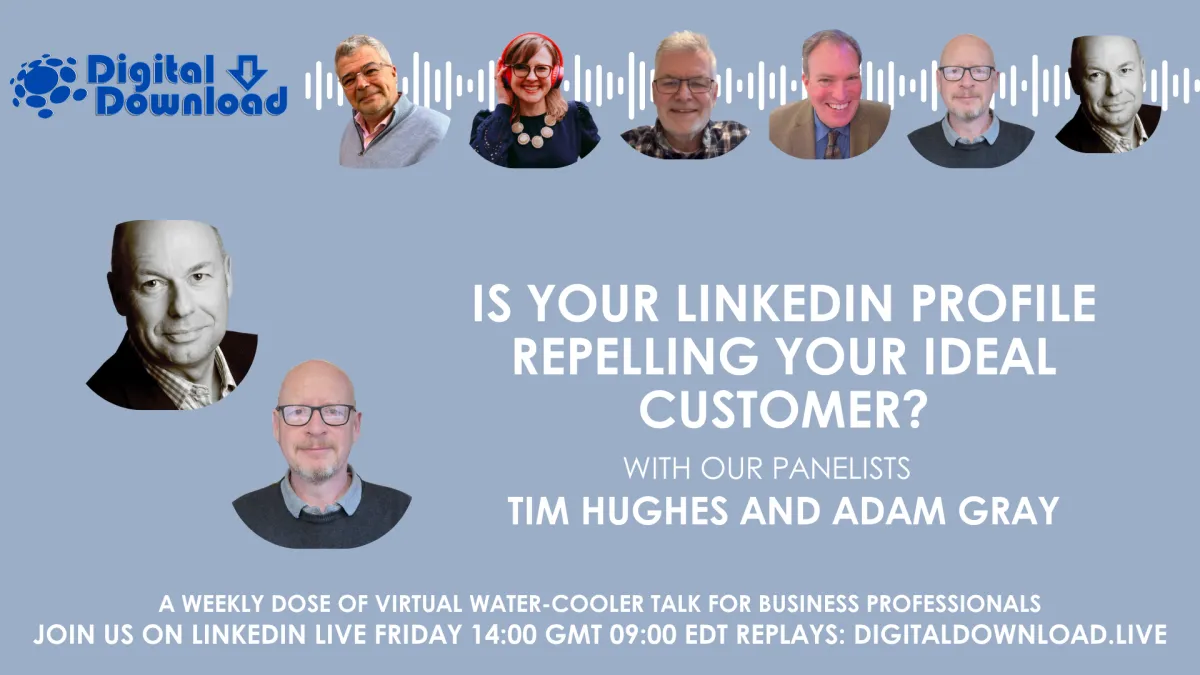
Is Your LinkedIn Profile Repelling Your Ideal Customer?
This week on The Digital Download, we are getting practical. We often talk about strategy and mindset, but the rubber meets the road at one specific place: your LinkedIn profile.
If you aren't looking for a job, why does your profile look like a CV?
In today’s ultra-competitive market, your buyers are searching for answers to their problems long before they ever talk to a salesperson. If they land on your profile and find a list of past job titles and quota achievements, they bounce. You are leaving leads and money on the table.
I’m joined by my co-hosts Tim Hughes and Adam Gray to discuss how to turn your profile into your number one prospecting asset. We will break down the difference between a profile that exists and a profile that sells.
Join us as we unpack the "Digital Storefront" concept and discuss:
* Why your profile needs to stop being about you and start being about them (the buyer).
* How to use "keywords" not just to be found, but to frame the conversation before it even starts.
* The psychology of "de-risking" yourself: How social proof and positioning build instant trust.
* Why "guru-speak" and fluff are killing your credibility.
* How to leverage AI prompts to power up your personal brand without losing your authentic voice.
We strive to make The Digital Download an interactive experience. Bring your questions. Bring your insights. Audience participation is keenly encouraged!
This week's Host was -
Bertrand Godillot, Founder and Managing Partner of Odysseus & Co, a proud DLA Ignite partner
Panelists included -
Tim Hughes, Co-founder and CEO of DLA Ignite
Adam Gray, Co-founder of DLA Ignite
Richard Jones, Richard Jones, Director of Qure 8 Ltd
Transcript of The Digital Download 2025-11-28
Bertrand Godillot [00:00:08]:
Good afternoon, good morning and good day wherever you may be joining us from. Welcome to another edition of the Digital Download, the longest running weekly business Talk show on LinkedIn Live, now globally syndicated on tuning radio through IBDR, the world's number one business talk news and strategy radio network. Today on the Digital Download, we are getting practical. We often talk about strategy and mindset, but the rubber meets the road at one place, specifically your LinkedIn profile. In today's ultra competitive market, your buyers are searching for answers to their problems long before they even talk to a salesperson. If they land on your profile and find a list of job titles and quota achievements, they bounce. You're leaving leads and money on the table.
Bertrand Godillot [00:01:08]:
But before we get into the, before we kick off the discussion, sorry, let's go around the set and introduce everyone. While we are doing this, why don't you in the audience reach out to a friend, ping them and have them join us. We strive to make the Digital Download an interactive experience and audience participation, as you know, is more than welcome. All right, Tim, you want to kick us off please?
Tim Hughes [00:01:32]:
Yes, thank you. Welcome. My name is Tim Hughes. I'm the CEO and co founder of DLA Ignite. I'm famous for writing the book Social Selling Techniques to Influence Buyers and Change Makers.
Bertrand Godillot [00:01:44]:
I'm surprised you don't have the book cover. You, you don't have to go on.
Tim Hughes [00:01:48]:
I, I, I never presented.
Bertrand Godillot [00:01:53]:
All right, thank you for that, Tim. Adam.
Adam Gray [00:01:56]:
Bonjour, Madame. Je, Adam le Chat. So that's the, that's the entirety of.
Bertrand Godillot [00:02:04]:
My French Brian is in the kitchen.
Adam Gray [00:02:07]:
Absolutely. Many years ago. Hi, it's, it's great to be here. Interestingly, interestingly, personal brand. This has been a week of personal brand type conversations and stuff for Tim and I. So it's, it's very apposite that we should be talking about it today, I'm sure.
Bertrand Godillot [00:02:27]:
And we can't wait for it. Yeah, we do have to introduce Richard.
Richard Jones [00:02:32]:
Hi, I'm Richard from Curate, a DLA Ignite partner. It's quite apt that this is the topic of conversation this week because I have indeed changed my profile or at least the title because I discovered that a lot of people were disappointed to find out that I wasn't actually an astronaut. So I've had to sort of subtly change things to get you're slightly more realistic sort of take on what I might be able to help them with.
Bertrand Godillot [00:03:01]:
Excellent, excellent. So that will give you, that will give us a Lot of things to talk about, I'm sure. Well, thank you everyone.
Adam Gray [00:03:08]:
Can you introduce yourself, Bertrand?
Bertrand Godillot [00:03:11]:
Yes, of course. I am a prisoner of my own brilliance.
Adam Gray [00:03:18]:
Well, we can talk about that in a minute, can't we?
Bertrand Godillot [00:03:21]:
That is exactly what happens if you ask Gemini or any other tool to write your LinkedIn title for you, which I didn't, obviously. Well, I did, but I didn't use it for some reason, maybe because I am a true prisoner of my own brilliance. All right, thank you very much. Obviously, I do have a financial question.
Adam Gray [00:03:44]:
For each of you.
Bertrand Godillot [00:03:46]:
What is the difference between a profile that exists and a profile that sells?
Tim Hughes [00:03:59]:
I think that. So Adam and I delivered a personal branding workshop on Wednesday of this week. And I think that there was a number of aha moments. One, one of them was the fact that the, the, this, this, this point, which is that most people, pretty much 100 people on, on LinkedIn see the Pro profile. It's just a profile. It's, it's a, you know, I've got to get a job, I've got to get going to put my CV up. I'm, I'm going to tell people about the company that I love, the company that I work for. Even though you've worked for lots of companies, you say that you, you love the company that you're currently working for.
Tim Hughes [00:04:38]:
And, and, and this aha moment when they actually realize that, that buyers are actually checking you out. Well, future employees, employers could be checking you out. Everybody's checking you out. And the fact that this, that your, your LinkedIn profile is in effect a shop window to whatever it is that you want them to, to, to, to conclude about you is, is a, is a, it's a massive compelling thing to do. And you know, we often get that I don't have time to do this, that what, you don't have time to sell, but you, you don't have time to sell. And, and, and so we, and so the, and you know, there's a, there's a whole bunch of things around it about being found, you know, whether when someone's looking for your products and services and they're looking for someone that's going to help them to, to buy those products and services because they, because you don't sell commodity, I'm sure, and they don't just buy off the website. So when they're looking for help around that they might find you and then contact you and say, can I buy some of your stuff? Wouldn't you want that? When, you know, most people, most people at A time in their life when they're actually, you know, I'm in this job, but actually I'd like to be found by somebody else and go into work somebody else, because I want to progress my career. You don't want your, you don't want to progress your career? Is that, is that right? You don't want to do that? You know.
Tim Hughes [00:06:06]:
You know, I know. I know a whole bunch of headhunters who are looking for people and they have to show what they're looking for is someone with, have, which understands digital and have digital qualities. It's nearly 20, 26, so you don't want that. So I could go on. I'm not going to, but I could go on. There's so many benefits by actually having a, a LinkedIn profile which is insightful and educational and interesting and shows who you are and what you do. There's so many business benefits that certainly it's, I mean, as I said, the, the headhunters I know all look for it and basically if you don't have it, you're qualified out anyway. That's, that's, that's enough for me, surely.
Bertrand Godillot [00:06:55]:
If I want to be found. The first thing I, the first thing that I need to do is just make sure that every single keyword is in my, is in my LinkedIn profile title.
Adam Gray [00:07:08]:
Well.
Bertrand Godillot [00:07:11]:
No. Well, am I getting something wrong?
Tim Hughes [00:07:16]:
Yes.
Adam Gray [00:07:16]:
Or I think right back to your first, to your, your first foundational question. What's the difference between a LinkedIn profile that exists and one that sells? Well, I, I think that it's dangerous to think about it as a tool to sell, because when you land on somebody's profile and they say, they say, here's a list of my products and services, that's very unattractive. So I think that it can, I don't think your LinkedIn profile will necessarily sell, but I think what it will do is if you get it wrong, it will absolutely stop you from selling. So it needs to, it needs to elicit somebody moving along the journey. So they see your profile, they read about you, they think you look interesting, they think you look like somebody that they should be talking to, and then they'll talk to you. That's not the same necessarily as them buying straight off the, off the bat. But, but one of the things that, that we found, and, you know, Tim and I have been doing this for 10 years now, helping people to create profiles that, that work, is that how well you tell the story and how well you lock somebody in and get them to, to Read the stuff that you've written. It gives you a competitive advantage because they feel that they know you.
Adam Gray [00:08:39]:
We have a client in Singapore and he said that when he goes out and he has lots of first meetings with, with clients as a result of his behavior on LinkedIn and he said it's actually quite eerie sometimes because he sits down for dinner or for, for lunch with somebody and they seem to know him. He doesn't know them, but they know him because they've read about him and they've seen his posts and, and, and that makes them feel that they know him better than they, they do.
Tim Hughes [00:09:07]:
It's, it's worth adding to that because some people would list. Think that's quite fluffy. Yeah. As a sales leader listening to that. So he has lots of first meetings. What's that quantify? Well, to quantify it, his PA has told him to stop booking meetings because he's got so many.
Adam Gray [00:09:25]:
I'm sure loads of sales leaders hear that. Don't.
Tim Hughes [00:09:27]:
And, and I'm sure lots of salespeople hear that from their sales people that they have got so many meetings they don't know what to do. But there's a, there's a quant. There's a quantifiable connection between having a great LinkedIn profile and selling shed loads. Regardless of the fact that Adam always talks this, this down because he doesn't like the term selling. Because actually when you go to LinkedIn you shouldn't sell.
Adam Gray [00:09:52]:
Yeah. And, and I think it's a difficult, it's a difficult line to walk, isn't it? Because absolutely. You want your profile to help you sell things, but you mustn't sell on your profile. So you've been in sales all of your life, Tim, and there's nothing salesy at all on your profile. It's all about getting to know you and about building your credibility and about being interesting. But nothing on there says you can buy this from me here. Nothing.
Tim Hughes [00:10:18]:
Do you want to buy a watch?
Bertrand Godillot [00:10:19]:
Yeah.
Adam Gray [00:10:20]:
Because it's just it, it's so. Sheepskin jacket, car salesman, isn't it? It's, it's that terrible Arthur Daly feel to it. You know, hello. And then you grab someone's hand and you don't let go of it until they've bought. You know, they keep, keep pulling them towards you and, and that we see so much of that on LinkedIn. And I think the thing that is really, really interesting about this is that everybody who's selling a similar product or service to you is on LinkedIn. So if if you behave in a way that puts me off, literally everybody else is one click away. So you have to be so sensitive about how you deal with people and how you get to know people through this, this, this form.
Tim Hughes [00:11:03]:
And a great example of that is that someone sent me a connection request this morning, which is. And that their summary title was I Free Business Owners from the Daily Grind Without Sacrificing Revenue.
Adam Gray [00:11:16]:
Excellent. So did you assume that they would immediately start trying to sell to you?
Tim Hughes [00:11:20]:
Yeah, and I reported them for harassment, which always then stops them sending lots of connection requests to people, because I'm horrible like that. But if you do that and you spam people, that's what, that's the, the problem that you face is the people. You know, when people actually say things like, I'm sorry, I'm digressing, when people say, we are our engagements dropped or our visibility has dropped on LinkedIn, is it. Do you think that people have actually worked out they don't have to follow you anymore and don't follow you?
Bertrand Godillot [00:11:49]:
Yeah.
Tim Hughes [00:11:51]:
Because we can't put up with your spam and your crappy posts about any of your brochure and his. Yeah, I mean, up on that.
Adam Gray [00:11:58]:
Come on, we're busy, aren't we? We're all busy.
Tim Hughes [00:12:01]:
And we want, we want, we want to be educated, we want insight.
Adam Gray [00:12:04]:
Yeah, you, you, you want to be networking and building meaningful relationships with the people that you're connected to on LinkedIn. So part of the way you do that is by somebody, somebody pings you a message, someone that hasn't bought from you, and they say, hi, Tim, I wonder if I can have a bit of advice. Have you got 10 minutes? Your answer will always be, yeah, no worries, let's jump on a call.
Tim Hughes [00:12:24]:
Because usually they say they want to collaborate.
Bertrand Godillot [00:12:28]:
Yeah.
Adam Gray [00:12:29]:
Which means sell you something.
Tim Hughes [00:12:31]:
They want to find synergies.
Adam Gray [00:12:32]:
Yeah, yeah, obviously. Obviously. You know, when somebody genuinely reaches out to you and because they want advice or they want your help, that's kind of what everybody should be there to do. In the same way you meet somebody at a, a networking event, you know, who's an accountant. And the first question today, the first question is, so what does the budget really mean for me in real terms?
Richard Jones [00:12:55]:
But I think that the networking event sort of metaphor is a good one, because when you go to a metaphor or event, you don't walk up to people and instantly start pitching your wares and telling them all about, you know, what it is you do. You know, there is always the sort of, the sort of the rapport building that precedes any sort of conversation of a kind of more business or commercial nature. And it might never actually get there on a first meet either, might it? So it's, you know, it's very much about sort of kicking off the relationship rather than, you know, sort of going straight on into, into selling. In fact, the, your story about want to buy a watch, it kind of reminds me of a phenomenon that you guys will probably remember where every time you parked up at a service station, somebody would come and knock on your.
Tim Hughes [00:13:47]:
Car with and try and sell you a watch.
Richard Jones [00:13:49]:
Try and sell you a watch.
Bertrand Godillot [00:13:54]:
If you're part of a large corporation for sure there are, there are social selling experts in there that will help you build a, a great looking profile.
Adam Gray [00:14:07]:
Well, you said Bertrand, your last question was. So I need to put all of the keywords in my headline, Tim.
Tim Hughes [00:14:15]:
I'm trying to say give a response with that swear word. I mean, who, who is, I mean who's telling people to do this? I mean it's such, it's such, such a bad thing to do. I mean there's so many people that give bad advice out on, on LinkedIn that, I mean anybody who tells you to put all your keywords in the summary title is I'm sorry, it's, it's an act of self harm. Why would you do it?
Adam Gray [00:14:39]:
Yeah, I mean, I think the thing that people forget is being able to put themselves in the shoes of the person that they are trying to convince. So if your headline says software salesman and then you engage with somebody they know, they don't need to talk to you because I don't want to buy any software today, so I don't need to talk to you. So fundamentally, putting what you do in your headline enables people to qualify you out at the earliest possible opportunity with the least possible effort. And if you offer somebody that they will take that opportunity and you don't.
Tim Hughes [00:15:16]:
Get a second chance at a first impression.
Adam Gray [00:15:18]:
No, so, so the, your headline needs to do something which is to, to pique somebody's interest, make them think, I wonder what this person does. And then you've got them. I mean, you shared a While ago some LinkedIn stats, Tim, that said 76% of people, 76% of people make a decision about whether they're going to view a profile in the first six seconds and 70% of people, or 71% of people do not read past the headline. So your headline is the most crucial thing that first impression people get of your profile is the most important thing because Most people simply look elsewhere, like the stats about Google. You know, if you search for something on Google and you don't see what you want, most people don't go to page two, they search for something else. Because I think they haven't got the search terms right. So if you're not there immediately in somebody's line of sight, you know, I look at your profile, I look at your headline, I glance at it and I go, actually, this is somebody I don't want to engage with. And then I move on to the next person.
Adam Gray [00:16:34]:
So. So you do need to have keywords in there, because clearly if you are a SEO consultant and nowhere in your profile does it say SEO consultant when somebody searches for it, you're not going to come up in the search results.
Tim Hughes [00:16:48]:
Just to, just to clarify that when, when Adam says you need to have certain words in your summary title, you're talking about the profile, not the time. Yeah.
Adam Gray [00:16:58]:
Not the title in the. In the profile.
Tim Hughes [00:17:00]:
So. So just so people know, the way that LinkedIn was built 20, 25, 30 years ago was basically as a way of getting a job, it holds cvs. So the way that, the important thing, the way that Google indexes it is it sees it as a whole bunch of words. So if you're looking at stuffing keywords in your profile, which at some point you will do, you shouldn't just put your them in your summary title, you just should sprinkle them through your LinkedIn profile.
Adam Gray [00:17:28]:
So, just saying, because once again, we have that issue where Andrew's comments are not showing up. He said keywords. Is that like a safe word? Yeah, similar in fact. In fact, joking aside, your headline is like a safe word because if your headline says software salesman, it's a safer, because I know I don't need to click on it and look.
Tim Hughes [00:17:51]:
Well, I wouldn't go near the person because I know that I'm just going to turn up as a piece of meat in a CRM. So why would I do that?
Adam Gray [00:17:57]:
Absolutely.
Bertrand Godillot [00:18:01]:
But isn't that tricky then? Because, isn't that tricky, though, because you, you know, ultimately you want to raise interest.
Adam Gray [00:18:09]:
Right.
Bertrand Godillot [00:18:10]:
So isn't that just. Is it, is it, is it real or is it.
Tim Hughes [00:18:17]:
Well. Well, is it tricky? The thing is, is that one of the things that people always miss on LinkedIn is the fact that if I'm selling or if you think I'm selling, I'm there for a risk and the risk is that I end up being a piece of meat in a CRM and therefore anything to do with Selling or sales where I think that you're going to try and sell me something, I will try and run away.
Adam Gray [00:18:50]:
And.
Tim Hughes [00:18:53]:
Regardless of whether I'm in, regardless of whether I'm, I'm particularly in market or not anything, especially where I'm not in market, what I will do is I will, I, I see you as a risk and therefore I will walk away.
Richard Jones [00:19:08]:
I, I mean personally, if I was out sort of looking to buy something, I'd be looking for people who sort of came across as being sort of experts in their field. I wouldn't go straight to the salesperson because I would feel that I'm bypassing the sort of expertise and knowledge that I would need to help me achieve my desired outcome. And I think that's part of the issue. Sales just has a bad reputation these days. It isn't considered to be. Whilst we like to think we're, we're sort of supporting the customer to find the right solution, all too often that isn't the case and that people are really just there to do the deal and that's the last place you really want to stop or I would want to start.
Adam Gray [00:19:58]:
So we've got a couple of comments through. The first of them says example of a 60 second verbal business card helps focus on what, where, when and how is used a lot in networking events. Yeah, I think the, the thing is that a 60 second pitch only works when I've invited you to pitch to me. And that's the key thing, isn't it? You know, in a face to face networking event, I walk up to you, I stick out my hand and I say to you, hello, who are you? What do you do? And then you tell me if I walk up to you and I say, hi, I'm Adam, you know, in the street, hi, I'm Adam. Here's what I do. I won't be able to catch you because you'll be running away so quickly.
Tim Hughes [00:20:44]:
If anyone tries to pitch to me on LinkedIn, you certainly won't get through 60 seconds.
Adam Gray [00:20:51]:
Yeah, absolutely.
Richard Jones [00:20:52]:
It's a long time, 60 seconds.
Tim Hughes [00:20:55]:
So same with anyone who sends me video messages. Anything like that.
Adam Gray [00:21:00]:
Yeah, anyway. Are only a generic video message with a whiteboard board on it with your logo on it. So I mean it's put on automatically.
Tim Hughes [00:21:09]:
No, I, I totally understand that. If you go to networking events there are certain things where they give you permission to do that. I've been to a couple and I get people talking to me who I'm not interested in and, and, and it's, you know, yeah, sure. If, if, if, if, if you've given, you go to a networking event where you've been given permission, but on LinkedIn, I, I've not given anybody permission to, to pitch to me. No, in fact, you know, in fact, I would love to put a sign up saying, do not pitch to me. I've just answered, I've just had someone tag me in a post where someone said, why are people still pitching to people on, on LinkedIn? You know, like, why do they, what do they not get? It's like, yeah, what do you not get? It's a social network, not a sales network.
Richard Jones [00:21:55]:
No, no, no.
Tim Hughes [00:21:56]:
Hawkers.
Bertrand Godillot [00:21:57]:
And on that, we have a comment from Nigel.
Adam Gray [00:22:00]:
This is lovely.
Bertrand Godillot [00:22:02]:
Thank you for. Thank you.
Tim Hughes [00:22:03]:
Are you gonna read that out? Read it out word for word.
Bertrand Godillot [00:22:09]:
I reply to everyone trying to pitch me suggesting that I'm not the icp that they should be focused on. That they should focus on.
Adam Gray [00:22:17]:
Sorry.
Bertrand Godillot [00:22:18]:
I received this reply this week, Nigel. Thanks.
Adam Gray [00:22:23]:
I.
Bertrand Godillot [00:22:25]:
Knows I'm obviously getting old. Who is the right, who in his right mind sees that as a suitable sales.
Tim Hughes [00:22:36]:
It's. I totally agree, Nigel. It's absolutely in, in 2025, it's, it's people coming to LinkedIn and thinking they can sell. Like it's 1980. I can tell you the way it's from. It's straight from 1980s. And I, I, you know, maybe a few years ago I would actually respond to that. Now I just, I just don't have the time.
Tim Hughes [00:22:55]:
I mean, I actually spent a week when, when Chat GPT was, was early, I actually got Chat GPT to, to do replies to, to spam emails. And then after a week, ChatGPT actually said to me, you know, you shouldn't be doing this. It just encourages them. So if, if AI says that, then.
Adam Gray [00:23:16]:
Yeah, then it should pretty much be the case in this instance that it's, that it, that it's not appropriate. But, but that's the thing, isn't it? You know, I think that the, that nowadays the sales process, the sales management process is so terribly misunderstood because it focuses on the wrong things. How many responses have you made? You know, like, Nigel, who got the response, you know, I love it when people say no. It's like someone messages him, he says, I'm not your icp. And the sales manager of the sales rep that did that will go fantastic. I've got a response from somebody and, and, and you know, we, we are absolutely. How many calls have you, how many dials have you done today, tim? I've done 100. Well, you should have been doing 120 because that, the question probably got a whiteboard.
Tim Hughes [00:24:05]:
And, and, and what they've decided to do is rather than count yeses, they're counting no's.
Adam Gray [00:24:12]:
Yeah, yeah.
Tim Hughes [00:24:13]:
And, and every no.
Adam Gray [00:24:15]:
Every no moves you closer to it. Yes.
Bertrand Godillot [00:24:16]:
Yeah, yeah, yeah.
Tim Hughes [00:24:17]:
Every no moves you closest to a yes. So, and they're counting. And, and so whoever sent it, Nigel, Sorry, I'm just going to use your name because it's a metaphor for the person you know. Not if Nigel's got 200 no's and Richard's only got 150. Get your finger out, Richard, because Nigel's got 200.
Richard Jones [00:24:36]:
No, you need to turn some of those yeses into no's because that's what we're counting.
Adam Gray [00:24:42]:
Yeah, but that's, it isn't know, fundamentally, we are asking sales reps to talk about stuff that people don't want to hear, to push people that don't want to be pushed, and we're driving them to do more and more of things that aren't getting the results that they want. So, you know, one of the things that we did this week when we were doing the session on personal brand is we, we said, here's what your personal brand is, is what your profile should look like. It should be kind of like an autobiography of yourself. So people read it and they get to know you and they see lots of stuff which they find interesting and educational, and you look like you're approachable and friendly and not aggressive and knowledgeable about all of these things. So somebody that should really be in their inner circle of people they're connected to and everybody around the table, none of whom had really thought about this before, everybody around the table just went, yeah, but it's obvious, isn't it? Which, of course it is. You know, your profile can go out and do exactly the same job that you would do when you were first introduced to somebody. And this can do it to everybody on LinkedIn, over a billion people, 24 hours a day, 365 days a year. So it's, it's, it's like a, a salesperson for you into the marketplace.
Adam Gray [00:26:00]:
So why not make that salesperson as good as you possibly can, as effective, as friendly, as chatty as possible?
Tim Hughes [00:26:07]:
No, because I'm collecting no's, so I'm written my LinkedIn profile to get, make sure I get a no.
Adam Gray [00:26:13]:
And most of the profiles that we.
Tim Hughes [00:26:15]:
Say, most of them get loads of no's. That's for certain.
Adam Gray [00:26:17]:
They do.
Tim Hughes [00:26:19]:
Nigel, Nigel. Thank you so much for that comment. You are your, that comment is gonna enter our, our in internal jokes for this show. So thank you, that was brilliant.
Adam Gray [00:26:33]:
Perfect.
Bertrand Godillot [00:26:34]:
All right, so we talked about the title and the overall, the overall goal of your profile, but how do you make that happen? So for instance, you know, let's take you know, the banner or your info section or, or the idea of social proof which I think should be addressed here.
Adam Gray [00:26:58]:
So we've done quite a lot of work with the ISP on this particular topic and the things that you would look for in somebody that is doing a mission critical thing for you. So whether that's a mechanic fixing your car or whether or not that's a doctor operating on you, whether it's an accountant doing your books for you, that stuff is buried inside your LinkedIn profile towards the bottom of your LinkedIn profile generally. And that's the stuff that, that can be the, the thing that torpedoes a deal or a relationship. However, most people are not going to get to that point in your profile because everything is just noise and, and, and just vacuous words. So the job at the bit at the top, your name, your summary title, your photo, your background, the purpose of that is to sell people the idea of reading your about section and the purpose of your about section is to sell them the idea of them reading the rest of your profile. So you've got very little space in that top section with your, your headline and your images to make a good impression. So you have to work quite hard. And then on the about section you have to tell the story about why somebody should listen to you and why they should believe you.
Adam Gray [00:28:22]:
Nothing to do with, I've been doing this for 20 years. Absolutely to do with the fact that I collect teapots and that's my passion away from work and, and you know, I've got two kids and, and you know, I live in a, a house overlooking the sea or whatever the story is that you tell that. So people think this seems like a real person, but most people don't. They try to cram the stuff that is the, what they think as being the, the winner, as close to the top of the profile as they possibly can. And why would I believe that you're really good at something if I don't know you? Because it's just words. No one ever says buy from me because I'm. Everybody says buy from me because I'm really good. So when you say buy from me, I'm really good.
Adam Gray [00:29:11]:
It doesn't carry any weight until I know you do you think some of.
Richard Jones [00:29:16]:
This is driven by people seeing LinkedIn as really an online CV and it's a way of sort of pulling in sort of recruiters who might be able to deliver the next big opportunity for them career wise rather than them seeing it as a way of putting themselves out there to prove attractive to the market they're trying to serve.
Bertrand Godillot [00:29:38]:
I have a different theory on this. I think most of the advisors on your LinkedIn profile are actually coming with a background of online cvs regardless of your intention. So, so if your intention is to increase your network and make some, some new friends so you can have business discussions with them, it's a slightly different approach than. Although we could challenge this and you have challenged this team early on the call. That's probably. That might also be the reason why there are so many online CVs rather than the profile you want to read.
Adam Gray [00:30:23]:
Maybe. Let me just say we've got another comment from Andrew again that hasn't come through in the chat. It says in a data driven environment. Environment. Are we forgetting to read the data results? Yeah, well, well, sort of. I think we're reading them but we're not believing them. So you know, if you put up a, something, if you'd make a change to your profile and you know it's great but it doesn't have an impact. You refuse to believe that because you know it's great.
Adam Gray [00:30:51]:
You refuse to believe that it isn't great.
Tim Hughes [00:30:52]:
Well, it's confirmation bias, isn't it? I mean there was a time a couple of years ago where everybody was talking about the data driven organization and of course what happened was that people didn't like the data so they stopped being data driven because it, it, you.
Adam Gray [00:31:07]:
Know, told them stuff they didn't want to know.
Tim Hughes [00:31:09]:
Yes, I mean it was, it was, you know, when we went to, when we went to the market and said, you know, here's David Pugley Pugsley, he's a, he's an AE at Salesforce. He's getting seven meetings a week by doing what we tell him to do. And they go, no, we don't want to do that. What we want to do is we want to spam people and send and cold call and we want to live in our little world where we don't actually get anything from demand generation because that's, that's all we know and that's what we've done since 1980. So, so yeah, I mean it's a, I totally agree with Andrew. We are missing that if people Actually woke up and actually looked at the data and said, what's the best demand generation mechanism in the world that's going to generate you the most things?
Bertrand Godillot [00:31:53]:
Yeah.
Adam Gray [00:31:54]:
And how, and how can I use that? You know, so, so it's not like you upload something to your profile and then it never gets changed. You know, you can put a new headline up and see whether or not. And if they do, it's great and if they don't, it isn't. No matter how well written it is. You've got to try something else.
Richard Jones [00:32:12]:
I, I changed my profile headline this week.
Adam Gray [00:32:16]:
And your background image as well.
Richard Jones [00:32:18]:
Yeah. And I had 51 people have looked at it in the last few days, which is interesting. Which is more than when I was an astronaut.
Tim Hughes [00:32:25]:
They did. When? Before.
Richard Jones [00:32:27]:
Yeah.
Tim Hughes [00:32:27]:
They couldn't see your face, you see.
Richard Jones [00:32:30]:
Yeah.
Adam Gray [00:32:30]:
Or maybe it's because they weren't in market to buy space travel.
Richard Jones [00:32:35]:
I had a few tech billionaires sort of tapping me up to see if I was available for one of their missions.
Adam Gray [00:32:41]:
But you said, I've got a few health issues at the moment. Yeah, exactly.
Richard Jones [00:32:45]:
I'm, I've been signed off.
Tim Hughes [00:32:48]:
So I got a question for the panel. You know when people put in their summary title X Google X that people don't tend to put X Oracle X Oracle X Meta. I mean, what, what do people think about that?
Adam Gray [00:33:06]:
It suggests, doesn't it, that the best part of your career is behind you.
Richard Jones [00:33:10]:
Yeah. Ex Duke X Prince.
Adam Gray [00:33:18]:
So we've got another really interesting comment from, from Nigel.
Bertrand Godillot [00:33:23]:
You want to read it to them? Yeah.
Adam Gray [00:33:24]:
Yeah. This is a very interesting session. Thank you. Sales, in effect has been my life, but it astonishes me that in my 62nd year when I meet with organizations who apparently have sales personnel who can't close, when I dig deeper and ask, they cannot define what selling actually is, how they see it, what it means to them. It's a great way of starting any meeting. Absolutely. I mean, we've worked quite closely with a number of sales organizations and it never ceases to amaze me when people have in the past said to us, well, we want something which is performance related in terms of your fee. And we've said, well, you cannot expect us to be reliant on your ability to close deals, to get paid.
Adam Gray [00:34:13]:
And we are always, we were always told, in that scenario, you don't need to worry about our sales team, they can close. And in every single instance it turned out not only could they not close, they couldn't even present and hold a meeting effectively.
Tim Hughes [00:34:27]:
They couldn't close a door.
Richard Jones [00:34:29]:
Yeah.
Adam Gray [00:34:30]:
And, and, and part of the reason is that they had, they, they had fallen out of practice of doing this stuff because they were not having enough conversations and meetings. So, you know, if you're, if you're having one pitch per year, you can, you can win 100 or lose 100 based on luck. If you're having three pitches a week and you're not closing any of them, clearly there's a problem with how you're pitching. If you're winning all of them, clearly you're brilliant at pitching. But the first thing is you need to fill up the number of those things that you're actually doing in order to determine whether people have the skills they need to execute further down the chain. And I think that Roger's comment is a prime example of that. Sales personnel who can't close. And actually they probably can close, but they're not given the opportunity to close.
Bertrand Godillot [00:35:25]:
I'd like to go. There's a new comment, Adam, but I'd like to go back to your question. Tim, on the axis, I am not, I mean, personally not sure that the best way to introduce yourself is to explain that you divorced four times.
Tim Hughes [00:35:42]:
No, no.
Bertrand Godillot [00:35:44]:
At least when you want to create a relationship, I mean, well, it looks like you can.
Tim Hughes [00:35:48]:
I can't hold a job down.
Bertrand Godillot [00:35:51]:
Yeah, that's, yeah.
Adam Gray [00:35:52]:
Made redundant from Google. Made redundant from Salesforce. Made redundant from SAP. I'd like to come and be made redundant from your company as well, please.
Bertrand Godillot [00:36:01]:
But at the same time, you know, I had one of our customers at that, and, and it was Amazon.
Adam Gray [00:36:07]:
Ex Amazon.
Bertrand Godillot [00:36:08]:
So there was some, some sort of, it was kind of a little bit of, of a pride basically to, to, you know, tag the fact that they were there. But I, you know, I, I, we got rid of it at the end of it.
Tim Hughes [00:36:26]:
I actually found, when, when I, when I was in sales, being, being Oracle actually was a, Basically it was, it was either a. You'd either get or you get a yes. So, so for people in this country, it's, it's, it would be called as Marmite, which is a product that you spread on your toast and have in sandwiches, which you either love or you hate it. And certainly being ex Oracle, it was either the recruiters would go, now you won't get in there because you ex Oracle the person, he doesn't like people from Oracle, or it'd be, you can get, I can get you a, I can get you a, you know, an interview just because you're exorcal.
Bertrand Godillot [00:37:12]:
Can we talk about, you know, you said that you've got plenty of space into your, into your. Plenty of room. Sorry. Into your profile to make sure that you, you know, assuming that you, you sold the ID in your, in your title, that you have to read your about section and solve the idea in the about section, that you need to read the next sections, how would you. How do you best manage this? And I want to come also down to the recommendation section.
Adam Gray [00:37:54]:
Well, storytelling is really powerful. You know, lots of people, they go on, like storytelling workshops and stuff to learn how to tell stories, but then on their profile, what they don't do is tell stories. What they do is they list their achievements and things that they've done. And, you know, a shopping list of achievements is not an attractive thing to read and it's not something that you can easily remember. So making sure that you tell a coherent story about where you've been, what you've learned there, and what your challenges have been and how you've overcome them. Because at the end of the day, it's, it's all. It may be true that you've always got 150% of your number, but there's no reason for me to believe it until I know you and I've seen you in operation. So I can't necessarily believe that.
Adam Gray [00:38:49]:
But what I can believe is that you went from company X to company Y and you got promoted and, and you had to do all of these new skills or you had to have all of these new skills, which you didn't have. So you had to learn them really quickly. And that was a real challenge for you. But it was also really exciting that I can understand it. Is it.
Tim Hughes [00:39:06]:
So there's some comments that Chris Double is making in there about building trust fast, and I think it's really relevant. So I'm a new business salesperson. You know, I started selling in the 80s when there was no Internet. My, My job as a new business salesperson is to build trust fast. You. You have to, you know, you've got, you. What you're trying to do is get that first meeting, you know, and it's about. And, and you have to do that in some shape or form.
Tim Hughes [00:39:42]:
And what, What I found was that coming to social and the aha moment I had 15, 20 years ago was that social gave me that ability to build trust at scale far faster than if I was sending spammy emails or making cold calls. Because in. In on social, just as you were saying, Adam, with my profile, it's there all the Time if I'm making a cold call or sending a spam email. Let's take cold calling. I've, I've got a one to one, you know, I've got somebody that's just called me saying that they want to talk to me about company insurance and they've left the message. They've only got the ability to do that on a one to one basis. They can do 1, 1, 1, 1, 1-1-1 1. I can do it at scale because I can just put my profile up.
Tim Hughes [00:40:32]:
And also all of a sudden I've got thousands if not billions of people who can basically look at my profile and go, that person looks interesting. So you've got this factor of digital is giving you that factor of scale. If, if I was in Silicon Valley, I'd call it 10x or 11 100x or ability to, to scale up. And I think that's that an ability to do trust at that level of scale, at that scale. It's just a fascinating. And I mean, you know the way that if you take David Pugsley as an example, who's getting seven meetings a week, his ability to, he's going to people he doesn't know, new people, and he's able to build trust at that scale to get him seven meetings a week. I could never do that cold calling in the 1980s. You can't do it cold calling in 2025.
Adam Gray [00:41:23]:
Can we just go to Mike Svetlit?
Bertrand Godillot [00:41:25]:
Yes, absolutely.
Tim Hughes [00:41:28]:
This is Mike Felic, magnet.
Adam Gray [00:41:31]:
This is the best comment that we've ever had, however, absolutely wrong. So let me, let, let me.
Tim Hughes [00:41:42]:
Sorry, Mike, he's a bit blunt.
Adam Gray [00:41:45]:
We are moving from individuals promoting companies.
Tim Hughes [00:41:47]:
So. Mike. So I'm going to give you a bit of a hug, Mike, please, because.
Adam Gray [00:41:49]:
No, no, he'll see why I said that. We're moving from individuals promoting companies to companies promoting individuals. Companies absolutely enable their internal thought leaders to distribute their own insights. Too many voices are buried in bureaucracy. Bureaucracy, absolutely right. We're not though. We should be moving from individuals promoting companies. What you have written there is a utopian view of how sales should work and will work in the future.
Adam Gray [00:42:15]:
However, the bureaucracy hampers many large enterprises from behaving that way. You know, they, they pay lip service to the fact that, you know, our staff are our most important asset. And, and actually they don't believe that because they don't give them the freedom to be exactly what you described there.
Tim Hughes [00:42:32]:
I talk to a lot of salespeople, Mike. I talk to a lot of salespeople that are Basically the marketing department basically stands in the way of them doing that. That they don't.
Bertrand Godillot [00:42:42]:
And legal, and legal.
Tim Hughes [00:42:44]:
Sometimes the company is crying out for leads, they're laying people off, they're posting, their profits are going down and they're and, and still marketing stand in the way of saying you could, I've been. And, and the whole of the team was going, this is what we want to do, this is what we need to do. No, we're not going to do that. We're going to run, we're going to go, we're going to do events, we're going to make cold calls, we're going to send emails.
Adam Gray [00:43:12]:
Easy to measure.
Tim Hughes [00:43:15]:
Like we've always done. And, and oh, isn't, isn't what you've always done means that the company's going like this.
Adam Gray [00:43:21]:
Chris, thank you.
Tim Hughes [00:43:23]:
Thanks. And, and don't, don't. He's a lovely guy really.
Adam Gray [00:43:30]:
But it was, it was a, it was a absolutely hit the nail on the head and it summed up exactly the way things should be and the biggest challenge that organizations face because this idea of vesting control, you know, the brand police will make sure that, that we're controlling everything that goes out. And actually you cannot form a relationship with a company, you can only form a relationship with an individual. And allowing the individuals to be themselves and attract to them people that find that kind of thing valuable is so important. Tim. Sorry.
Tim Hughes [00:44:04]:
Yeah, sorry. Anna Lidsky. Really good comment, which is well worth it. I'm getting the feeling that people are now putting LinkedIn profiles through AIs to determine how likely this person is a net worth individual. For example, in the last month I've been receiving pitches from fund managers, financial advisors, even though I haven't posted on LinkedIn for a while. Have you guys heard of any profile scoring tools powered by AI or something? It's strange that. So first and foremost, and I get loads, I will get one a week from, you know, I help CEOs become financially independent through having their own. Real estate portfolio.
Tim Hughes [00:44:54]:
I'll get that probably on a weekly basis. Are people doing it? Yes. LinkedIn are doing a lot to stop scraping. So I don't know if you noticed on LinkedIn when you come, if you cut and paste something it now so they're actually measuring what people are doing but there probably are scraping tools. Can I turn that around? And to, to the question to the panel is what happens if I was using it. So what we've talked about today about LinkedIn, why don't we just use AI? To write our LinkedIn profiles.
Adam Gray [00:45:30]:
Yeah, well. Well, because.
Tim Hughes [00:45:32]:
Is it?
Adam Gray [00:45:32]:
That's a question.
Bertrand Godillot [00:45:34]:
I'll let Adam start.
Tim Hughes [00:45:35]:
Well, is it because AI is only as good as the prompt that writes it, the human that writes the prompt?
Adam Gray [00:45:41]:
It is partly so, but I think that the challenge here is that, you know, as we said, there's over a billion people on LinkedIn and all of your competitors are one click away. And people need to recognize and genuinely believe that they are their most attractive asset. And the problem with using AI is that everybody's got chat, GPT or Gemini or co pilot or whatever it may be. So we've all got access to the same tools to do our work for us, which means that we're. We're squashing down the quality into a narrow band of average or slightly above average, or slightly below average, whatever. But, you know, we're squashing it down into this narrow band and what people have always looked for is the outliers. You know, you watch the Olympics because you're watching a bunch of outliers fighting, performing, to, to their best. And that's what you want in your business.
Adam Gray [00:46:36]:
You don't want to engage a consultant that's average. You want to engage a consultant that's exceptional, that can give you competitive advantage. And the only way that you can judge whether somebody's exceptional is by looking at them, not looking at Google's version of them or other tools available. So I think it's a fundamentally bad way to go.
Tim Hughes [00:46:59]:
So the comment there from Alexandra, How can we. Adam, you may need to take a couple of breaths before you answer this. How can we differentiate and highlight individual sales profiles when the company tightly controls all content published by the sales team? This approach often leads to sanitized LinkedIn profiles and overly standardized posts. No, Sherlock, what process would you recommend to give more voice and autonomy to salespeople who are closest to the market and the customers?
Adam Gray [00:47:40]:
Yeah. So if you work in that environment, if you work in an environment where the company tightly controls all content published by the sales team, there are two things that two options. One, you educate the company about what they should be doing, because whilst the company needs to march towards the market in, you know, in step with each other, the actual, to use your comment that you made earlier, Bertrand, where the rubber meets the road is you, the salesperson. So if I don't like you, then we are not going to conduct any business. If I do like you because you share a passion for guitars or travel or food or, or. Or shoes or whatever, our point of intersection is then I'm much more likely to be able to have a conversation with you. So if you can't educate the company, you're working for the wrong business. Yeah.
Adam Gray [00:48:41]:
Because actually, if, if you are not allowed to be yourself on social networks, the question is, are you allowed to be yourself in terms of how you dress when you go to clients? You have to wear a blue suit and a green tie. You have to. Because that's the company policy. Policy. Or are you allowed to actually have conversations with the client? Or do you simply have to read from a script? Because that's the. The extrapolation of that, of not being given the freedom to be yourself. So I, I would say you either got to educate or you've got to leave.
Tim Hughes [00:49:11]:
If that's the position you find yourself in, I'd agree.
Bertrand Godillot [00:49:16]:
Pretty sweet.
Tim Hughes [00:49:19]:
I mean, it's interesting that Alexandra says completely opposite of what Mike said.
Adam Gray [00:49:27]:
Well, I think maybe that's how we've.
Tim Hughes [00:49:29]:
Got two ends of the spectrum there.
Adam Gray [00:49:30]:
Yeah, maybe that's based on experience, because, you know, I think that we've, we've all worked for companies that has viewed their brand as being such an incredibly valuable thing that needs to be protected at all costs. And, and sometimes you can, you can bend that framework. You know, I was very lucky when I was at Oracle that I had a boss that said, yeah, basically just go and do whatever you want and I'll fly air cover for you. But lots of people did not have that opportunity. Lots of people, you know, no, you have to do it this way. You have to learn this particular pitch. You have to do this. And, and I see that as being catastrophic.
Adam Gray [00:50:08]:
If you're employing donkeys, fine. If you're employing good people that are experienced and have value to add, you have to let them add the value. You know that like Richard Branson said, somebody said to him, what happens if we train people and they leave? And Richard Branson says, what happens if we don't train them and they stay? You know, so if you're going to hire good people, you have to let them be themselves and be good.
Tim Hughes [00:50:33]:
I think that. I mean, it's a really good comment, Alexandra, but basically the, the problem is, is that the people don't understand the way that the world works today.
Adam Gray [00:50:46]:
And.
Tim Hughes [00:50:48]:
Therefore, and if you take, if you look at the Sixth Sense data. So I'm. This is, I'm. This is. Okay, this is my opinion from working in Social for 15 years, but it also is the, the data that comes from Sixth Sense, which is that.
Bertrand Godillot [00:51:04]:
People.
Tim Hughes [00:51:05]:
Are the Brand is important, but people are basically seeing individuals as part of the buying process. You know, if I go and buy from IBM, Salesforce, Oracle, I don't, I'm not actually going to the website and buying, I'm actually going to an individual and I'm dealing with Salesforce because I know David, I'm dealing with Gartner because I know Rob. And, and an entry point is something that, that we need especially if we're dealing with, with, with those companies. And so what happens is that brand ambassadors, so what, what Mike was saying earlier on brand ambassadors, brand ambassadors in, in, in effect the people are an extension of the brand. And, and, and having that human element to the brand is so important. But the things that we often miss is that we're, we're taught how to, we taught about health and safety and we're taught about diversity and inclusion. We're taught about all of those things. But people don't teach us about how to use social media.
Tim Hughes [00:52:17]:
So what happens is that people go on to social media and immediately it's a, it's a, it's a car crash. So what happens then is that they try and actually control it. So there has to be, if, if people want to start re. Realizing that it is 2026 and realizing that people are actually wanting to be, and deal with humans and get away from all of that standardized stuff, then there has to be a process in place and, and they need to go to people that actually understand all this stuff and can actually put that process.
Adam Gray [00:52:49]:
In place for them. Absolutely.
Bertrand Godillot [00:52:53]:
Excellent. We have a lot. A last comment from Nigel.
Adam Gray [00:52:58]:
Thank you.
Tim Hughes [00:52:58]:
Thank you, Nigel.
Bertrand Godillot [00:52:59]:
Trust, simple.
Tim Hughes [00:53:00]:
We're counting our nose.
Bertrand Godillot [00:53:06]:
All right gentlemen, this has been great and we will do more of these.
Tim Hughes [00:53:12]:
We've got, we've got Gary coming next week, haven't we?
Bertrand Godillot [00:53:16]:
Yes, we do have Kerry Cunningham next week. So, so next week for next week.
Tim Hughes [00:53:21]:
Next week we've got Carrie Cunningham coming, all being well and he's going to be talking about the six sense data. So we're really interested. If you've got any questions about what's happening in the buying process, you need to come along and, and tell your friends and ask questions because it, it's. Carrie is the font of all knowledge in terms of that, that data. We're really lucky.
Adam Gray [00:53:42]:
And I think now we've, now we've processed the report, having read it and, and kind of, of work through it, I think we're going to have some quite good questions based on, on the stuff that we've already read from him, hopefully.
Bertrand Godillot [00:53:56]:
And if you, and if you want to know more about this and don't miss the episode, you can scan the QR code on screen or Visit us at digitaldownload.live/newsletter because everything will be there and and the link to to our next session will be there. Thank you so much, gentlemen. Have a great weekend.
Adam Gray [00:54:19]:
Thank you.
Bertrand Godillot [00:54:19]:
Next week.
Adam Gray [00:54:20]:
Byebye everyone.
Tim Hughes [00:54:21]:
Thanks everybody. Thanks for the comments.#PersonalBranding #LinkedInTips #B2B #SocialSelling #DigitalSelling #LinkedInLive #Podcast