Previous Shows
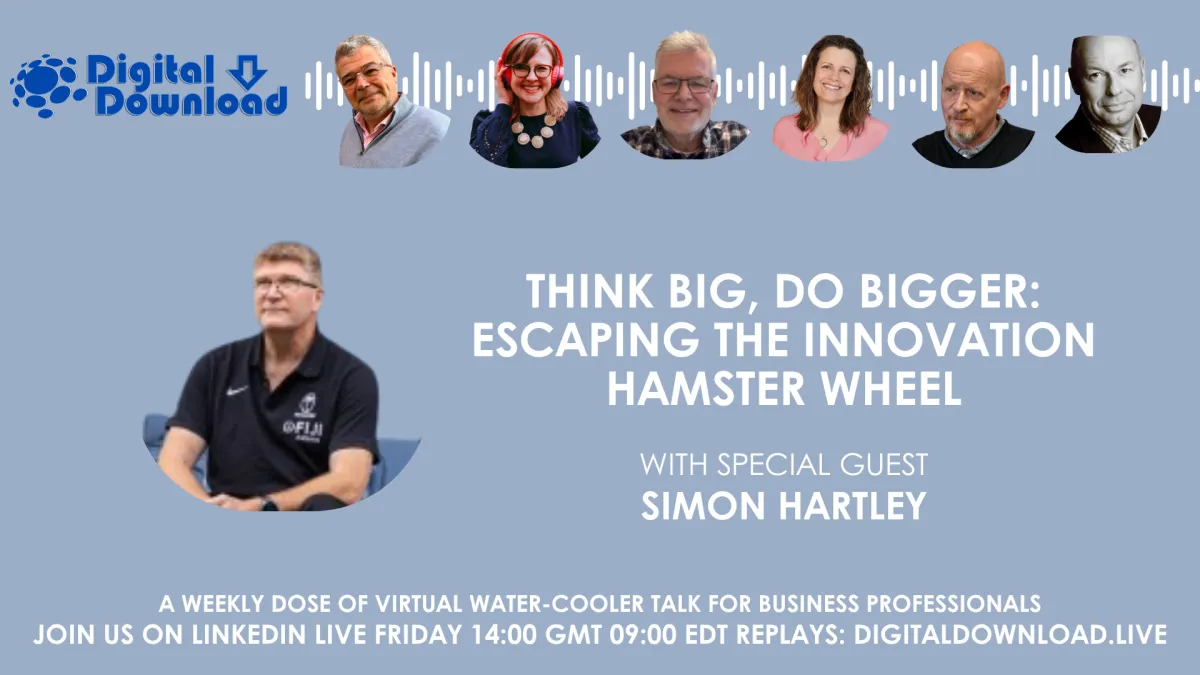
Think Big, DO BIGGER: Escaping the Innovation Hamster Wheel
This week on The Digital Download, we are stopping the endless strategy meetings and getting to work.
Corporate environments love to "Think Big." We talk about disruption, we host innovation workshops, and we build massive slide decks. But when it’s time to actually pull the trigger, too many teams get stuck on a hamster wheel of planning and endless conversations.
How do you shift from just talking about innovation to actually doing bigger things?
To answer this, we are thrilled to welcome a very special guest: Simon Hartley. Simon is an elite sport psychology consultant who coaches individuals, teams, and leaders to perform at their absolute best. For almost 30 years, he has worked with top-tier athletes in Formula One, Premiership rugby, and the Olympics—helping them amass around 50 world championships and records.
Simon joins Tim Hughes, Adam Gray, Tracy Borreson, Helen Mackenzie, and Richard Jones to translate the mindset of elite sports into actionable business execution.
We will unpack:
* The Execution Gap: Why businesses get stuck on the "hamster wheel of innovation conversations" instead of taking action.
• The World-Class Mindset: How to adopt the mental frameworks used by championship-winning teams to deliver on your full potential.
• Silencing Your Demons: How to overcome the corporate fear of failure that keeps teams paralyzed in the planning phase, drawing on concepts from Simon's book, Silence Your Demons.
• Peak Performance Every Time: How leaders can coach their teams to stop theorizing and start delivering consistent, world-class results.
Join us on August 14th to learn how to turn your biggest ideas into world-class reality.
We strive to make The Digital Download an interactive experience. Bring your questions. Bring your insights. Audience participation is keenly encouraged!
This week's guest was
Simon Hartley, Founder & CEO of Be World Class Group, Author, Keynote.
This week's Host was
Bertrand Godillot, Founder and Managing Partner of Odysseus & Co, Co-founder at Azpertilo.ai
Panelists included
Tim Hughes, Co-founder and CEO of Azpertilo.ai
Adam Gray, Co-founder of Azpertilo.ai
Tracy Borreson, Founder and CEO of TLB Coaching & Events, a proud partner of DLA Ignite
Helen Mackenzie, a very proud Azpertilo.ai partner.
Transcript of The Digital Download 2026-02-20
Bertrand Godillot [00:00:02]:
Bonjour à toutes et à tous et bienvenue dans ce nouvel épisode du Digital Download.
Helen MacKenzie [00:00:07]:
Oops.
Bertrand Godillot [00:00:08]:
Good afternoon, good morning, and good day wherever you may be joining us from. Welcome to another edition of the Digital Download, the longest-running weekly business talk show on LinkedIn Live, now globally syndicated on TuneIn Radio through ABGR, the world's number one business talk news and strategy radio network.
Bertrand Godillot [00:00:26]:
Today on the Digital Download, we're stopping the endless strategy meetings and getting to work. We have a special guest to help us with the discussion, Simon Hartley. Simon is an elite sports psychology consultant who coaches individuals, teams, and leaders to perform at their absolute best. But before we kick off the discussion, let's go around the set and introduce everyone. As we're doing this, why don't you in the audience reach out to a friend, ping them, and have them join us? We strive to make the digital download an interactive experience, and audience participation, as you know, is highly encouraged. Helen, do you want to kick us off, please?
Helen MacKenzie [00:01:08]:
Uh, yeah, thanks a lot, Bertrand. I'm Helen McKenzie, proud associate of DLA Ignite and contemplating whether I'm gonna join Asbatillo as a tech versus tech bro, in case anyone was wondering. Mama, perhaps I should have said mama.
Bertrand Godillot [00:01:27]:
Tracy. Thank you, Ellen. Tracy.
Tracy Borreson [00:01:30]:
Oh, good morning, everybody. Tracy Borison, founder of TLB Coaching and Events, a proud partner of DLA Ignite, and our resident authenticity champion, uh, in the room. I love a good conversation about how to get off the hamster wheel of anything, Fun fact, I was actually in London last October attending one of Simon's events, which is the reason I got to meet Adam in person. There's lots of good digital download vibes happening on this panel.
Adam Gray [00:02:00]:
Had you already met Tim at that point?
Tracy Borreson [00:02:02]:
I had because Tim had been in Calgary.
Tim Huhges [00:02:05]:
I came out to stalk Tracy in Calgary.
Bertrand Godillot [00:02:09]:
Adam.
Adam Gray [00:02:11]:
Hi everybody, I'm Adam Gray. I'm co-founder of DLA Ignite. and co-founder of aspetillo.ai, your employees' authentic voices, your company's strategy scaled safely. I'm very much looking forward to this.
Helen MacKenzie [00:02:26]:
Taglines!
Tracy Borreson [00:02:28]:
Can we just celebrate that tagline? I haven't heard it yet.
Helen MacKenzie [00:02:30]:
It's good. I like it.
Bertrand Godillot [00:02:32]:
Excellent. Tim?
Tim Huhges [00:02:35]:
Yes, thank you. Welcome, everybody. My name is Tim Hughes. I'm the CEO and co-founder of aspetillo.ai. Also famous for writing the book Social Selling and Influence: Using Social Media for Cold Outreach and New Business Sales.
Bertrand Godillot [00:02:53]:
Thank you very much, Tim. And myself, Bertrand Godillot, I am the founder and managing partner of Adisuse Co. and a co-founder of Espertilo.ai. I don't know the tagline yet, by the way, Adam, so you'll have to share that. As I said, this week we will talk with Simon. For almost 30 years, he has worked with top-tier athletes in Formula 1, Premiership Rugby, and the Olympics, helping them— sorry, helping them amass around 50 world championships and records. Let's bring him on.
Tim Huhges [00:03:35]:
Welcome, Simon.
Simon Hartley [00:03:37]:
Thank you very much. Thank you.
Bertrand Godillot [00:03:40]:
Hello, Samuel. Why don't we start with having you telling us a little bit more about yourself and what led you where you are today? Yeah, sure.
Simon Hartley [00:03:49]:
I'm in sweltering hot North Yorkshire in the north of England. My background is sports psychology, as you said, working with sports teams and athletes, helping them to win medals and trophies and championships. But my real passion has always been to figure out what makes the best in the world different. What do they do differently? How do they think differently? How do they take on challenges differently? How do they negotiate risks differently? And I don't do it just because it's interesting, although it is genuinely very interesting. I do it to help people adopt those principles for themselves and be able to become great at whatever they do.
Bertrand Godillot [00:04:28]:
Excellent. Well, thank you for that intro, Simon, and we are going to start with what we call the foundational questions. So here we go. Why businesses do you think get stuck on the hamster wheel of innovation conversations instead of taking actions?
Simon Hartley [00:04:46]:
Yeah, it's a great question, and actually you could widen the question to why do human beings get stuck talking about things rather than actually doing them? But in business, I don't think there's one point at which we get stuck. I think there are several. If I think back in the journey, do we actually recognize and identify the need for change? Do we actually pick our heads up often enough and say, does this thing work? Should we really change it? Is there a better way? And a lot of people are so kind of head down in the mire, they've got so much stuff going on, they're overwhelmed, the bandwidth is stretched to breaking point already, they're They're driven by their targets, their KPIs, their priority, whatever is in front of them, and it's usually a very, very short-term thing in the corporate world. And so lots of people don't even lift their heads up to look. And even if they do look, do they think, oh, you know, I'm already exhausted and I've got so little bandwidth, I'll get around to that tomorrow or next week or next month? If they've seen it and they're not a senior member, do they have the courage or the permission or the scope to put their hand up and say, I think I've spotted something? That we should be changing, that we should be doing differently, or there's an opportunity in front of us, or even I've had this really bold idea about where our market's moving and I think we could do with a radical change. I mean, if you think about how commonly those things happen in business, in my experience, they're actually pretty rare, and that's just getting us off the blocks. That's not turning ideas into reality. That's just capturing an idea or a thought or a challenge in the first place.
Simon Hartley [00:06:35]:
So I think that's maybe where we get stuck before we even start generating ideas and before we even start trying to turn them into reality.
Tracy Borreson [00:06:45]:
If I could add something there, because that makes me think— I'm thinking about the visual of the hamster wheel, right? And one of the things that I think also happens is we get caught up in this We're moving, right? We're moving. So that's the point, right? Like, we should be doing stuff. We're doing many things. We're checking boxes. We're attending events. We're whatever your list of things are, right? Then we're doing a lot of them. And now we have AI so we can do more of them, which really makes hamster wheels spin faster, right? But we still don't go anywhere. And so being able to stop long enough to understand what's the difference between movement, or how do we define movement versus momentum, right? I think that like forward motion is something that if we're just checking movement, this happens in marketing a lot, right? Like people track tasks.
Tracy Borreson [00:07:39]:
How many emails did we send? How many posts did we post? How many? How many? And it just is like, just Yeah. But it doesn't actually take us anywhere. And we didn't stop to ask whether or not it took us anywhere.
Simon Hartley [00:07:54]:
And are we closer to something meaningful, something important? And the answer is often we're not, but we don't realize that we're not.
Tracy Borreson [00:08:04]:
Well, like you said, do we have the confidence to be able to say we did all this stuff and it didn't move us any closer? to our target because that sounds like we could sound like we failed, right? Like what we're doing isn't working. Instead of being like, okay, we're all committed to going here. What we've tried didn't take us there. So what else can we try that will take us there instead of getting stuck or even like defend? Because I've been in corporate cultures too where that now you're like defending, right? Like, well, it can't be me who was wrong. I'll get fired, right? So like now I just like Distract. Instead of taking ownership, we distract, and then we don't actually go anywhere else, still stuck on the hamster wheel.
Simon Hartley [00:08:47]:
Yeah, and I think there's the corporate version of that many people can understand because you're right, people get defensive. Actually, I think even solo entrepreneurs have a version of this, which is that they kind of become defensive. They defend against themselves, if you know what I mean. They're busy doing stuff and they want it to be productive, they want it to take them in the right direction, it was their plan in the first place. Who comes up with a stupid plan? Therefore, if I came up with it, it can't be stupid, right? And therefore, sometimes we don't even self-examine whether we're moving forward or whether we're moving our feet very, very quickly, getting exhausted but essentially standing still.
Helen MacKenzie [00:09:33]:
And I think one of the things that I see in some of the work that I do at board level is, just to bring it back to the corporate, is around risk appetite and how it's not a level playing field, how you judge risk appetite towards status quo versus something new. So I think status quo gets— that's doing what we've always done on the hamster wheel, you know, gets a lot less tough of a ride when we think about risk appetite. It feels less risky than getting off and trying something new. So I do think that, you know, when you're evaluating options, something that you're doing already, that you can measure already— talking about Tracy and her marketing metrics— feels less risky than actually getting off and doing something that you don't know that will necessarily work, but feels like the right direction because what you're doing right now isn't working. So I do think that we, in the corporate world, we don't measure things in the same way. And I think that does affect how the corporate psyche feels about failure. It's more excusing of failure where it's the status quo, whereas it's harder judging On failure when it's something new.
Simon Hartley [00:10:53]:
Yeah, I've reflected often that I think entrepreneurs tend to have a different view on this, and they will ask what's the risk of doing, and there is always a risk of doing, but they'll ask what's the risk of not doing. And actually, the risk of not doing anything can be higher, and sometimes it's because, you know, not doing equals stagnating, not doing equals getting overtaken. And you're right, if we don't really have a clear view of the risk of not doing, we might opt to stand still thinking that that's the safest option, but actually it may not be. And I can remember actually years and years ago I was working with a swimmer, and he was a very, very high-level swimmer, he was an elite swimmer, and he had a really difficult decision to make at one point. He was going to throw out kind of 66% of everything that he was doing in search of a better way. And the 66% that he was throwing away hadn't made him a failure. It had taken him to the most successful point he'd ever been. And it's easy to throw away things that are failing.
Simon Hartley [00:12:00]:
It's not easy to throw away what you've got that's made you as successful as you are in search of something that's going to take you further. And, and that, I think, is a really interesting dynamic for lots of people.
Tim Huhges [00:12:14]:
But Bertrand tells a story often, because I don't— Bertrand's an elite golfer. And, and he was saying that he's actually changed his golf swing, was it 3 times or something, Bertrand? And what he found every time that he changes is he actually gets worse. before it gets better.
Bertrand Godillot [00:12:37]:
Yeah, very classic one. Uh, 2 things that I would like to come back to, uh, that you said, Simon. The first one is, you know, you're not necessarily into a senior position, and I identify— so first of all, you need to identify that you are an ID, basically, because things are changing. And I think it, it goes back to what leadership, a certain form of definition, of leadership definition. You've identified that things are changing and you've got a great idea. Assuming you're not into the leadership position, how do you make that happen?
Simon Hartley [00:13:19]:
Yeah, I think there's an opportunity that we've all got. But some people, I think, are probably more able to take the opportunity than others. I think right at the beginning of curiosity, at the beginning of this journey of curiosity, is what I call a moment of wonder. And it's that moment that we all have where we go, oh, I wonder how that works, I wonder why that happens, I wonder why we do it like that. Sometimes it's because something doesn't stack up, sometimes it's because there's a gap between what we know and what we want to know, but it creates that little tension. And some people capture that moment of wonder and some people let it pass. And some people go even further and they take that moment of wonder, they capture it, and they sort of bind a question around it. And maybe they just hold on to that question for a little bit longer.
Simon Hartley [00:14:13]:
And as they hold on to it for a little bit longer, it unsettles them because maybe we should know, maybe I should find out. And when we do that, we've got— I think of that as a little spark It's not a flame yet or a fire, it's a little spark, but if we wanted to take that even further, we'd have to start investing into that. And that's the first little step that anybody, not just leaders, anybody can make. Now, one of the reasons that I think we maybe end up on the hamster wheel and we don't then progress things further is that lots of the little stages after that require courage. Because whilst it's just a question in our own head or an idea or a thought, it's quite safe But as soon as it steps out of our head, if we put a voice to it, we're stepping into some potentially dangerous territory. People could laugh, people could close us down, people could fire us for saying the wrong thing, we could get excluded. You know, that there's a social risk which is very real because we're human beings, we're kind of wired for belonging, aren't we? If we, if we were ejected from our tribe and thrown out into the wilderness, we'd be in danger. So we feel this innate need to belong, and of course that creates a social risk.
Simon Hartley [00:15:34]:
So are we willing to put a voice to this thought or this question or this challenge or this idea that maybe we need to break the status quo, or do we keep it nicely safely locked inside our own head? And maybe that little spark— if we think that could become dangerous, maybe we just squash it down and extinguish it because that's the safer option.
Tracy Borreson [00:15:58]:
I think, like, one of the things that I've also experienced is, like, my own personal desire to not assume, right? So I was actually at— on site with a client, and I was, like, I was waiting to go into a meeting, but then I was listening to what was happening in the meeting.
Helen MacKenzie [00:16:17]:
The door was open.
Tracy Borreson [00:16:19]:
And they're talking about something I know a lot about. And so then, I'm like sitting and listening and be like, well, I'm not invited to this meeting. I haven't been asked my opinion, right? So like, I think this and like, I feel like maybe it's risky to not say what I know. And I didn't during the meeting. But I did bring it up later in what I considered a, like, safer environment. So not in front of everybody in a room I wasn't invited into, but with one of the parties that was in that conversation. And then the thing that was really interesting about that is it was like your own internal process of that question, like, do I say something?
Helen MacKenzie [00:17:06]:
Yeah.
Tracy Borreson [00:17:07]:
Like, I got the wonder, I've got the the spark. And I, I think I have enough personal confidence to know that I have something valuable to contribute in this scenario. Will I?
Bertrand Godillot [00:17:22]:
Yeah.
Tracy Borreson [00:17:22]:
And, and that's the question then. Are we taking ourselves up on that opportunity to— will I? Because we are putting— it's a risky scenario. I haven't been asked. This is a senior member of the team, right? Like, I don't really think, if I really play it out in my head, I don't really think me saying something is going to like endanger my role or anything like that. But like, there's that risk. And are we going to understand that there is a risk and say yes anyway? And I will say, in my experience in doing that, which is where I think people get the experience and they just start doing it more naturally, every single time I've done it, it has added value.
Simon Hartley [00:18:03]:
Yeah.
Tracy Borreson [00:18:03]:
Whether that means it takes the conversation in a different direction, whether it means it creates what needed to be known to make a decision, it has always been good and it has always been celebrated by the other parties. And I think if a lot of people ask my early bosses, like when I was young in my career, I didn't always do it maybe in the best way. I've learned different strategies over time, but I've always like taken the risk. And I think that that's what you're speaking to, Simon, with even— and Helen, you were talking about like, how do people manage risk? There are some people that are just like, I'm more willing to take that risk than some other people. But then when we talk about innovation, I think that buries a lot of ideas because we're waiting for somebody to have the confidence instead of maybe from a leadership perspective, inviting people to the table to share their expertise.
Simon Hartley [00:18:59]:
Yeah, and inviting them to openly challenge what we've got and give them a space that feels safer. Absolutely. But interestingly, I think the psychological comfort element of all of this plays a huge role. So whether we feel safe or not, whether it looks like a risk, whether we've got the courage to do it, that's one element. But I think there's another element that also squashes innovation, And that's that innovation often requires time. It requires us to what I describe often as hold the question open, hold space for what if, not close it down and try and dash for an answer too quickly. But of course, the world likes certainty, human beings like certainty, corporate environments reward certainty often. We want an answer, we need an answer, we don't actually leave the question open long enough to explore it because if we're going to get innovation we need time to actually explore things, to try new possibilities, to imagine new futures, to come up with some stuff that might be bold, might be out of the box, that's all going to require time and if we need answers now and if leaders feel like it's almost their duty provide an answer and to provide certainty now, we're going to crush innovation.
Simon Hartley [00:20:24]:
We're literally going to squeeze it out of our timeframe here. So I think there's some psychological comfort or discomfort around that, which if we're not careful, could also extinguish innovation.
Adam Gray [00:20:38]:
But how do we balance these 2 opposing concepts? Because I've worked in organisations that have been incredibly innovative and never got anything done because they were so busy innovating, they innovated the innovations and nothing ever got to a point where people go, okay, that's what we're going to run with. But equally, I've worked in organizations that have been successful, but within that window of, you know, there's relevance to— if you were making horseshoes 150 years ago, you had a job for life, or so you thought, and it turned out that that wasn't the case. So, you know, they're successful in that particular moment or for that particular period, but you could maybe see the end of the road coming and needing to change. So how do you balance those 2 things? Because you either get stuck and never change, or you're forever changing and never achieve anything.
Simon Hartley [00:21:30]:
Yeah, that's a really, really good question. I mean, having an understanding, as Tracy said earlier, about where we want to be going, what actual progress looks like and does, I do think, guides that to a certain extent. Equally though, I mean, I'm a huge fan of being focused and knowing what we're working towards, but equally I do know that when people play, genuinely play, they sometimes find answers they weren't expecting that take them off in a completely different and better direction. And if I look at some of the great innovations in history, they weren't intentional. It was a result of somebody noticing. Penicillin is a great example. Penicillin didn't come into being because a biologist was looking for the answer. They just noticed that on the edge where there was this sort of this juice, that pathogens didn't form.
Simon Hartley [00:22:29]:
I was like, oh, why there? I mean, that's curiosity at work. Why there? And, uh, and, and if we could extract some of that, would it also kill other pathogens? Wow, what have— what have we found here? Can we replicate this? Could this become medicine? It was the same, um, if you look into the event— invention of the microwave oven. You know, it, it occurred because somebody was playing around with some radar equipment and their chocolate melted. They're like, oh, Would that happen if I put an egg in here as well, or popcorn, or whatever? What's happening? My goodness, these waves are cooking things. And so they weren't looking to invent an oven or an alternative form of cooking. So there is almost a danger to being too focused, I think, sometimes. But if we just innovate for the sake of innovation, we might come up with some really interesting stuff that doesn't take us forward, I agree. And I think that's— call that a dialogue within leadership, conversation, dialogue around this.
Bertrand Godillot [00:23:37]:
I think there's a great question from Mark, and maybe Adam or Tim, you want to take it? Yeah, Mark ties very well into the discussion.
Tim Huhges [00:23:47]:
Yeah, Mark asks a question. Mark Crosby asks a question. So in a corporate environment, what is some practical advice of how to nurture a culture to challenge the status quo on a regular basis and not just in a workshop?
Simon Hartley [00:24:08]:
Yeah, great question.
Tim Huhges [00:24:10]:
Great question.
Simon Hartley [00:24:11]:
I would ask, how do we have conversations, regular conversations about that stuff? And not necessarily, you're right, in a workshop environment or even between leaders and people. How do we get people talking to people about it? How do we build it into the fabric of our conversations on a regular basis? And one of those things that I often do within elite sports environments is encourage people to reflect on the performance on a regular basis, talk about how well we're training, what could we do better, How can we prepare better?
Tim Huhges [00:24:47]:
Just—
Simon Hartley [00:24:48]:
and not just for the 1%, but sometimes for the larger chunks, you know, things that we could really do differently. And keep that conversation flowing throughout the whole of the organization. So sometimes it will be with a coach in the room, sometimes it won't be. Sometimes it'll be with one of the senior players in the room, but sometimes it won't be. Sometimes it'll be just a couple of players leaving a training session, walking off and saying, should we have a chat to the fitness coach about doing the warm-up a bit differently? And if we can get that kind of conversation going on, this is likely to become more cultural.
Helen MacKenzie [00:25:29]:
Yeah, and I think, you know, from my experience of a team of 50 people, what, myself and the leadership team did was to, well, to nurture a culture where any suggestion about anything to do something better, differently, was welcomed. But also to act on that and to make that happen. So it could be anything like, why don't we stagger lunch breaks? Or why do we have to answer the phone all the time? Why couldn't we have times where we just put the phone to voicemail and then we can get more work done? Through to you know, bigger things, um, big transformational things. But also, I think that one of the things that we did was try to storytell around that within the, within the team. So it's not just that you've got the bright ideas, but also that you're reflecting back with the team at, you know, just a coffee break or whatever, that, that one of the, the leader or supervisor would say, you know, that was a, that was a great idea that, that Adam had this week about about this, and we've, you know, we've made that happen. And, you know, thanks to Adam for, for the suggestion. Or, or even, you know, for me, I had a bright idea about something and somebody in the team, you know, had a look at it and told me, um, that it wasn't, it wasn't worth doing, but it was good that we— that I thought of it and that, that you, you were able to challenge it. So I do think leadership's got has a responsibility, back to Mark's question, about just trying to make that the way that we do things, but it's not a big thing, it's about how you embed it into how you do things, but also how you reflect it back.
Adam Gray [00:27:16]:
But it can be a big thing, can't it? Because, you know, you can consciously engineer this into how you operate. So the new Apple headquarters is a great example of this, where the bathrooms and kitchens are quite a long way from where people sit, not because they're trying to minimize costs, because obviously that's the most expensive building ever made, but because they want people to have to traverse through the office to go to these communal places, so that as I'm walking past, I say, oh, hi Simon, I haven't seen you for a while, I've just got this idea, what do you reckon? And clearly, you know, it works for them. And whilst we can't all build build a huge doughnut-shaped office that we live in. There is an opportunity for us to consciously engineer these things in, I guess, isn't there?
Simon Hartley [00:28:04]:
Yeah, and if you think about how conversation flows, leaders could start by not getting everybody together and saying, right folks, how do you think we can improve stuff? But maybe having some one-to-one conversations, particularly with those who they think are less likely to volunteer that in an open public environment. And just sparking a couple of those, I often try when I'm working in environments, try and maybe catalyse some of those, you know, be the catalyst for them, but then step out and see whether they can work without my input, and then see if we can get the leaders to step out and it works without their direct input. You know, just step back a little bit further, but make sure the wheels are turning.
Tracy Borreson [00:28:52]:
I think one of the things that comes up for me in Mark's question too is the word nurture. Because I've mentioned it on the show before when we talk about nurturing and like email funnels and things like that. If you don't have a— look at it like it's a plant. If you don't have a seed, you don't have something to nurture. You have to have something to nurture. And I think when it comes to culture, a lot of times people aren't looking at what their systems and processes are telling people. As we have a system for this, we have a process for this. We like, we report every single time we're going to be out of the office to go to run an errand.
Tracy Borreson [00:29:33]:
And you're like, wow, okay. I'm not saying any of that is bad, right? But like when employees then get into like, I'm reporting this because somebody supervises me versus I'm reporting this because I'm keeping the team in informed because I'm a critical member of the team and people might need to reach me. There's a lot of that underlying mindset we don't control. And so, if we're not looking at— and we can't control, right? Like, humans control their own mindset. And so, if we're not looking at what our systems and processes are telling people what they're doing and how it's related to how we run the business, then— we don't understand what the seed is. And so, we can unintentionally nurture the wrong thing.
Adam Gray [00:30:21]:
Yeah.
Tracy Borreson [00:30:22]:
So, coming into an environment where people think that they have to report everything because the systems and processes tell them they have to report everything. And then, a leader telling them, I want new ideas. The more new ideas you share, the better. And the leader actually believes that. The leader is not lying. The leader wants those new ideas. But the systems and processes haven't taught the team how to do that. So I think it's important to look for the seeds before we talk about what are we actually nurturing.
Simon Hartley [00:30:53]:
Yeah. And sometimes things can be built into systems and that's not a bad thing. But if we rely on the systems, then we might unplug ourselves from the thinking that we really need. And my understanding here, what I've learned over the years, is that if leaders are really curious themselves about how we can do things better, they'll ask that on a more regular basis, they'll spark more conversations about that, they'll share their own ideas, they'll pull out ideas from other people, they'll circulate ideas, they'll build on ideas. They'll do that because they are curious. If they're relying on our innovations meeting because it's in the diary and it's part of the system and the structure and everything else, then they, when they get there, they may not actually ask some very good questions. They may not actually draw the ideas out of people. They might not actually create a little culture, mini culture within that setting that allows people to share their thoughts, ideas, challenges, etc.
Simon Hartley [00:31:54]:
And so, so the structure is great and it's fine. But if the leader was curious, I suspect a lot would flow from there. Yeah, without the structure and the processes, it would just naturally flow.
Helen MacKenzie [00:32:05]:
Because I sort of went through a phase where I was a new leader and I was reading books and books and books. They're all— a lot of them are behind me. And they used to dread the Friday team meeting because I'd come in and say, I was reading this thing in the book, can we try it? I was reading this thing in the book, can we try it? Luckily for me, I had a, a team that were— would— that indulged me, or perhaps they just indulged me because I was the boss. But I do think that helped them to feel a bit more curious because I was curious. Now, I, you know, would lend them these books and they wouldn't read them and things like that, but on the other hand, it shows an appetite for doing something different. And I was having a call this week with somebody and It was, it was quite sad, actually, because they were out in the field talking to prospects about things and ideas and what the prospect actually needed. But what the organization felt that they were going to be delivering was totally different. And he was very sad that he didn't operate in a corporate culture, I think, where he felt that he could actually safely raise that without it being you know, totally off the mark, and perhaps that being the beginning of the end of his career in sales, really.
Helen MacKenzie [00:33:23]:
So, you know, I think it is difficult to be brave. I think we spoke about that at the beginning, didn't we?
Simon Hartley [00:33:29]:
Yeah, and, you know, even if we get to the point where we do have ideas flowing from people, the ideas are only the first step, of course. We were talking about the hamster wheel of innovation and why sometimes We've got plenty of talk, but we haven't actually got any movement, forward movement. There's a huge gap between ideas and stuff that's in reality. You know, we've turned the ideas into something real, and that, I think, is probably the tougher part of the exercise for many people. I mean, I know lots of entrepreneurs who've got billions of ideas. The ideas are not the difficult bit. Turning the ideas into reality is the difficult bit. that's where all of the challenges, all the hurdles come from really in that process.
Simon Hartley [00:34:19]:
And if you think about the likelihood that your idea is going to be successful first time, it's pretty small because the idea is just pictures in our heads really. That's not real, that's just images that we've got, usually conjured up by our imagination. To turn them into something real and have that real thing become successful is a totally different challenge altogether and it requires quite a different skill set, I think, as well. So when I look at it, I don't see a single skill set for innovation, I see quite a lot of different tools.
Bertrand Godillot [00:34:56]:
So we talked about courage, but— and I think you actually mentioned that some of that is about our own mental blocks. So how do you get that sorted out?
Simon Hartley [00:35:12]:
How do we build courage?
Bertrand Godillot [00:35:15]:
Yeah, well, how do we overcome some of our, you know, own mental limits? Are there any secrets that you could share?
Simon Hartley [00:35:25]:
Well, there are 2 ways that I look at developing courage and overcoming fear. The first, if we look at fear, the first is to understand that most fear is imaginary. It's, it's not something that's real and right in front of us. It's something that we imagine could happen, that might happen. And I give people often a little example. If you were swimming in the sea off the coast of California or South Africa, and you saw this big triangular shape coming through the water, this fin coming out of the water, and you heard the Jaws music playing in your head, what are you scared of? And the headline answer for most people is they're scared of the shark. The truth is you're scared of what the shark might do to you, and what it might do to you is in the future. And it's the same if you think about what, what might happen if I voice this concern, or share this thought, I might get ostracized from the group, I might get verbal barrage from my boss.
Simon Hartley [00:36:31]:
Because it's, it's what might happen, it's in the future. And the only way we human beings can ever experience the future is through our imagination. So it's imaginary. So if we can understand that it's imaginary, we might be able to change our relationship with that fear. Equally, if we would like to develop courage— courage is our ability to step towards the things we're scared of. And the only way we'll ever flex that muscle and develop courage is by continually stepping towards the things we're scared of, even though we're scared of them, because we're scared of them. And if we do that time after time after time, our little muscle gets stronger. And we become a more courageous person.
Simon Hartley [00:37:15]:
And if we do it in multiple different domains, we start to understand that our courage isn't narrow, it's not purely a contextual characteristic that we've got in one certain circumstance. If we do it in lots of different areas, we start to understand ourselves as a courageous person, see ourselves as a more courageous person, and as a more courageous person, we're more likely to step towards the things that we're scared of. So we can start to both change our relationship with fear and develop courage in combination if we like. If we, you know, if we, we have to drive that, of course.
Adam Gray [00:37:55]:
It's, uh, frankly, I'm still getting out of the water though at this point.
Tracy Borreson [00:38:00]:
Well, I think, I think I've shared this on this show before, and honestly, it's like what I feel is one of my biggest parenting wins is that like when Nicholas was in kindergarten and we were standing in like the vestibule and he didn't want to go into the class. And I couldn't verbalize to me what he was afraid of, but he was afraid. He's afraid of something, right? That's why he doesn't want to go in. And so I asked him if we could practice being brave today. And he thought about it for a minute and he was like, yes. And he took his lunch kit and he went into the classroom. And I was like, that Right? Like, we aren't just brave. We only can practice our bravery muscle in the face of fear.
Adam Gray [00:38:44]:
Yeah.
Tracy Borreson [00:38:45]:
So fear is not bad. Fear is good. It gives us the opportunity to be brave. And at the end of the day, we have to be the ones to take the lunch kit and go into the classroom. But at the same time, it's also really powerful to be surrounded by people who are asking you, Can we practice being brave today? There's nothing wrong with you being afraid. And would you like to practice being brave today? I mean, I didn't have that as a young employee from a leader. And like, as a leader now, it's one of the things that I think is the greatest gift that leaders can give to people is that like, you don't know if you're going to be right. And I don't know if you're going to be right.
Tracy Borreson [00:39:26]:
And should we practice?
Tim Huhges [00:39:27]:
it anyway?
Bertrand Godillot [00:39:29]:
Yeah.
Tracy Borreson [00:39:30]:
What if we did? And just like Helen mentioned, right? Like when a leader is leading by example, when they are showing curiosity, especially I think I love when leaders don't come and just be like, I have all the answers. But more of the like, I have all the questions. Like, let's figure it out together. This is then what people see. And especially when you're like, I don't know if any of us can go back to our 20-year-old selves and think about if we had seen that from a leader, how much space it would have given us. Even whether it was all the way to permission, but at least the belief, right? The belief that that is available. We might not have given ourselves permission yet, but it's available. People are doing it out in the world.
Tracy Borreson [00:40:15]:
Maybe I could do it too. Again, this is why I love to look at it as an invitation. Right? Like, our behavior can invite other people to get off the hamster wheel. We can be like, hey, we're like over here, not on the hamster wheel. And if you would like to come over here and just like see what it's like, you can always go back, right? Like, you always go back to your hamster wheel, but maybe just come over here, see what it's like. And then that's the— that's— you want to practice being brave, getting off of your hamster wheel?
Simon Hartley [00:40:46]:
Yeah, and there's a real opportunity, I think, for leaders to just enable people to play with ideas and solutions. We don't have to create the perfect solution first time if we're trying to innovate here. Let's just play with some things, let's just imagine different possibilities. We'll stretch it as wide as we can, we're going to refine it back again, that's fine. You know, we're going to come up with maybe a few solutions and then back one of them perhaps, but let's give each other permission to play here because if you watch kids when they are playing, there is no fear because there's no definition or defined boundary of success and failure, right and wrong or anything, they have permission to play and in doing so we allow people to be really creative. So we can create those and we can expand out the ideas. The other sort of characteristic that I think is really important and helps us to turn thoughts, ideas, maybe even solutions into tangible outcomes is we have to experiment in this process. We have to put it through iteration 1 and then iteration 2 and 3, you know, and that's not new within innovation.
Simon Hartley [00:42:03]:
But what I think might be for some people is the ability to truly explore and to— and that characteristic that we could start to flex, become an adventurer, be adventurous.
Helen MacKenzie [00:42:17]:
And I think that leads, you know, leads me back to in the corporate environment, it's really important that you understand the risk appetite for all of that because, you know, one of the things that we've done on the, on the board of the housing association that I'm on is, is, is be really clear about our risk appetite, particularly around innovation in particular areas. So there's some areas we just don't have a risk appetite at all. We have a very low risk appetite for people going on an adventure, but we've been very clear about that, and so that's absolutely fine. Other areas we want people to innovate, so we've been really clear about that, and I think that that then leads us to think about what are the consequences for people when things don't work. Because if you're going to play, if you're going to be adventurous, some things will work and some things won't. So again, having— if you, if you're very clear about where people can play, let's call it that.
Tracy Borreson [00:43:16]:
Yeah.
Helen MacKenzie [00:43:17]:
And you're— then you're— and you, you understand what the consequences are. And they're not playing in areas where there are going to be huge, significant consequences. then I think that, that is really enabling as well. And I think that's, that's really important because otherwise you're, you know, you just, you're like a child where you're not setting them any boundaries. Like, you go and do that near the edge of the cliff. I'm thinking about where I am, you know, run where you like, there's no boundaries, just go and play. Well, actually, that's, that's not responsible in terms of managing risk. So I do think that's quite interesting.
Helen MacKenzie [00:43:52]:
I was, I was interested because Adam and Tim worked in a really, really big organisation. Was it in the areas where you were encouraged to be a bit more creative, was that— were the boundaries and the consequences clear, or did you have to sort of fly kite and be brave? Was it— or you just didn't do it at all?
Adam Gray [00:44:16]:
Certainly for me, we were selling a product into some some large clients, and it became very clear that the product was great, but the clients didn't really know how to use it. And I said to the VP, we need to sell consulting with this, because that's, A, it's the right thing to do, but B, it's another revenue stream. And I was told, no, we sell software licenses, that's what this business does. So, okay. that told me. And I think that there's a risk, and certainly Tim and I try to not bury any ideas until we've established whether or not they're good or bad within the business, because we always say we haven't got the monopoly on good ideas, don't we? We do.
Tracy Borreson [00:45:07]:
This is why we have panels like this, because then there's more good ideas.
Simon Hartley [00:45:12]:
Quick question for Bertrand. So you took your swing apart and put it back together, you've got to redesign your swing 3 times. When did you do it?
Bertrand Godillot [00:45:28]:
When I was willing to step to the next level.
Simon Hartley [00:45:34]:
And did you do it in the middle of a competition? major competition?
Bertrand Godillot [00:45:42]:
Well, that would have been a disaster because every single time my entire summer has been a nightmare. I was doing that between seasons, let's put it that way.
Simon Hartley [00:45:56]:
And if I look at how athletes answer this question, sometimes it's in a training session, sometimes there's a point in a 4-year Olympic cycle where we say, let's take everything apart. And it won't be 6 months before the Olympics because at that point we're trying to refine things down.
Bertrand Godillot [00:46:15]:
Yeah.
Simon Hartley [00:46:16]:
But we might do it 6 months after an Olympics when we still got 3 and a half years left of our Olympic cycle. When I think about golfers and tennis players, they will do it between seasons, not in the middle of a competitive season. They might tweak some things During a competitive season, but they're not going to dismantle their swing or their serve or whatever and put it all back together again, because that would be ridiculous. Like you say, that would be a disaster. So, so where and when we allow people to play and the boundaries we put on it absolutely are critical, or else we'd create chaos. But if we just keep rigidly doing things the same way we did yesterday, we're also going to create a different kind of chaos, we're just going to stagnate and go backwards. So I think the where and the when are important questions with it.
Tracy Borreson [00:47:08]:
There's also something that ties this back to the destination for me, right? And again, in sport, especially in Olympic athletes, right? Your goal is probably a gold medal, right? Silver and bronze are nice, but your goal is the gold. That's what we're all going for. When I look at a lot of the safe areas to play that happen in marketing, people will be like, subject lines, you can put whatever you want in the subject line of an email. But then there's also a huge disconnect between how that play actually turns into something meaningful. And so I think while I love your example, Helen, because Kids go to the playground to play or a field to play, not the cliff. We have like a water channel by our house, which it like creates electricity. And so it has like a huge undertow. If you fall in, you will die, right? You will drown.
Tracy Borreson [00:48:11]:
Doesn't matter how good of a swimmer you are. So the kids don't play there, right? This is an area where the kids do not play. So even foreplay, having that like safe zones is important. But I think it's also important to look at, have we made that safe zone too small? Because now I can't actually play in a meaningful way, right? I'm not playing towards growth. I'm not playing towards revenue. I'm not playing towards something better. I just am like— Like, here's this little box you can play in. but don't let your friends in.
Tracy Borreson [00:48:50]:
Like, now it's too small. And I just see that very often in marketing.
Simon Hartley [00:48:56]:
Yeah, and one of the sports teams I work with are a very, very creative team, the Fiji Rugby Sevens team. They're known for being incredibly creative and flamboyant, and that starts on the training field. In fact, it kind of culturally, it starts in fields, you know, just without posts or without lines on the field, they just play. And gradually it moves towards a training field, and then it moves towards a competitive training field with a stadium around it, and then there's a gold medal at the end of it. And each movement allows them to bring that creativity a step further. They hone it in one environment, and when it's working really well and they can trust it, they'll bring it into another environment and they'll hone it there, and then they'll bring it into another environment environment. And so at each stage, they're sort of battle testing it towards reality. They're not hoping that they can take it from a field with no posts and no white lines on the floor and just a bit of sand next to the road and all of a sudden import that into an Olympic final, into a major stadium.
Simon Hartley [00:50:05]:
But they will take it through little stages along the way. And I think we can kind of do the same with any element of creativity. We can get it much closer to our coalface, our sharp end, whatever that happens to be, our commercial output, but we don't have to lose the play that underpins it. We just have to understand how it all knits together.
Bertrand Godillot [00:50:30]:
Simon, this has been great. Thank you very much. Where can we learn more? Where can we find you?
Simon Hartley [00:50:40]:
You can find me at be-world-class.com. You can find me on LinkedIn. I would love to connect on LinkedIn. And the YouTube channel is @SimonHartley.
Bertrand Godillot [00:50:52]:
Okay.
Tracy Borreson [00:50:52]:
And fun fact, you can also find Simon in Calgary in April of 2027, because Simon and I are are doing an activation on how we actually think big, do bigger when it comes to innovation. So if you're in the Calgary area, or if you have always wanted to come to Calgary, this is a good time to do that. Just saying.
Simon Hartley [00:51:20]:
I would also say if you're on the planet called Earth and you fancy maybe even getting a flight to Calgary, we'd love to see you there. We are pulling people in from all over the globe. Let's Wow. So you don't have to be native to Calgary to come to this event, and there's a good reason why we've called it Think Big, Do Bigger, because that's exactly what we're going to be doing over the course of 2 days in Calgary.
Bertrand Godillot [00:51:45]:
Excellent. Well, certainly, you know, if I were in Calgary, I would attend.
Tracy Borreson [00:51:52]:
Yeah, man, I heard flights are not that expensive. Yeah, and perhaps if we think big—
Simon Hartley [00:51:57]:
I actually think there's a direct flight from Toulouse, maybe not to Calgary.
Helen MacKenzie [00:52:01]:
If we think big, we might be there.
Tim Huhges [00:52:04]:
But think big.
Bertrand Godillot [00:52:05]:
One of the things I'm taking away from the discussion: fear is imaginary. I love this one. Really cool. Really cool. Courage comes from practice. Pretty good as well. We need space to play. Thank you for this one also, Tracy.
Bertrand Godillot [00:52:26]:
And that certainly shed a specific light on the whole Azpertilo experience we've been going through in the last few quarters, but we'll come back to that another day. Okay, so we now have a newsletter. Everybody knows, everybody should know that. I'm sorry for this because I am probably going to— That's okay, Adam. You're still safe. If you want to know more about the show, the upcoming episodes, just flash the QR code on screen or visit us at digitaldownload.live/newsletter. With that, Simon, thank you very much. Thanks to our audience and see you next time.
Simon Hartley [00:53:06]:
My pleasure.
Bertrand Godillot [00:53:06]:
Thank you. Bye-bye. Bye.
Tracy Borreson [00:53:08]:
Thanks, everyone.#Innovation #PeakPerformance #Leadership #BusinessExecution #SportPsychology #B2BGrowth #LinkedInLive