
Previous Shows
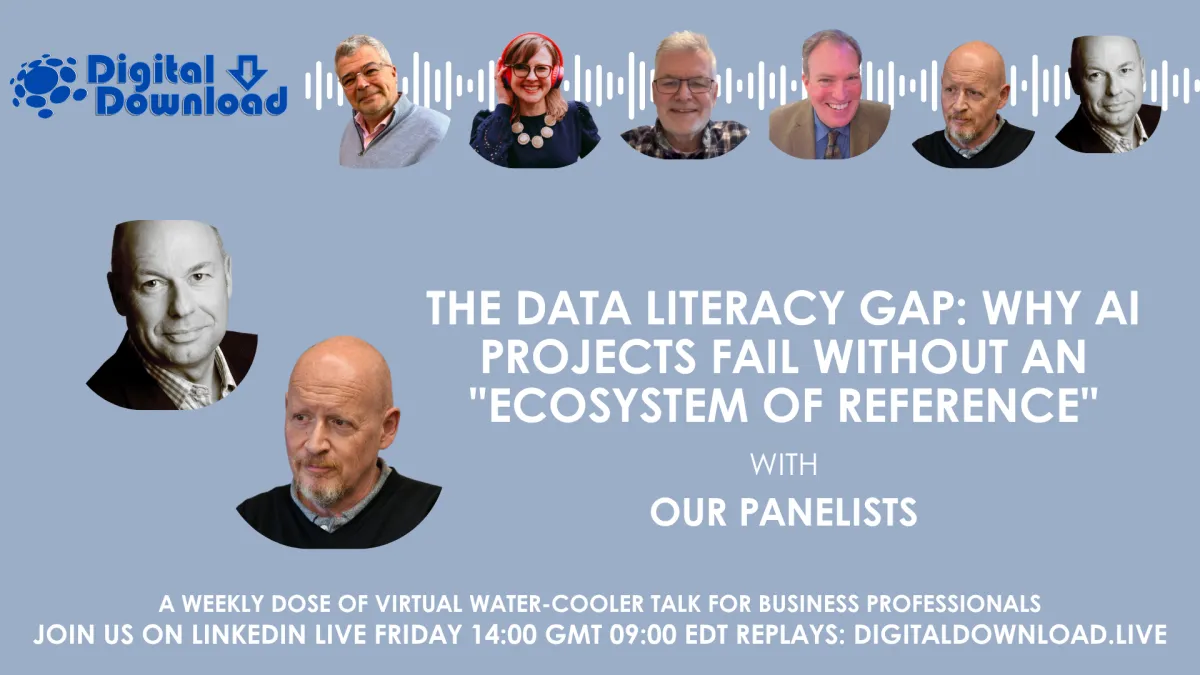
The Data Literacy Gap: Why AI Projects Fail Without an "Ecosystem of Reference"
This week on The Digital Download, we are tackling the silent killer of AI initiatives: The Data Literacy Gap. If 95% of AI projects are failing, the problem isn't the technology, it's the fuel.
Welcome to the era of Data Literacy. Most businesses are trying to power a jet engine with "fuzzy" marketing data and corporate brochures that are disconnected from reality. When the output is beige and generic, we blame the AI. We should be blaming our information strategy.
I am joined by Tim Hughes, Adam Gray, Tracy Borreson, and Richard Jones to discuss why the most important AI skill of 2026 isn't coding—it's knowing how to build and maintain your Ecosystem of Reference.
We will dive into:
The Three-Layer Moat: How to organize your Business Context, Professional Identity, and Voice to create a "Single Source of Truth" for your digital teammates.
Rich Data vs. Fuzzy Fluff: Why a two-hour recording of your leadership team is worth more than a thousand corporate PDFs (and how it can generate 15 perfect ICPs in seconds).
The "Jimmy Cliff" Hallucination: Why "trusting your AI" is a trap, and why critical judgment is the final, non-negotiable step of data literacy.
The BYOAI Revolution: Why "Bring Your Own AI" is the new "Bring Your Own Device" (BYOD), and the massive governance risks of an illiterate workforce building their own bots.
Onboarding the Scribe: How to treat AI as a high-level "Archivist" that mines your own knowledge rather than just repeating the internet.
Join us to learn how to stop being an AI consumer and start being a data-literate leader.
We strive to make The Digital Download an interactive experience. Bring your questions. Bring your insights. Audience participation is keenly encouraged!
This week's Host was -
Bertrand Godillot, Founder and Managing Partner of Odysseus & Co, a proud DLA Ignite partner
Panelists included -
Tim Hughes, Co-founder and CEO of DLA Ignite
Adam Gray, Co-founder of DLA Ignite
Transcript of The Digital Download 2026-03-20
Bertrand Godillot [00:00:39]:
Oops. Good afternoon, good morning, and good day, wherever you may be. Joining us from. Welcome to another edition of the digital download. We had some fun with Lyria this week, as you can say. So what is the digital download? The longest running weekly business Talk show on LinkedIn Live, now globally syndicated on TuneIn radio through ABGR, the world's number one business talk news and strategy radio network. Today on the digital download, we're tackling the silent killer of AI initiatives, the data literacy gap. If 95% of AI projects are failing, the problem isn't technology, it's the fuel.
Bertrand Godillot [00:01:21]:
But before. we kick off the discussion, let's go around the set and introduce everyone. We are missing Tracy today. While we are going this, why don't you in the audience reach out to a friend, ping them and have them join us? We strive to make the digital download an attractive experience and audience participation, as you know, is highly encouraged. So, Tim, why don't you kick us off, please?
Tim Hughes [00:01:51]:
Thank you. Yes, my name is Tim Hughes. I'm the CEO and co founder of DLA Knight, famous for writing the book Social Selling Techniques to Influence Buyers and Change Makers. And also just to say that we're going to miss Tracy today. She always provides a spark and an inspiration.
Bertrand Godillot [00:02:14]:
But we have Adam back with us and thank you, Toby, for underlining this.
Adam Gray [00:02:18]:
Adam, thank you to. Yes, I'm delighted to be here. I'm co founder of DLA Ignite and Tim's business partner. Back from a couple of weeks off as I had a bit of a health issue. But I'm. I'm on the mend now and delighted to be here because this is. This is, I guess, a burning topic for every organization at the moment, isn't it? You know, we see these shocking statistics about the number or the percentage of. Of AI projects that fail.
Adam Gray [00:02:51]:
I think discussing why that fail is a really important conversation to have.
Bertrand Godillot [00:02:58]:
And there are many aspects of this and many angles that hopefully we'll be in a position to discuss in the next 45, 50 minutes. All right, so today we're discussing how, as a team. Sorry, we're discussing as a team, of course, how the most important AI skills in 2026 isn't about coding. It's knowing how you build and Maintain your ecosystem of reference and obviously how as contributors and employees, we actually work with AI. And we'll, we'll discuss a little bit about this. Okay, so I've got a financial question to start with, and I'll probably start with the following. How do we organize business context, professional identity, and voice to create a single version of the truth for digital teammates? Who wants to take that?
Adam Gray [00:04:00]:
Well, I can certainly weighed in on that. So I think the issue, certainly the issue that we see when we talk to organizations is that AI has been lauded as some sort of savior for business processes. So organizations are told they can, just
Tim Hughes [00:04:22]:
like the Internet was.
Adam Gray [00:04:24]:
Just like the Internet was.
Bertrand Godillot [00:04:25]:
Yeah.
Adam Gray [00:04:26]:
So organizations are told that they can save 10, 15, 20, 25% of their time by deploying AI agents or AI tools to provide shortcuts for them. And that's a very compelling story to be told and something that, that we, all of us kind of feel. Well, AI can help me with that. I think that the thing that is overlooked, which is the point of that comment further to your, your, your question, Bertrand, the point is that when everybody has. Let's assume everybody uses the same AI tool. I mean, there are several out there, but let's assume everybody uses the same one, then everybody has the same language, same knowledge, the same infrastructure that is providing those shortcuts and those answers that they're looking for. And the challenge that we face is that in a world where we now have a turnkey solution to producing content, producing answers, producing RFPs, producing responses, all of those are the same. And in that world where everything is commoditized, it becomes a race to the bottom in terms of price.
Adam Gray [00:05:44]:
You know, why would I buy from Bertrand when Tim is offering what appears to be exactly the same thing for 20% less? Well, I'll obviously buy from Tim. And the problem is that that way hell lies. And, and I think that, you know, the challenge for every organization is to understand how they can empower their AI instance to provide them with something which is in their voice, reflects the people, reflects the brand values of the organization, and reflects what's special about that organization, which is the very reason customers buy from them in the first place. So creating that infrastructure, that knowledge base for AI is the first step if you don't want to have your prices and profit margins hacked to pieces.
Tim Hughes [00:06:32]:
The thing that I've seen, I was talking to an organization this week that they've bought an AI tool, and ultimately what the AI tool enables them to do, what they've always been doing in terms of cold outreach faster and blander and probably. Well, yes, and probably blunder. There's clearly that the, the, the tool is selling itself on the, on the basis that you can see intent of buying. So what you're able to do is rather than having to ring up somebody and they tell you to go away, what you're going to do is you're going to ring them up and they go oh wow, I didn't know that you, you, I didn't know you. How did you know? Yes, actually we're just about to buy something. So, so of course and, and with AI and, and using any tool probably gets you 10% increase in, in what you were doing before, but they're not doing it any differently. It's the same old. You know, I was writing an article the other day, you know, I started cold calling in the 1980s and people are still cold calling.
Tim Hughes [00:07:44]:
And so, and so here we have, you know, people that are using 1980 technology but they're adding AI to it. Yes, yes, they'll do, yes, they'll get a response from it, but it's not fundamentally changing what they're doing. You know, when we saw that the Internet was, was introduced, I remember when the, you know, the dot com boom happened and you know, all people were doing were putting web e commerce sites on their, their company. It wasn't actually changing the company at all. I remember when Specialized Bikes, being a specialized bike owner, they actually announced that they were going through a whole process re engineering. They were, they saw that the Internet as a, as an opportunity to actually re engineer their business from the outside in and that's the, the things that we need to be seeing. I'm actually amazed that the KPMGs and the PWCs and the Essentias aren't already shouting that from the rooftops because that's kind of their comfort zone.
Adam Gray [00:08:54]:
I think the other thing is further to what you said there Tim, about it provides you with intent. I think intent is a very difficult thing to divine within your audience. For years we've had marketing MQLs that have said this person is a hot prospect at the moment because they have entered a webinar and I'll go to
Tim Hughes [00:09:23]:
the HubSpot website and download a paper and within 30 minutes I've got a
Adam Gray [00:09:28]:
phone call saying yeah, exactly. And the answer is no. And, and the reason it's no is because it's either a resource that you want or you are learning about that particular environment or that product or that, that opportunity prior to even thinking whether or not. This can add value to your business. So I think that the thing is that, yes, if you come to attend one of my webinars, you have more intent to buy than somebody that hasn't come to one of my webinars. But that doesn't mean you're going to be picking up the phone next week and ordering. What it means is that you could be very early on in the process, or you might even be learning a little bit about that environment to decide that environment is not something that you want to buy. And I think that, like with SalesPeople's pipelines and MQLs and SQLs and website visitors and impressions of your content, I think often we are deluded in terms of how important we think these things are.
Adam Gray [00:10:29]:
You know, I got a million views of my content this week and the phone rung, well, no. Okay, so. So what does that tell you? That means that people may have noticed it or they may not. They may have consumed it or they may not. And I think a lot of this stuff is us hoping for a result, isn't it?
Tim Hughes [00:10:49]:
So, Bertram, if prompts are processes, but context, context is fuel. How do we practically build a context library without it becoming a disorganized data dump?
Bertrand Godillot [00:11:02]:
That's a great. What, What a great question. But before I answer that question, a few points that I'd like to make. I think you talked, I think, Adam, you talked about the easy button, right? So the fact that, you know, why don't. Why don't I use AI to, to basically gain some, you know, maybe 10, 15, 20% of my time, be more efficient, etc. I think one of the things that is, and that's probably the topic of the day, a little bit underestimated, is what it takes to your resources, your colleagues, to really understand how AI works so that they can be more critical with respect to the outcome. And that works whether you are in sales or you are in marketing. You know, if you go for the easy button, you're taking risk.
Bertrand Godillot [00:12:00]:
Actually, you know, the fact that we are human and that we, you know, base our decisions or should be basing our decisions on facts as all of a sudden quite changed with the rise of AI usage almost everywhere. So that when it comes to, you know, what you have to sell, your differentiators, what makes you different, I would say even your cult as an organization are things that, you know, you need to somehow monitor into any of your AI outputs or outcomes. And this is something that, I mean, we have statistics on this, but we know that there is quite a lack of understanding across the board how you use this stuff. And that generates, as you said, you know, if you're not careful, maybe your ICP definition, it does not really reflect what the reality is in the field because you made up your mind on some sort of deep search analysis and didn't really take that from. Give it a reality check, I would say. And that is a big change challenge. So I think everything you do when it comes to, you know, things that you would like to automate and, and the most complex one being content generation, if at least personalized content generation, meaning this is your voice, this is your voice in your company culture, then this takes a little bit of homework basically, to make sure that what you input is actually relevant, that it is risk free and there are many risks, whether it's legal or cyber, and that you can actually leverage all of these new technologies with, I mean, being efficient and, and, and really, really helpful. So we've worked on that, of course, to try to understand, you know, how we can ground our AI teammates so that they are reflecting this culture.
Bertrand Godillot [00:14:52]:
And we are therefore limiting the risk of, you know, getting exposed to stuff that we would have been exposed to without this kind of, you know, safety net, you could say, around what your AI is going to generate at the same time as creating differentiation with your competition. Because that's what we want, you know, not to forget, of course.
Adam Gray [00:15:14]:
Well, I think that, that the work that particularly you, Bertrand, have been doing around this is really crucial in terms of creating a structure for how this is implemented within organizations. Because I think that one of the challenges is that every organization, certainly every organization that I've spoken to wants to deploy AI. They don't know how they're going to deploy AI. They don't really know what the output from that is going to be. They don't know how to create these, these ring fences around it. And they're not sure about what are the, the dependencies that they have, you know, the raw materials that they have, and which things do they need to create or manufacture in order to upskill the AI to do the things that they hope it will be able to do. And I think that, you know, part of the reason that we see such a massive failure rate of AI projects is that that groundwork is not done. So organizations either deploy AI, switch it on and go, okay, write me a blog or do some research on this or whatever it may be that they're asking it to do, and the stuff that comes back is mediocre.
Adam Gray [00:16:38]:
It's Better than nothing, but it isn't great. So low performers look at that and they go, well, that's great. I've not to do any work and I've got the answer that I need and they share that answer, which reduces the perceived value of the organization and its thinking. Or they're high performers and they look at it and they go, I'm not sharing that because that's rubbish. And then they have to go away and do it themselves. So you've either got high performers that, that are not using the AI because the AI isn't fit for purpose in their eyes, and low performers who are propagating far more information out into the marketplace, which is reducing the value of the organization. And you know, when we see that the, the MIT research that said that 95 of AI implementations fail, it's exactly for that reason, isn't it? It's because what's being churned out by it is not fit for purpose. And, and therein lies the issue.
Adam Gray [00:17:32]:
You know, the very thing that we are trying to do, which is differentiate ourselves and make ourselves look more attractive than our competitors in the marketplace, is exactly what this is failing to do. And in fact, compounding the problem of
Bertrand Godillot [00:17:45]:
we have Greg saying hi. Hi, Greg. Well, thanks for that, Adam. Yes, there's something that for sure we see over and over again because in the meantime, yes, as you said, a number of projects are failing and there might be governance issues around this, you know, from, from the start, but then one of the things that keeps going while, while this is not happening into organization are people using their own, their own AI assistant. And when you actually have a new, a new teammate on board, it actually comes with a complete digital force workforce with it, with, you know, along alongside, you know, is that workforce completely secured? How, how do we deal with that from a, you know, just rules of engagement perspective? That is also something that probably, you know, needs to be at least underlined and obviously brought to the table when, from, from day one in, in this type of project.
Adam Gray [00:19:04]:
Yeah. Well, I think Greg's last comment. Mediocre prompt equals mediocre return. I think that, that, yes, that is partly true, however, and I think that this is the big issue. This is, this is way beyond prompts these days. You know, you can write a brilliant prompt which is an instruction for the AI to, to do a particular task. The issue is if the AI doesn't know what you want it to do, it knows what the world is expecting because it's, it's sourced from every single person that's using it. If you haven't upskilled it with that context, which is unique to you as a person and you as a business, it doesn't matter how good the prompt is.
Adam Gray [00:19:46]:
You know, it's like taking an incredibly intelligent intern that knows nothing about your business or your industry and then giving them very clear instructions of what you expect them to do. The very insights that you're hoping to use to give you that differentiation and that profit margin are going to be absent from the output. So it's that, it's that baseline that, that, that upskilling and creation and learning process for the AI that's the crucial part, isn't it?
Tim Hughes [00:20:15]:
Yeah. I went to see Tim Harford, the economist last night at Richmond and he was talking about AI as part of that. And he said that he went to Chachi PT and, and he just put in the prompt that said, by the way, the, the blind date that you organized for me didn't go very well because when I got there, it wasn't a girl, it was an octopus. And, and Chachi PT responded and said, well, I'm really sorry about that. Um, but, um, here's a towel. And, and he said that in, in, in. In some cases when you go to chat GPT, what it understands is that actually what we're doing is improv and it actually responds. And there's a, I had a, I had a lady come on my podcast and she's come up with this strategy methodology which she calls soap and everything.
Tim Hughes [00:21:14]:
The, the, the, the I AI basically came up with had a soap pun in it. So, so, so you know that, that what, what it's trying to do is actually see that it's improv. But it, but by doing that it, it, it doesn't necessarily know the context, when to do that and when to. When you actually ask it a question that, that what you're doing is that you're talking about it, something for real. So it will give you the answer that you want. And, and it won't go away and make something up because even though we may say it's hallucinating because it's not giving us what we want, it may be because it's thinking that this, what we're doing is that this is a joke and actually what we want is this back and forwards laughter thing. So, you know, we do need to be very careful about the context that we're using within the, within AI. Yeah, thanks.
Tim Hughes [00:22:12]:
Yeah, I thought he was a brilliant response as well.
Adam Gray [00:22:13]:
Yeah. So, so, so an organization is thinking about thinking about implementing AI to help them achieve efficiency or upskill people or, or create a greater volume of outreach, whatever their, their objective may be. So I mean, I know the snappy catch answer is phone Bertrand,
Bertrand Godillot [00:22:39]:
but.
Adam Gray [00:22:40]:
But what. What things does an organization need to think about before they switch this thing on and empower the people to use it? What, what are the steps that need to be put in place?
Tim Hughes [00:22:52]:
Well, it was interesting, Bertrand shared a, a link just before the show which people may not know that the, the UK is no longer part of Europe, but in Europe, what they've done is they've actually passed a law that everybody has to be trained on AI. Is that right, Bertrand?
Bertrand Godillot [00:23:12]:
Yes, it is right. It's part of the AI Act. And the whole idea is, you know, as we said earlier in our discussion, is really to make sure that people understand, you know, what this story is all about. And the fact that this is no longer that you're not, you know, it's not because you have an answer from an AI that you should take, take this as facts or take this as granted. In other words, because it is just an, let's say, a statistical answer. And I was attending also a very interesting meeting this week on AI and defense. And obviously, as you can imagine, you know, when it comes to defense and your bombing and stuff like that, you're, you'd better be sure of what the target is. So there's a lot of research and I'm sure that people who are actively following the AI topic know about this.
Bertrand Godillot [00:24:14]:
But you know, one of the, the key, I would say one of the main drivers right now in terms of research is about certainty or let you could say conscience confidence level. So that this answer, you know, I am confident that this answer is 92%. Okay. And you can, and you can proceed. So that's why we keep hearing about human in the loops is because we are not very sure about this confidence level. So that's what you know, the AI act is underlying is underlining is you need to make sure that your staff understands that they are not dealing with something that presents facts, but is presenting interpretations of facts so that you keep, you know nothing when you think about it. You know, if you get your emails generated consistently to your customers as or pre drafted etc. But say, say we, we jump on that and you know, you don't, you don't even, you don't, you don't even read well or you, you read very quickly the answer.
Bertrand Godillot [00:25:26]:
Nothing prevents the answer to a specific mail to a customer to include A side letter or side letter elements. So, you know, we are on to a general topic that, you know, be beyond generating content for social platforms, etc. But you know, think about social platforms as well. You know, you could be relaying stuff that are absolutely, you know, that's a word that starts with a B, but that are non trustable, therefore exposing yourself, exposing your organization. And obviously we want to have security checks before we do that. That's what I'm keeping. I like the idea of adding a safety net on everything that you get generated for you.
Tim Hughes [00:26:27]:
And, and I think going back to Adam's question is what you do? I think it's so important, isn't it, to actually understand that when you generate something from AI that it's not necessarily the truth.
Bertrand Godillot [00:26:40]:
That's a good starting point.
Tim Hughes [00:26:42]:
Yeah. You know, just like, you know, just like, you know, I get lots of emails saying that they want to give me $3 million. You know, it isn't necessarily the case that they do.
Bertrand Godillot [00:26:53]:
Yes.
Adam Gray [00:26:53]:
So how, how. I mean, I think that one of the challenges is that the three of us and most of the people that are watching this may well be very confident in their knowledge and their ability. So, you know, if you read something and you know that it isn't right, you will not send it because you are experienced enough and knowledgeable enough to know that that thing that created is not. So if you, if you're not you, if you are somebody that is relatively new to an industry or an organization finding your feet, how do you develop the bravery to be able to say this thing that has been put in front of me, I don't think this is correct. Or how do you spot something that isn't correct?
Bertrand Godillot [00:27:40]:
Well, this is where grounded grounding stuff is important. So, you know, and I'll talk specifically maybe for, for our audience who operates in disruptive markets. So, or with a disruptive, selling a disruptive service or you know, service or solution, this is, this is probably where you've got to get into understanding what is the culture, what are your beliefs and documenting these so that your agents, your assistants are grounded into something that potentially reduces the scope of their answers to something that is more in line with what you think. So if you don't do that, then, you know, if you are into a disruptive market, what's going to happen is if you're selling something disruptive in your, in your industry, your AI will systematically come back to something that is average. So, you know, your, your differentiation gets absolutely unnoticed. So you, you've got to, that's why I think you've got to document the things that as an organization you are pushing to the market and obviously always have someone in the loop and potentially even also do the same for yourself. Because I think this is an equation that for those who are taking content to, outside to, you know, on social media or on, even on marketing campaigns, there's always this balance that I think should be considered between, you know, what is it that makes you different as an organization and what is it that makes you different as an individual?
Adam Gray [00:30:04]:
But, but how, but I guess how do we, how do organizations structure that? Now obviously we, we know the answer to this, but how do organizations structure that? Because you patron, have worked with organizations and you've said to them, do you know who your ICP is? And they go, yeah, absolutely. And you say, okay, show me the document. And they say, we haven't got a document.
Tim Hughes [00:30:23]:
It's in the head.
Bertrand Godillot [00:30:24]:
Yeah, it probably depends on the size. But you know, there are lots of
Adam Gray [00:30:30]:
different elements here, aren't there, where, you know, you speak to people within the organization and they go, yeah, I absolutely know what my organization stands for. And actually you knowing what your, your organization stands for and you having the raw materials to be able to load into your AI so it knows what you're, those are, those are poles apart, aren't they? So a lot of that pre work, you know, is, is around consulting and brainstorming and listening and, and scribing what people say. So you, you can gather that great cloud of unstructured data and say, okay, here's a summary of what we stand for. Here's a summary for what our values are. Here's a summary for who we're looking to talk to. Here's a summary for what our bandwidth is, the area of the market that we operate in, our value prop, all of these different elements. So, so what typically are the big holes in this, you know, because we've got a brand guidelines document from our agency and we've got a website full of content. Oh, well, we're good to go then, aren't we? Well, actually, no, no you're not.
Adam Gray [00:31:34]:
You're a millionaire.
Bertrand Godillot [00:31:35]:
No, you're not. No, you're not. No, you're not. I think, you know, going back to sanity check, if you believe your, you as a marketing organization know very well your icp. I mean, in detail.
Tim Hughes [00:31:50]:
Yeah, but can I, so, so I want to share, share this with the audience. So we, we, we, we're working with an, with an organization where first and foremost, Bertrand Said, do you, do you have the icp? And they said, yes. And, and they said, send me the document. And they said, no, it's in our heads. So he then took the ICP document and it would say a page of a page, a page of A4, just holding up a pad. So people look, as in America, some people. So it's a, it was a page of a four.
Bertrand Godillot [00:32:23]:
Right?
Tim Hughes [00:32:24]:
So, so Bertrand says that's not really, not really long enough. So he runs a, a zoom call with them and takes the AI out of that and he creates something which is 17 pages long. When we're, so when we're talking about defining an is I, I, I your ideal customer? But so now what? It's, it's, it's, it's, you know, in terms of magnitude between. It's in my head to it's a page of A4 to it's 17 pages of A4. And so, so when we, so I just wanted to set that so that the people out there understand, you know, that's the size of magnitude that you can use. And if you think about how you should be defining your ethics and your purpose and making sure that you're going to market in the way that you want. Sorry, Bertrand, I butted in. I thought I just said.
Bertrand Godillot [00:33:21]:
No, no, no, no. But that is perfectly right. And I think the point is that even though, even then we've done this, you've done this, you know, you still have room for improvement. So it just gives a size. Talking about data literacy, it just gives you an idea of, you know, what AI to come any, you know, closer to what, what the reality and what, yeah, what your audience, your true audience is. But that is where I think there's, there's, I mean, in that area, there's a lot to get from AI if you, if you have the right issue, raise the right questions in the right audience. And there's all of this knowledge which all of a sudden is shared, you know, is basically a brand dump. Especially if you do that with scale companies where you do have the founders and, you know, people fully understand where they come from and where they are going.
Bertrand Godillot [00:34:32]:
It's obviously very high value. And if you can capture that, then obviously you can carefully use AI tools to get what is usually quite difficult to get, which is a level zero or level one of your ICP definition. And that is a starting point, then we can work, refine this, share it, discuss it validated. And what I think is always interesting is to get the, the field validation, because we know we know, the three of us, that the larger the organization, the weakest the link to the field is when it comes to defining targets, for instance.
Adam Gray [00:35:25]:
So I've got, I've got a question here. So there is, at one end of the, the spectrum, there is. I work within an organization. I've signed up for chat, GPT. I just put some smart prompts into it and it gives me stuff that I just cut and paste into my outbound stuff, whether that's an email or a script for a call or introductory letter or a post on social media. That's one end of the spectrum. The other end of the spectrum is that I never get my AI to market because I spend all of my time doing consulting projects in order to get better and better briefs for AI. Obviously there's a sweet spot in the middle to a certain extent.
Adam Gray [00:36:16]:
There's an element of this shoot, shoot, aim, fire kind of thing where you, you know, you have to, you have to dip your toe in the water. However, there is, and I think that often what's not spoken about is there is a bit at the start where it is catastrophically bad to just say to people, here's access to the tool. Away you go, go and have some fun. Because you couldn't. You can have decades of brand value eroded almost instantaneously. A bunch of people posting garbage. One end is, is legally and ethically bankrupt stuff that causes real visceral damage to the organization. And at the other end, it teaches the people that are consuming content from the organization that there's no point in consuming content from the organization.
Adam Gray [00:37:10]:
So Marketing has spent 20 years building an audience and the audience is switched off in a matter of days because you just share loads of rubbish with. So, so, so what does an implementation Runway look like in, in your estimation? What things do we need to put in place and how long does it take to put those things in place before we can safely and confidently switch this on and get people to use it?
Bertrand Godillot [00:37:37]:
Yeah, well, I think it's a, you know, you know what, it goes faster and whatever we say here will be obsolete tomorrow. So maybe, maybe, maybe before tomorrow, because as a matter of fact, you know, access to technology is just simpler and simpler. The barrier of entry is just going down every single day,
Tim Hughes [00:38:04]:
which,
Bertrand Godillot [00:38:06]:
which is actually very good news because it means that the difference doesn't lie into this part of the story. It is more about how you proceed. So in other words, your methodology. The good news about methodology is that it's too independent and for those who have been in it we like things that are independent, we love independent layers. So having a framework that you can use and reuse regardless of the technology is I think priority number one. As part of that framework you also need to have governance things set up so that you don't do you prevent, you know, you, you prevent yourself from, from getting into the major risks. Now is this long? Not necessarily, you know, we have a, you know, I think three months into, so it's probably in the magnitude, in the magnitude of a quarter that together with that you're going to run that framework and you know, set up the fine tune the tools and the knowledge that you need to get to put together to ground your agents, your assistants and your agents and that's it. And then maybe another, it's a little bit, I see this a little bit like an HR on, to be honest.
Bertrand Godillot [00:39:44]:
So you know, you've got, when you onboard someone, you've got an onboarding process which is probably the quarter framework we were talking about. It can be less, it all depends on, you know, access to data and how much your content is actually rich. So and then just make sure that you've got regular monitoring of the outcomes. So that's a lot of time you are improving. And I think that's also the point, is also the point that is sometimes overlooked which is, you know, this is not a one shot, it is not a one time activity. Yes, it is a one time activity to get started but then you've got to make reviews and so that you can improve over time. And to be honest, there's also something that is part of that story is that your positioning is changing, it is changing over time, it's changing, you know, if you're a very agile organization, it can change, you know, quarterly. So all of that needs to be taken into account as well.
Adam Gray [00:41:06]:
Yeah, I mean I think that idea of being agile and responding to changes as they happen is absolutely crucial because you know, Tim spoke about large consulting firms helping organizations do this and you know, in many instances this is like a multi year project for them, which seems to me to be ludicrous. However, the flip side of that coin is well, we're just going to press the start button and hope for the best, which is equally catastrophic. So you know, there is a window of opportunity, isn't there, of doing your kind of suitable diligence ahead of watching this. But equally there's a time precedent, you know, that you, you have to act and you have to act now because if you, if you talk about this as being an, an AI transformation within the organization. Well, actually you, if you're not careful, you're going to miss the boat.
Bertrand Godillot [00:42:00]:
Absolutely. But I think any roadmap that goes beyond, beyond 12 months, I think you have a roadmap for the next three quarters and then you have opportunities that may actually come first, that may seen as being in 12 months from now, but actually, actually are maybe, you know, further away and all of a sudden you can make it happen much, much, much faster because you've a new piece of technology, you've got something new that comes up.
Adam Gray [00:42:39]:
Yeah.
Bertrand Godillot [00:42:40]:
So it needs to, you know, you need to have a framework so you know where you're going, but you also need to bring agility into the loop because otherwise your, you may miss the boat, as you said.
Adam Gray [00:42:52]:
So here's a question that will probably be bothering a lot, particularly smaller organizations. There's a lot of great AI tools out there. How do you decide which AI platform to be on? Now we're a Google house and I love the fact that we're a Google house because Gemini is really good and NotebookLM is really good and Google Studio is really good. So all of these things and they all talk to each other and I'm sure that every AI has similar kind of things. So how do you make a decision about which one is the one to back, do you think?
Bertrand Godillot [00:43:34]:
I think you just need to test it. I think you should have a few. Well, the way I look at this is more from a, how can I say that there's a bit of strategy into this.
Tim Hughes [00:43:50]:
So what's the strategy?
Bertrand Godillot [00:43:52]:
There's a bit of a long time view, but so here is the way I look at this and you know, probably I'm, you know, as I said, you know what I'm saying will be obsolete tonight. But I think there are two types of organizations that, two types of suppliers. Let's put it this way, there are suppliers who are building enterprise software around AI. Just like it's a little bit like in the automotive industry. Right. So you've got, you've got automotive manufacturers who have built cars around, who are building cars around the computer. And you have, you have automotive manufacturers who are, you know, building AI into their cars. And, and you've got to make up your mind which one you want to go for a long ride with.
Bertrand Godillot [00:44:56]:
You know, do you want to, do you want to, you know, do 2,000 kilometers in a car built around the computer or do you want to go for a really well known car manufacturer for long runs who happens to have AI built into Their cars. I've gone for the second option because I believe that when you need to go to growth and enterprise type of infrastructure, you go for people who understand what enterprise software is. Yeah,
Adam Gray [00:45:41]:
it's, it's an interesting story. No, no, no, no, you know.
Bertrand Godillot [00:45:48]:
Oh, we see. Okay.
Adam Gray [00:45:50]:
It's, it's an interesting dilemma, isn't it? Because you know the car analogy that you, that you said, you know, it's like I remember Tim and I went on a Tesla years ago, probably 10 years ago.
Bertrand Godillot [00:46:05]:
Yeah.
Adam Gray [00:46:06]:
And the thing that was really interesting about that was one of the comments that the guy made was that you buy Tesla, the day you pick it up will be the worst the car ever is and it will just keep getting better as they update it, which obviously is very, it's the opposite of a, of a traditional petrol engine car. But I, I do think that, that in some ways, you know, we're, we're in a situation where a lot of these, these large tech companies that are producing enterprise level software are, they're creating a, a solution, looking for a problem, you know, and, and they're using AI agents at an enterprise level to provide chat bots and, and help centers and stuff like that, which, which may be really valuable things, but they're not necessarily providing the individuals within the organization a tool to amplify their voice. Which felt has been like the key thing for enterprise sales being successful has been taking the unique personality of each of the people and helping them take that to market.
Bertrand Godillot [00:47:17]:
Yeah, I think, yeah, well, as a matter of fact, you know what happens. So I think that there's plenty of stuff. And again, you know, that's, that may be, you know, that's only a personal interpretation of this, but when you look at, if we now look about, we talk about AI within the enterprise and, and we're now looking for instance into supply chain predictive, predictive maintenance and stuff like that. There is zero chance that the big players will let any AI niche player or you know, who have, who are actually monsters get into their business and they will acquire, they will, there will be an, there will be integrations, acquisitions, etc. It's going to be vertically integrated. That's my view. Because there is no way, you know, someone like, you know, Salesforce, SAP or, or you know, any of these big players, you know, let someone get into their processes and remember they own the data.
Adam Gray [00:48:39]:
So, so Tracy's going back to our comment today.
Bertrand Godillot [00:48:44]:
Tracy is participating. Hi Tracy.
Adam Gray [00:48:46]:
Tracy's last comment. That, that is the comment of the day.
Bertrand Godillot [00:48:53]:
Great, great. Thank you, Tracy, for participating.
Adam Gray [00:48:57]:
Yeah.
Bertrand Godillot [00:48:59]:
All right, I think.
Tim Hughes [00:49:01]:
Okay, we've got four minutes to go.
Bertrand Godillot [00:49:07]:
Unbelievable. Who wants to. Tim, do you want to.
Tim Hughes [00:49:11]:
What are the red flags that a digital teammate is operating on? Fuzzy data rather than rich business context,
Bertrand Godillot [00:49:22]:
irrelevant output, you know, average. Something you already know it says. Something we already know, something everybody says.
Tim Hughes [00:49:32]:
But if we take that and. And we take that and think about all of the things that we've talked about in this show in terms of. As a company, you know, we now believe that we have a purpose. We believe that there should be ethics. And it's not just brand guidelines written by our marketing agency. It's about how we show up on social media and how we're using AI as a way of showing up. That can have a massive impact, can't it? Not just. Not just the fact that we're saying.
Tim Hughes [00:50:09]:
Not just what we're throwing out is slop, but the fact is that we may be saying something which is. Is going to get us taken out from as a. You know, saying something that we just. We shouldn't be saying.
Bertrand Godillot [00:50:28]:
Yeah, we need as. As Craig says. I said, I think earlier in the. In the.
Adam Gray [00:50:33]:
In the chat.
Bertrand Godillot [00:50:34]:
Let me just retrieve this. But that was also. That's my. My. My comment of the day coming from Greg. A great opportunity to create, to. To teach critical thinking and the Socratic process, not how to use AI. Interesting.
Bertrand Godillot [00:50:55]:
Well, gentlemen, thank you very much for the discussion.
Tim Hughes [00:50:59]:
Thank you.
Bertrand Godillot [00:51:01]:
May I just.
Tim Hughes [00:51:01]:
Thanks, Greg.
Bertrand Godillot [00:51:02]:
Tracy, may I just remember. And I. Adam, could you just copy. I'm so sorry. Let me just put myself here. Maybe. Maybe that's gonna. Yes.
Adam Gray [00:51:17]:
Oh, it was the other way around, frankly. Bertrand.
Bertrand Godillot [00:51:20]:
Okay. So, gentlemen, thank you very much. If you want to know more about the show, this is the QR code. You should be scanning or just visiting us at digitaldownload.live/newsletter with that to our audience. Thank you very much and see you next week. Thank you.
Adam Gray [00:51:41]:
Bye.
Bertrand Godillot [00:51:41]:
Bye. Bye.
#DataLiteracy #AIStrategy #DigitalTransformation #BYOAI #FutureOfWork #DataGovernance #LinkedInLive