Previous Shows
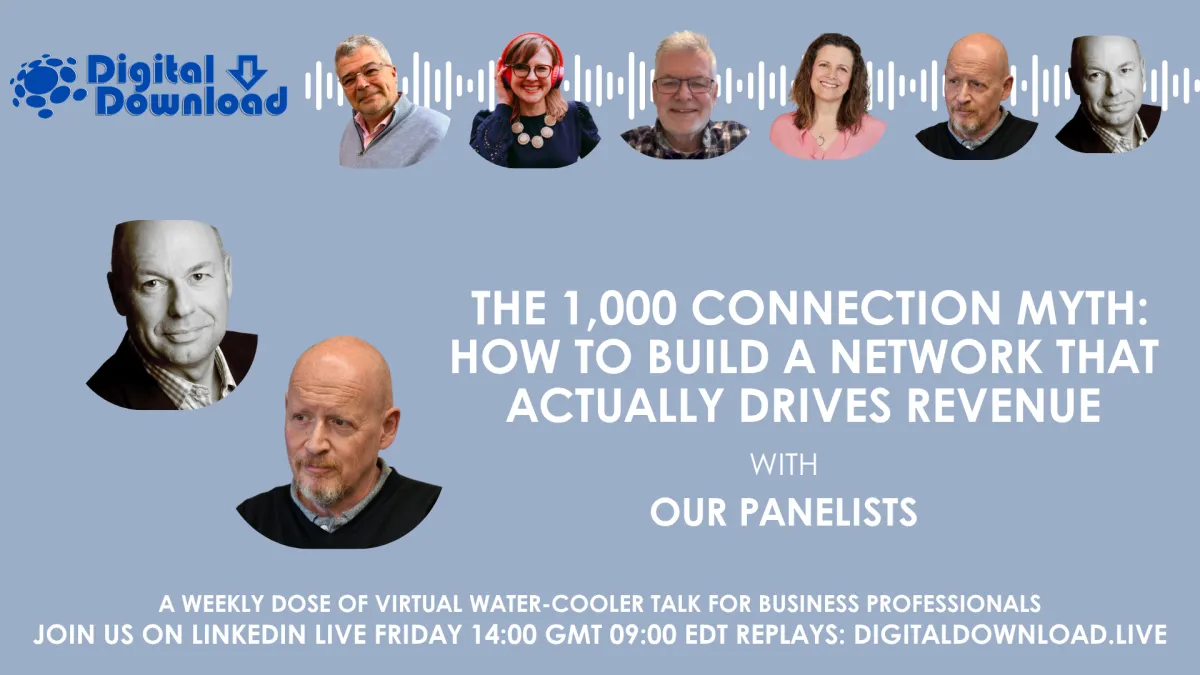
The 1,000 Connection Myth: How to Build a Network That Actually Drives Revenue
This week on The Digital Download, we are asking a brutally honest question: You might have 1,000 connections on LinkedIn... but how many of them do you actually know?
More importantly, how many of them actually know you?
A strong network cannot be overstated. It is the distribution vehicle for your thinking, the engine for your digital influence, and your greatest source of referrals and meetings. But a large network is entirely useless if it isn't full of the people you actually want—and need—to speak to.
I am joined by Tim Hughes, Adam Gray, Helen Mackenzie, Tracy Borreson, and Richard Jones to unpack the crucial concepts you must master to prospect effectively in a digital world.
We will discuss:
Strategic Connecting: Exactly who you should be connecting to, why they matter, and the right way to approach them without sounding like a spammer.
Waking the Dead: How to re-engage and actually get to know the hundreds of people you have already connected with but haven't spoken to in years.
The Distribution Engine: How to build a strong, active network that eagerly amplifies your ideas and refers you to decision-makers.
Targeted Growth: How to stop relying on random inbound requests and start growing your network in the exact places your business needs to expand.
Join us to learn how to turn your digital rolodex into a predictable pipeline.
We strive to make The Digital Download an interactive experience. Bring your questions. Bring your insights. Audience participation is keenly encouraged!
#Networking #SocialSelling #DigitalInfluence #B2BSales #Pipeline #BusinessStrategy #LinkedInLive
This week's Host was -
Bertrand Godillot, Founder and Managing Partner of Odysseus & Co, a proud DLA Ignite partner
Panelists included -
Tim Hughes, Co-founder and CEO of DLA Ignite
Adam Gray, Co-founder of DLA Ignite
Tracy Borreson, Founder and CEO of TLB Coaching & Events, a proud partner of DLA Ignite
Transcript of The Digital Download 2026-02-20
Bertrand Godillot [00:00:02]:
Oops. Good afternoon, good morning and good day, wherever you may be joining us from. Welcome to another edition of the Digital Download, the longest running weekly business Talk show on LinkedIn Live, now globally syndicated on tuning radio through IBTR, the world's number one business talk, news and and strategy radio network. Today on the Digital Download, we're asking a brutally honest question. You might have a thousand connections on LinkedIn, but how many of them do you actually know? A strong network cannot be overstated, of course. It is the distribution vehicle for your thinking, the engine for your digital influence and your greatest source of reference and meetings. But a large network is entirely useless if it is not full of the people you actually want and need to speak to.
Bertrand Godillot [00:01:06]:
We're having a panel discussion this week on that topic. But before we kick off the discussion, let's go around the set and introduce everyone. While we're doing this, why don't you in the audience reach out to a friend, ping them and let them join us. We strive to make the Digital Download an interactive experience. Elian's participation, as you know, is highly appreciated. Tracy, you want to kick us off, please?
Tracy Borreson [00:01:30]:
Good morning, everybody. Tracy Borreson. I am representing the marketing function in this conversation today. And as an authenticity champion, I am very excited about where this conversation. I mean, it's a very common conversation, right? Get more leads, get more connections. That's what we want. We want followers for our business. We want all these things, but so many people are not getting business results from them.
Tracy Borreson [00:01:56]:
So I'm really excited for this conversation and yeah, that's me.
Bertrand Godillot [00:02:02]:
Excellent. Thank you, Tracy.
Helen Mackenzie [00:02:04]:
Ellen, Hello. I'm Helen Mackenzie. I'm a proud associate of Digital, of DLA Ignite even, and wondering who I'm representing. Possibly not the Vikings that are rowing across the Atlantic for a football match. Possibly not the knights in armor with the St. George's Cross on the front. I don't know, sailing across the Atlantic for a football match, but perhaps representing somebody who's out there in the weeds selling and making lots of connections and, and actually meeting people. So, yeah, really looking forward to this conversation.
Bertrand Godillot [00:02:46]:
Excellent. Thank you, Ellen. Tim.
Tim Hughes [00:02:49]:
Thank you, Bertrand. Welcome, everybody. My name is Tim Hughes. I'm the CEO and co founder of Azpertilo and I'm also famous for writing the book Social Selling and Influence, Using social media for cold outreach and new business sales.
Bertrand Godillot [00:03:05]:
Excellent. Thank you, team.
Tim Hughes [00:03:07]:
And I can't believe that Helen is sitting there with long sleeves on.
Tracy Borreson [00:03:14]:
Even I don't have long sleeves on. It's only 7:00am Here.
Bertrand Godillot [00:03:22]:
Adam.
Adam Gray [00:03:24]:
Hi everyone. I'm Adam Gray. I'm co founder of DLA Ignite. And Azpertilo as is Tim. He didn't say he was co founder of DLA Ignite. So yeah, this is, this is a really interesting conversation and it's the cornerstone of everything that Tim and I have been doing for the last decade really in this space. I am wearing short sleeves and I'm wearing shorts as well, which is a rarity because that. Yeah, yeah, you don't need to see that.
Adam Gray [00:03:52]:
But, but that is, but that's something that doesn't happen very often, I can assure you.
Tim Hughes [00:03:58]:
Cringe.
Adam Gray [00:04:01]:
Thank you, Tim.
Bertrand Godillot [00:04:02]:
Excellent. Excellent. Thank you Adam. Myself, Bertrand Godillot. I am the founder and managing partner of Odysseus & Co. And I happen to be the co founder as well at Azpertilo. But we'll talk about this later on.
Bertrand Godillot [00:04:18]:
Okay. So foundational question of course for you all. Who should be connecting? Who should we be connecting to and why? And the right way to approach people without sounding like a spammer. I'm sure that whether it's Tracy. Maybe it's a question for Tracy. In this one.
Tracy Borreson [00:04:49]:
I was gonna say, I feel like
Tim Hughes [00:04:50]:
I always start, I should have gone out the door and run in and said buy my product.
Tracy Borreson [00:04:57]:
I just. Okay, so here's my, the way I like to look at it and I too proud partner of DLA Ignite. And I love the methodology because it creates the space for you to do things in the way that work for you. But I think we people receive that like weird car salesman energy vibe from the sales efforts that are like, I don't really care who you are. I'm gonna try and sell you. I like, I don't know if you have a problem. I don't really care about you as a person, but I'm gonna try and sell you a thing. And like that's the, the beginning energy.
Tracy Borreson [00:05:37]:
And I mean first, I mean I, I, I don't understand how people do that. I can't, I could never like I, it would feel so gross. So I, yes, icky. So I have never done that. So I don't actually know. I mean my logic brain says it has to work for some people otherwise that nobody would do it. I, I think but like I don't understand that. Every time I've been approached with that like in person, I feel like car sales, furniture sales is another place where I've experienced that where I'm just like, leave me alone.
Tracy Borreson [00:06:15]:
Like I Just want to at what's here. I don't. And that the more you, like, creep me, the less I want to buy from you. So it's like, it's confusing to me that people would approach sales that way. From a social media point of view, it's very confusing. I don't know that there's any human that likes to receive that. So now if we look at that from the flip side of like, okay, we want to use this channel to create commercial opportunities, right? We, we call it sales, but like, really we want commercial opportunities. This could be partnerships, this could be investments, this could be sales.
Tracy Borreson [00:06:52]:
This could be a variety of different things. And so when we're looking at the who I like to look at, well, like, who are like the right business profiles, but also the right human profiles. My favorite exercise for this is like, if you go on to like LinkedIn Navigator, if you don't have LinkedIn Navigator, then just a LinkedIn search and you're like, who's talking about authenticity today? So I can like search authenticity and it comes up with a whole list of people who have used the word authenticity in their posts. And there's a way to do that where you're like, I'm going to connect with all of these people. Or I could be like, okay, here's the group of people. We're talking about authenticity. So that's probably my peeps right now. Who do I feel drawn to connect with today? Right, like, and I've done that from like, I like this, this person's smile, which might sound kind of creepy, but it's a vibe thing.
Tracy Borreson [00:07:50]:
I think I would enjoy having a conversation with this person. So it's not just about the business profile. It's not just about someone meeting a business profile, because there's a lot of people who meet a business profile, but, like, see who beats the business profile. And then within that group, who do you actually feel called to have a conversation with and start there? I don't know. I think I. I'm not sure I answer the question.
Bertrand Godillot [00:08:19]:
Feel, feel drone. Connect to love this one. And maybe let's say just hello to Greg.
Adam Gray [00:08:24]:
Hi, Greg.
Helen MacKenzie [00:08:25]:
Hello, Greg.
Tim Hughes [00:08:25]:
Hi, Greg.
Bertrand Godillot [00:08:26]:
Welcome. Is it. Is this a, a B2C approach or that you got that infiltrated basically the B2B world, or is it just the, the good old idea of. The good old marketing idea of, of one too many?
Helen MacKenzie [00:08:52]:
I think it's. I mean, for me, it's. I'm not quite so particular as Tracy, partly because interesting people don't always post on LinkedIn. So, you know, you're not necessarily able to see if somebody's mentioning the word authenticity, for instance, to, to do that. So for me, I always think about it as, as my network, as my, as my, as my, my web of people, my, my network of people that I've got something with common in, with common with, in my business life. Because again, you can't search on, particularly on, I don't know, likes motorcycle racing, for instance, which I do. You can't search that on LinkedIn. So I'm looking at things like, are they in Scotland? So that's what I'm looking at.
Helen MacKenzie [00:09:48]:
So.
Bertrand Godillot [00:09:48]:
Because that's how you've got the.
Helen MacKenzie [00:09:50]:
Yes, yeah. And I've got, I've. I live in Scotland. I'm interested in people who are doing business in Scotland. So are they in Scotland? Are they people that are in roles the same as me, for instance, because when I was in procurement, I was looking for peers in procurement to exchange ideas and views with. I. And then I'm just looking to connect with people. So back to that network.
Helen MacKenzie [00:10:20]:
You know, it's about having a network of, of people who can potentially become your, you know, business friends rather than your friends friends. So you might be friends with people, but people that you have conversations with become, you know, people that you can ask things of. Like, I've got somebody that's coming to your town that would love to meet you. They're in my network. You're in my network. Can I pet. Can I connect you both? So I look at it more like a sort of, I mean, a web makes me sound like a spider, which is a bit, I'm not quite sure I like that. But a mesh, a network, a group of people who I've got something in common with.
Helen MacKenzie [00:11:01]:
And actually if we've all got something in common with each other, then we, we feel like a network. So that's how I do it. I certainly don't appreciate somebody that asks me if I, you know, given that I'm in the plumbing industry, why don't we connect? Because obviously I'm not in the plumbing industry and I can't understand why somebody would have sent that to me.
Bertrand Godillot [00:11:24]:
Well, we've got a great comment from Greg. So, you know,
Tracy Borreson [00:11:32]:
Is it the creepy guys that sell the most or is it actually good sellers, sales people that sell the most?
Tim Hughes [00:11:40]:
Is it people buying?
Adam Gray [00:11:42]:
Yeah, well, it may be. It may be creepy people that, that sell lots. Whether they sell the most or not, I think is, is open to debate, but it's, it's a very different proposition, isn't it, selling to somebody personally than it is to selling to somebody in a business environment? Because, you know, when I walk into the, the car shop, the salesperson has to sell to me and if I like the car, if, and if I'm putting up objections as to why I can't buy it, you know, or I can't afford it, or it's not in the right color. And they're very easy to walk around those objections. So you can't afford it. So if we could get you finance at a really good price, or it's the wrong color, but we have a black one in stock as well. You know, actually it's, it's quite easy to walk around those at a business level. It's like there's another layer, isn't there? A.
Adam Gray [00:12:35]:
Because it may be my credibility and job riding on it, but also I'm not going to be the only person that has to sign this off. So they say to me, we've got a great new CRM system. And I go, that's an amazing CRM system. And the first person I need to phone then is Tim and say, this guy's approached me with a great new CRM system. And Tim says, tell him we're not interested. So I then have to phone him back and say, we're not interested. And actually, I think that in the business context it's a very different proposition, isn't it? And I think Helen's comment about, you know, creating this network community grid of people that you could have some commercial conversation with, you know, maybe today, maybe tomorrow, maybe next year. The beauty of having a commercial conversation with somebody next year, if you've connected to them today, is that by the time you have that commercial conversation conversation, you've already known them for a year, which means that you're not so scary.
Tim Hughes [00:13:33]:
Also, I always think that networking is one of those things, or building a network on LinkedIn is always one of those things that people put off, don't they? It's kind of difficult because it actually means talking to strangers. And we were told as little children not to talk to strangers. So therefore we're going against our parents wishes. But there must be hundreds if not thousands of people who have been laid off recently who suddenly, in a situation where they don't have the network that they wish they had done and had invested in it, because it was always that I'll do it. It's like it's fourth on the list, isn't it, of you and you Never really get there. You get to number three and you go, I've gone for, for me, it's. I'm gonna go and have an ice cream and a cold drink because it's so hot. But, you know, it's just one of those things that people just never get
Adam Gray [00:14:30]:
around to, isn't it?
Helen MacKenzie [00:14:31]:
Yeah. That's not.
Tracy Borreson [00:14:32]:
Because people don't see the commercial like, they don't see the value. Whether we're looking at that purely as
Tim Hughes [00:14:37]:
commercial value or Otherwise, it'd be 1, 1, 2 or 3, wouldn't it?
Tracy Borreson [00:14:41]:
Right. Yeah.
Helen MacKenzie [00:14:42]:
But I think thinking of it in a. In a totally sort of monetizing way, I think is also perhaps moving away from the idea that LinkedIn is a social network, because I think that that's where, you know, that's where the dilemma is, you know, is every time I connect with, have connected with somebody over the years because I, I think I might have a commercial relationship with them years on. You know, the reason I connected with Tim, for instance, is because I met him at an event, oh, very many years ago. And I. One of the things that I developed as a discipline is if I meet people either in person or even digitally, like somebody nice to be connected with you on email. Let's connect here too, which is something I do. I've got a bit of a discipline that if I've had an interaction with somebody on email, I'll do that, because then you've got that you are connected. And then years later that might come to fruition.
Helen MacKenzie [00:15:40]:
I think in the last three roles I've had, including this one, have all come from being connected with people who I've either met or I've come across or I've interacted with on LinkedIn. So, you know, it does.
Adam Gray [00:15:55]:
I think, I think that the, the important point here is that if you, you don't want to connect to just people that you think you can do business with today, you want to connect and get to know people that themselves have strong networks. So, you know, if, if you were to ask yourself or ask anybody, if Richard Branson spoke really highly about me, would that be beneficial to my business and for everybody, the answer would probably be yes. So, okay, so at a lower level, if anyone has got any kind of network and any kind of credibility, if they know you, that can only be a good thing. So if you're targeting people in Scotland, Helen, then every interesting, well connected, respectable, believable thought leader in Scotland is somebody that's worth having some sort of relationship with, because even if they are never going to buy from you. They will undoubtedly know somebody who could. And when they introduce you, it's like when Tim says, yeah, I think you should speak to this guy. He's a really interesting chap. I'm approaching that interaction with the fact that he's going to be an interesting chap because someone else has already done the due diligence for me.
Adam Gray [00:17:14]:
So getting your network to do that work for you is an incredibly powerful tool, isn't it?
Tracy Borreson [00:17:19]:
And someone you trust in your network in particular. Right. Because this is the thing I find that's interesting about networking is that someone will connect with me on LinkedIn and immediately being like, who can I introduce you to? And I'm like, nope, you don't, you don't know me and I don't know you. I don't know that I want your recommendation. Right. Like, just, whoa there.
Helen MacKenzie [00:17:41]:
But I think that's, that goes back to the, you know, why are we connecting and should we actually be having conversations with people? Because then you, what, you will, in a sense, weed out people that are. What's the word? Not aligned with your values. Let's, let's, let's say that, that you can actually weed them out. So having conversations with people, not, not, not a spray and prayer approach, which I was talking to somebody about earlier in the week about spray and pray emails, and she was saying that wasn't how she did it in her email outreach strategy. But I, I think that that, that feels quite interesting as well. I, I really like the, the comment that you've just made, Adam, about, about people with networks.
Tracy Borreson [00:18:27]:
It.
Helen MacKenzie [00:18:27]:
Does that, does that feel like, you know, me trying to photobomb Kim Kardashian when she's, you know, when she's getting photographed for Instagram and if I'm in the background and get tagged, I'm going to be amplified. Am I, am I trying to photo?
Adam Gray [00:18:43]:
Yeah, that would be nice.
Helen MacKenzie [00:18:44]:
Photo bomb people.
Adam Gray [00:18:45]:
It would be nice if that happened. But I, I always think that, that a network is a network is a network. So, you know, we're talking about a digital network where we're in the same digital room that could just as easily be a physical network, you know, so if you go into a physical networking environment and you know somebody who seems to be the center of the conversation and they say, oh, come and, come and join me. Let me introduce you to Janet and David over here. And that's incredibly powerful because it gives you that, that intro and digital works in exactly the same way. If Tim's favorite Thing about running in and going, buy my stuff, you know, if you don't begin the conversation that way. If you begin the conversation by saying, hello, I'm. I'm Adam, tell me a little bit about who you are and what you do.
Adam Gray [00:19:33]:
Because people. People like to be listened to, don't they? Yeah.
Bertrand Godillot [00:19:38]:
And I think.
Adam Gray [00:19:39]:
Sorry, go ahead.
Tim Hughes [00:19:40]:
I was going to just pick up some of the comments on the side.
Bertrand Godillot [00:19:42]:
Yes, there are a few comments. And. And who wants to read this one, by the way?
Tim Hughes [00:19:48]:
Ellie Timberlake. We don't know if you're related to Justin. If you are, let us know because you're part of the network. Sorry, my network, which is a really, really great comment, which is. My network was fantastic in helping me find a new role within two months of being laid off. My partner's network, which is very small and he is still trying to find the next role eight months after being laid off.
Adam Gray [00:20:13]:
Yeah, And I think that that's one of the interesting things, isn't it? You have to build value and political capital within your network before you ask them for a favor. And, you know, that's fundamentally what's wrong with how you so often get connected to on LinkedIn. You get a connection request, you think, okay, I'll connect to this person because I'm kind of open to meeting new people. And then that's immediately followed up with their pitch. And if they had, if you had known them for a period of time, months, years, decades, then there's much more chance that you would read the pitch, particularly in a. An empathetic kind of way.
Tim Hughes [00:20:56]:
Thanks, Ellie. So Elliot. So we found Elliot Timberlake is not justice.
Bertrand Godillot [00:21:02]:
No, but I think it's.
Tim Hughes [00:21:04]:
I wanted to know.
Helen MacKenzie [00:21:06]:
And the point you're making is that old chestnut, isn't it? Is it? Earl Nightingale says that, you know, if you want, if you want warmth from the fire, you've got to put fuel on it first. So in a sense, if you want, if you want warmth back from your network or support or connections or introductions or support to find you a job, as Ellie says, you've got to build that network first and you've got to put fuel on the fire first to get the warmth from it. So it sounds a bit twee, but I think it's a really good point
Bertrand Godillot [00:21:42]:
and maybe that's the difference. I think value, the term has been. I think it's been said, you know, value in the relationship, etc is probably, is probably what Greg calls ecosystems. Who wants, who wants to read this one?
Tim Hughes [00:22:00]:
Yes. So Greg Walters says, okay, I Understand what you folks are talking about by means, by networking. I've always resisted the networking groups, chambers of commerce, the jcs, etc, the realist, the, the, the, the real estate agent, roaming grounds. But ecosystems or ecosystems are different to me. And I've been part of ecosystems or ecosystems forever.
Adam Gray [00:22:27]:
Yeah.
Tracy Borreson [00:22:28]:
And I think all of us are actually like by nature, humans are part of ecosystems. Your neighborhood's an ecosystem. The grocery store you choose at school, that's an ecosystem. Like maybe you're in a church group or you volunteer with an organization. Like all of these are. Right. You play team sports. Right.
Tracy Borreson [00:22:51]:
Like all of these things are ecosystems. But it's interesting then when, if you, if you take that concept and you take how that feels to participate as part of that. And it's not that I'm first of all. Usually it's never like one to one ecosystem is many. It's actually many to many. It's not even one to many, it's many to many. And so if you look at that and then you look at some of this sales or let's call it networking because we're just talking about connections. Right.
Tracy Borreson [00:23:22]:
The networking that happens, it's like I have a thing. Do you need a thing? And if I have a thing and you don't need that thing, then we, it's like, it's like there's the. Your friends off. Right. We can't be part of an ecosystem together. Which is crazy because like you were. Someone was referencing plumbing. Helen was referencing plumbing.
Tracy Borreson [00:23:41]:
Right. I'm it. Yeah. I'm not a plumber. So if someone's trying to like build a network of plumbing professionals, then I'm not that person. However, when I have a plumbing issue, who do I go to first to find A trusted resource? I go to my network first. And this has been like, this has been done in the trades for years. Right.
Tracy Borreson [00:24:05]:
I, I recently needed to find a limo to, to take my baseball girls on a limo ride because this is what I promised them if they won city championships and they did so. But all the, it's Calgary stampede and all the limos are like three times the normal price. And I'm like, this is for 1012 year old girls in Strathmore. I do not want to pay a thousand dollars for the limo. And so I actually, I did a LinkedIn post and I was like, okay, LinkedIn, let's see what we can do. I need to find a limo, I need it to be, be this size. I need it on this date. And like all the other specs and two different people from my network were like, I know somebody you can talk to.
Tracy Borreson [00:24:45]:
And I ended up getting what I consider a reasonably priced limo, although it also didn't have air conditioning. So nothing is perfect necessarily. But like it was really interesting to see. I had people in the US who were sharing the post because they're like, I don't know, who knows a person in Calgary? And I was like this, this, that's the point, right? And people love to be helpful, right? Like I need help and I ask people for help and people love to be helpful. And it was awesome because it also helped me solve my problem. But that's also there's like the difference between the push and the pull, right? Like that's me pulling help from my network. But those people want to give me help because I have given them help.
Adam Gray [00:25:31]:
But if the, if the plumber had connected to you in a really nice way, hi, you've got some really great content and then somebody you know. So you've got 15000 connections. So somebody sends you a message that says hi Tracy or does a post saying hi Tracy or does post saying I I need to find a plumber local to me and you've got this plumber that you know, you've no experience of their work but you, they seem like a really nice person then you might end up recommending that plumber to the person that's looking. So when we think about that in terms of what we do, you know, whether you're a PA or a programmer or a marketing consultant or a printer, whatever it may be at some point somebody that you know is going to be asking for those products or services and if you know somebody, because you know by default we want to try to help people and so if you've got somebody that is your pet printer, whatever, then you're likely to offer them up as an option. And I think that that's the power in this, isn't it? You're not selling to your network but you're selling through your network to people. And I think that. So Greg said about these networking events that are the hunting grounds for real estate agents and yeah, we've all been to like a BNI networking breakfast where everybody is standing up and doing a 30 second pitch for what it is they do. I have got business from those and I have built some long standing relationships from those.
Adam Gray [00:27:02]:
However, it does seem a little bit outmoded these days but going to a networking event, Tim and I often go to thought leadership events where research is being unveiled. You Know, the state of sales, the state of compensation, you know, whatever the. The thing is. And what's really interesting about those is the conversations and the relationships that you build offline. You know, you happen to be sitting next to somebody that's in this field and then you end up having a conversation with them and you think, okay, there's some synergy there. Let's keep in touch. And those are where ultimately the value resides, I think.
Tim Hughes [00:27:40]:
Can I pick up on a couple of the posts, please? So Ellie Timberlake says, and I, I like this is. She says, two years ago I had no network at all, but expanded it massively in my first role, the i2 role after being a teacher for 20 years. So it's never too late to start. It was built primarily through LinkedIn events. And then she says, I tend to make a lasting impression in person. So, Ellie, you need to explain what that.
Adam Gray [00:28:08]:
Yeah, elaborate on that.
Tim Hughes [00:28:10]:
Yeah. And. But the fact that you said it is clearly. And the other one is the, the comment I wanted to. Was, is Michael Bathurst who says, keep shining your powerful light, Adam Gray.
Adam Gray [00:28:22]:
Yeah, it's the reflection off my bald head.
Bertrand Godillot [00:28:24]:
I suspect. We talked about.
Tracy Borreson [00:28:30]:
Greg has a. Greg has a question too about the, like an interesting point about the limo question because the connections that connected me to limo people were not in the limo industry. So it's even like one layer removed from the plumbing example. Like, I didn't have those. People were in like the construction industry, actually, which was like super surprising to me. But you never know. You never know where connect can come from if we're like out here actually building a robust ecosystem.
Bertrand Godillot [00:29:04]:
Okay. And then I'll take this one because there's no reason. Tim Hughes, always great to see you.
Tim Hughes [00:29:11]:
Hi, Michael.
Adam Gray [00:29:12]:
We feel the same way, Michael.
Bertrand Godillot [00:29:16]:
Okay, so we talked about. There's something I would like to come back to because you said earlier, Adam, that obviously, and this is something that there's a bit of theory around this. So there is your operational network, which helps you doing your job every day. So these are the people you connect to to be, you know, a good professional in your current position. But then there are, there are, there are people you connect to for the next. For the next position. For instance, if we just take a talk about having jobs and. Because I think that having, searching for a job is pretty much the same
Adam Gray [00:29:57]:
as
Bertrand Godillot [00:30:00]:
a sales activity. Do you mean that you need to have an intention in the way you grow your network?
Adam Gray [00:30:13]:
Absolutely, absolutely. And I think that one of the things that's really interesting is that for most People, when they start to use social media in a strategic way, they look at their connections. They might have 100, they might have a hundred thousand. And most of those connections are a legacy from where they have been. People they worked with, people they went to university with or college with, or school with, even people that they have encountered and met. Like you said, Helen, about, you know, every time you've met someone, you've sent the connection request as a matter of habit. Now, and, and that's, that means that for all of those people, you may have had some synergy or connection with them 20 years ago that may or may not help you today, but you can send a connection request to pretty much anybody on LinkedIn. So decide who you want to connect to and send them a nice note that says, hi, you look really cool.
Adam Gray [00:31:10]:
Is it all right if we connect? And the beauty of doing that is that that's no different to walking up to somebody at a, at a networking event, putting out your hand and saying, hi, I'm Adam, maybe, maybe connect. And I think that the, the beauty of that is that because you can send 200 connection requests a week if half of the people accept them, and you do this every single week, you're going to add 5,000 connections in the next year. So if you started with 100 connections, 90% of which are in the wrong place, you're only fishing in a pool of 100 people that could possibly buy your product. If you connect to 5,000 people, you've increased your, your network by fight or applicable network by 5,000% over the course of a year. So you're 5,000% more likely to get a connection and a conversation with someone you could sell something to. But always it's about. And, and Tim and I did a talk for an events company earlier in the year, and the sales leader there is incredibly charismatic. And you could tell from how he used to words, how he viewed the role of a salesperson in the conversation.
Adam Gray [00:32:25]:
And he said it is vital that salespeople are central to the network that they serve. And I thought that's, that's exactly sums up what it is that you're trying to do. Because this is not about what you can take out, not initially. It's about what you can put in. Take your best advice, show, share that with the people that you've connected to and give them some of your best thinking, because that demonstrates that you know what you're talking about and it demonstrates you're the right kind of person and it's not about following it. Up immediately with a pitch. But it absolutely is about sharing the ideas that help them to understand how good you are.
Tim Hughes [00:33:05]:
And that's. And I think the limo example that Tracy said is a great example about, of Tracy, who has put a lot of effort into her network. And then when the limo thing came up, that's where she starts getting the, the interest back on the investment that she's made. And, and, and everybody can do that. And I think Ellie is a, is another example is where she's put investment into her, into her network and then basically the interest that she got back was a job.
Tracy Borreson [00:33:38]:
But I think, and I think that the interesting thing about that too is we could look at building a network very linearly with like a predefined interest payback, right? Like, I just want clients, so I'm just going to build this way. Like I've had conversations with people who are like, are you interested in buying what I sell? And I'm like, I don't really know you, so I'm not sure. And they're like, well, if you're not interested today, then I don't connect. And I was like, okay, yep, good. That we're not gonna be friends anyway. But like there's a, that you can do it like that. And I feel like maybe that rolls more into those transactional type of feelings in the conversation. Whereas interest can pay back in multiple different ways, right? So for me, it paid back in a limo, but it's also paid back in clients and it's paid paid back in interests that have, are in people who have clients who then they need marketing help.
Tracy Borreson [00:34:33]:
So then I come in and do like the marketing component. And it's not necessarily like a well defined funnel, right? If this then that, right? Like if I connect with 100 people, I will get 12 clients. No, it's not like that. It's more like if I am known and liked, right? Like if people don't like me, they're probably not going to recommend me. Or if they've received my services and they did not feel taken care of, they're probably not going to to do that, right? Like, I don't know that I would recommend the limo guy that I chose because I'm like, unless you're really fine with like baking hot car in the summer, then I don't know that you want to choose this one. But I can create that as a framework and this person is available and they're have a good price point. But like interest can pay off in multiple ways, but only if we Also like approach, like our intention is to build a network that will allow us to have interest payback in multiple different ways.
Adam Gray [00:35:39]:
So I think what's really interesting, looking at the comments that we've got, we've got maybe half a dozen people have, have we got more viewers obviously, but half a dozen people have commented. So the most recent one is Michael Bar and he said you never know what opportunities are around the corner if you lead with kindness and intention. And prior to that Greg Walters had said, my point is the network is no longer 2D, it's at least 3D, possibly 11 day and always in motion. Adam it is almost mystical giving attracts. Now I think what's really interesting is that this and our client, that said about serving the network, everybody gets this, everybody gets this, everybody gets that. If you go out there and you are generous with your time and your advice and you help people, that comes back to you. Those people that you've helped feel a debt of obligation and they want to help find some way of helping you and other people get a chance to see how much you know and how good you are explaining that to people. So given that everybody gets this at a fundamental level, why do so few people behave this way?
Helen MacKenzie [00:36:49]:
I think some of it's, and you know, this is from conversations that I've had with people as I've been developing my network. There's such a, the, the old ways of thinking are entrenched. You know, there's such a group think in, in the sales profession in, well, business cards.
Tracy Borreson [00:37:13]:
Business cards, yes.
Helen MacKenzie [00:37:16]:
But also like I, if I, if I just, I was speaking to somebody this week and was just talking about the number of phone calls that they made. They're in bd. That was what they wanted to do. I was speaking to a senior leader in another company who was. The other way was all about, it's about, you know, repeat business and recommendations and nothing else. So I think people have quite fixed views sometimes about what? The way that you, the way that you attract, the way that you get sales conversations, the way you, you, you, you, you start that process. And I think that this is different and LinkedIn was, I think I've said it before on digital download, LinkedIn is seen as a very posh way of putting your CV up and not as a social network. And I think that's where it is changing.
Helen MacKenzie [00:38:13]:
What people are putting up is changing. I spoke to some the other day who was saying they just don't, you know, he spoke to somebody that just don't like anybody that puts A picture up of their child or their dog. They're just not gonna, you know, they're not their person, they're not gonna engage with them. And that's fine. That's absolutely fine. But that doesn't mean it's inappropriate to do that. So I don't know that that's my perception of conversations out there in, in, in the network as it were, is that, that people have the way that you do things. The one more call, the one more email, the, that that sort of prospecting template is, is really in ground.
Helen MacKenzie [00:38:52]:
It's possibly the folklore that, that that's talked about in terms of the way, I don't know what, what do you think? Am I, am I sort of deducing more into the conversations? Is it not as entrenched?
Tracy Borreson [00:39:09]:
I was having a conversation with a connection yesterday and we ended up talking about similar thing, right? Like all of this is like, makes so much logical sense. Why do people not want to do it? We were talking about a different thing that people don't want to do, but then we ended up talking about like gravity. Right? So practice, beliefs, methodologies, processes, hierarchies, right? Like all of these things have created a gravity for how this is done. And it's so it's easy to get sucked back into that. Even I work with a lot of small businesses that have the total capacity to choose to not just make 150 calls a week. You've been doing this for years and it hasn't given you any leads. So why do you want to keep doing this? Yeah, Greg, Me and Greg, we're on the same track today. 100 contacts equals 10 meeting equal ones.
Tracy Borreson [00:40:04]:
It's not a thing, right? Like, and we have so much data that says this is not a thing. But because this is, there's a gravity associated with that. So if you look at it like gravity, gravity and you think about humans going to space and what is required to get out of the gravity, right? Like you don't get out of the gravity by doing all the things that is driving the gravity. Like it just, you have to shoot, you have to shoot out of the gravitational pull in order to do something different. And I think this comes back to what Bertrand was saying about intention. Because if you have a strong enough intention or you're looking at a goal or a deliverable and you're like, well this is, let's just use a salesperson as example or in a solopreneur trying to sell X amount of things, right? Like I need to sell this amount of this in order to pay my mortgage. Okay, so we want to. Why do you sell that amount? There's that.
Tracy Borreson [00:41:05]:
There's that pressure, there's that constraint. But us breaking the Earth's gravity didn't happen because there were no constraints. There were lots of constraints, and we decided to do it anyway. So when you have that idea and you're like, this is what I'm doing, and I accept that there are constraints, but I'm not. I'm also not going to assume that there's only one direction that will allow me to actually reach the goal. I'm going to explore as many ways as possible to. To see what can deliver that for me. I think.
Tracy Borreson [00:41:41]:
I mean, I also, when I look at it that way, like, that feels more fun to me, right? Like there's more possibility, there's more fun, there's more expression, there's like a whole bunch more. If we want to talk about abundance, we want to talk about sales volumes, feeling abundant, then that happens in the area of abundance. It doesn't happen in the, like, teeny constraints of, like, I need to make 100 contacts today, and then hopefully that will make 10. But now it's not making 10, so that means I need to make 200 a day so I can get to 10. And you're like, like, if we're trying to break the gravity, that's like digging a hole into the ground.
Adam Gray [00:42:19]:
I think that the, the problem here is that people, as you said, Tracy, are wedded to their old way of doing things. So, you know, this is like, we are trying to break the earth's gravity, so we're going to build a faster airplane. And actually, that's not the answer, because an airplane is not the way to break the earth's gravity. And I think that, that, you know, whether or not you are cold calling or cold emailing or knocking on doors or cold advertising or cold connection requesting to people, the problem here is not any of those mechanisms, because telephone is fantastic. Email is fantastic. Meeting people by knocking on the door and visiting them is fantastic. Connection requests are. The reason that these things are, are, are failing is not because of what they are.
Adam Gray [00:43:04]:
It's because of the word cold in front of them. And, you know, I would rather have a telephone call with somebody than I would a LinkedIn messaging exchange because it's more intimate and it's more immediate. The problem, though, is that phoning somebody up and expecting them to be receptive and expecting them to carve time out of their schedule, then to have that call is A ludicrous ask, because we would never do that to somebody. So, you know, this is about. You get a call with somebody, but they have to be wanting you to call and expecting you to call and receptive to what you have to say or to the relationship building part of things. And then it's great. So, so. But it's, it requires a new way of doing things, doesn't it? A new thinking.
Tracy Borreson [00:43:51]:
Yeah, well, I think it's just. I feel like this is like being real, right? Or being honest. This is having a conversation with a friend of mine who's like a junior sales. Junior sales. And his boss had said like, oh, this person was on the website. You have to follow up with them, make sure your script is really tight. And I asked him, I'm like, how does it feel when you're told that like, like what does it feel like in your body? And he is like, well, like, I don't, I don't know how to make the script type because I don't. Like, this is completely cold.
Tracy Borreson [00:44:28]:
I don't know anything about these people. And I'm like, okay, well, it's one thing then to just have that clear in your mind and be like, I don't know this person, they don't know me. If I come in from that perspective and try to generate a conversation, it's like you're meeting someone at a networking event for the first time, right? Like there is actually possibility that exists in there. The problem is when we start to strategize to the point where we're like, well, now research them and they still don't know you, you could do all of that work or you could just come in and be like, I don't know you and you don't know me, but I think it might be cool to jam. What do you think? And like, I will say this is mostly my approach when I am on LinkedIn anyway. And the number of people who tell me that it is refreshing approach. And I mean, it also helps that I don't go immediately, seldom after. So you have to look at the rest of your relationship.
Tracy Borreson [00:45:26]:
But like, cold is okay when you treat it like it's cold, right? Like when it's like, take cold and make it like, I'm going to believe that this is warm, but you're cold. No, like, that's not cold.
Helen MacKenzie [00:45:39]:
I think it's all right to let people engage on their terms. I was back to this idea of if I phone you, it's not the right time. You know, I don't Even phone my mom at a time. That's that I just happen to phone her. I might text her and I might say, are you free? And then I might. But I don't. She doesn't phone me, and I don't phone her spontaneously. We have a set time when we speak every week, and that's what.
Helen MacKenzie [00:46:04]:
Because as, as Adam says, you know, somebody phones you up and you know that. I don't know that one of your kids has just spilt the milk all over the floor, or somebody phones you up and you're, you're desperate for the bathroom and you were just on the way there, or, or somebody phones you up and you're, you know, your, your meeting is starting in five minutes. So I think there's nothing wrong with allowing people to engage with you on, on their own terms. And that's what I like about the LinkedIn connection messaging way of doing it compared to cold calling is that actually allows people to engage with you on, on their own terms. And I think that's important that people you're connecting with feel that they, they're in control of the interaction rather than you immediately spamming them with messages or making them engage with you when it's not the right time to do that.
Bertrand Godillot [00:47:00]:
I've got a question, because all of you around the table have pretty significantly large networks, and I just wonder how you, you know, you maintain relationships. How do you, how do we make sure that you keep this network, a network around you?
Adam Gray [00:47:22]:
Well, I, I remember Tim and I were in Australia doing a speaking tour, and one of the people that we were on stage with was an Australian guy called Graham Hawkins, and he had, at that time an abnormally large network. It was like 40,000 people or something. And this must be getting on for 10 years ago. And someone in the back of the audience shouted out at him, you can't possibly know 40,000 people. And he said, I don't, but they know me. And I think that that's the key thing. He keeps adding value to his network, like we all try to do. And so people within our network know us and recognize us.
Adam Gray [00:48:06]:
And yeah, there will, there will be some people that will be specifically on your radar. Maybe they've had a big life event, maybe you've just met them, maybe they've sent you a request for something, or they've sent you a favor that they, they want, or they've engaged with your content, whatever it may be. But those people will be particularly on your network at that moment. But everybody else, you, you can't know, 500 or 5,000 or 50,000 people, you cannot, and you certainly can't keep up to date with those people. But a lot of the, the joy of having a biggish network is that people self select, don't they? If somebody wants to have a conversation with you, they'll start to engage with your content or they might even send you a note saying, hello, can we have a chat please? And the beauty of that is that then they've, they've kind of put their hand up and said, I would like you to notice me. I would like us to get closer at the moment because there is some, some opportunity there for me, for you, for both of us, whatever. So I think just being, being open is the key thing, isn't it?
Tracy Borreson [00:49:09]:
Yeah. And I think people also like move in and out, right? It's like an orbit if you want to come back to gravity, right? So like you're the center and different people orbit at different things. But unlike a planet in the solar system, those people move farther or closer away based on what they need not. I don't control that, right? Like I don't have strings and I pull them in when I need them. How that relationship works is they move in and out based on what they need, which is a thing that I don't control. And so like I always love to come back to Dunbar's number, which is 150, right? So Dunbar's research says you can know 150 people at a time. That's it. Which is interesting though because I know I rotated way out.
Tracy Borreson [00:50:04]:
I'm like Pluto to Adam. But like, but like people move in and out and you like. So if you think about it from like your childhood friend point of view, right? Like your childhood friends probably have like a really close place in your heart and in your memory, but you probably don't think about them every day, right? There they are rotating, right? So at any one time there's 150 people in here and people are rotating in and out and that is happening for all other people as well. And just like I don't control those rotations. They don't control those rotations. So when I think about a person, because all of us have this, right? When you'll like randomly think about a person. I had this this morning and I'm like oh, like a co worker of mine that I like used to play ball with and her son's the same age as Nicholas and like I haven't seen her for years and I thought about her this morning. Right.
Tracy Borreson [00:50:59]:
Like this, this is how it happens. And like we don't really control it either as individual people. But if. So what if you're, what you're looking at then is that if I'm the sun I could have like three people rotating or I can have 14,000 people rotating. I can't, I still can't have more than 150 in my mind at a time. And do I know all of those? 15,000. No, I don't. Right.
Tracy Borreson [00:51:26]:
But like this, it's always emotion I guess is what I'm trying to impart.
Bertrand Godillot [00:51:34]:
Great. Well team, this has been really a great conversation and we, I'm sure we could keep on going for a month for, for a while but very unfortunately we were reaching the end of this show. I'm just looking at the last, the last comments whether. But anyway, okay, that was really great. So anyone that want to say the final word to conclude on that topic or I just say what I use but what I'm very used to saying now and you know where I'm going. We now have a newsletter. So if you want to know more about the show, you know, go back, go back to this show. Kind of another summary and some insights we will be discussing next time around.
Bertrand Godillot [00:52:26]:
Visit us at using scan the QR code here or visit us at digitaldownload.live/newsletter. Thank you very much everyone and see you next time.
Tim Hughes [00:52:41]:
Thanks everybody.
Adam Gray [00:52:42]:
Thank you. Bye bye.
Tim Hughes [00:52:43]:
Thanks for all the comments.
#PersonalBranding #DigitalInfluence #BusinessStrategy #ProfileOptimization #B2B #DigitalTransformation #LinkedInLive