
Previous Shows
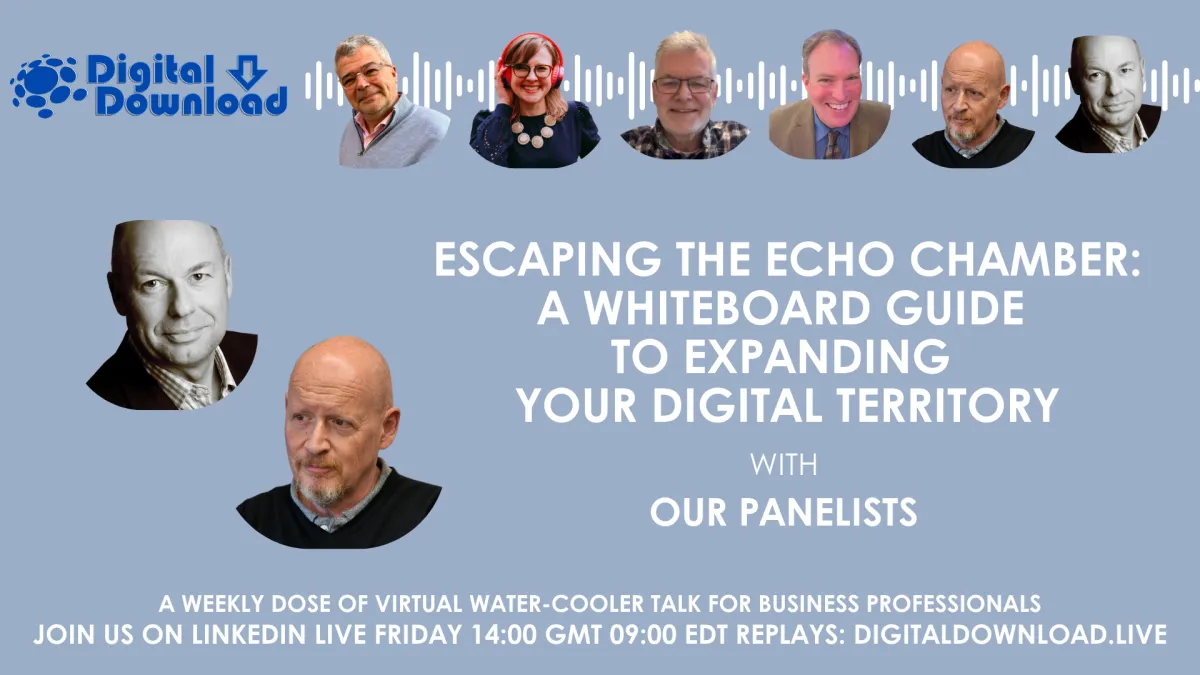
Escaping the Echo Chamber: A Whiteboard Guide to Expanding Your Digital Territory
This week on The Digital Download, we are going back to the whiteboard to solve a problem that is quietly killing your pipeline: The Echo Chamber.
Are you seeing the exact same 50 people in your feed every day? Are your posts getting likes from the same supportive colleagues, but never any new prospects?
The algorithm is designed to keep you in a comfortable bubble. But comfort doesn't grow a business.
I will be at the whiteboard to visually map out how you can break free. Joined by Tim Hughes, Adam Gray, Tracy Borreson, and Richard Jones, we will detail the exact mechanics of escaping algorithmic isolation by defining and conquering your Digital Territory.
We will discuss:
The Algorithmic Trap: How the platforms naturally wall you off from the people you actually need to meet.
Mapping Your Digital Territory: How to define the online space you want to own and influence.
The Breakout Strategy: Why "developing new relationships" is the only sustainable way to force the algorithm to show you to new audiences.
The "Familiarity" Bridge: How to cross from your current network into a completely new ecosystem without looking like a spammer.
The Visual Blueprint: A live whiteboarding session showing the step-by-step math of expanding your digital footprint.
Stop talking to the same room. It's time to build a bigger one.
We strive to make The Digital Download an interactive experience. Bring your questions. Bring your insights. Audience participation is keenly encouraged!
This week's Host was -
Bertrand Godillot, Founder and Managing Partner of Odysseus & Co, a proud DLA Ignite partner
Panelists included -
Tim Hughes, Co-founder and CEO of DLA Ignite
Tracy Borreson, Founder and CEO of TLB Coaching & Events, a proud partner of DLA Ignite
Transcript of The Digital Download 2026-03-20
Bertrand Godillot [00:00:02]:
Good afternoon, good morning, and good day wherever you may be joining us from. Welcome to another edition of the Digital Download, the longest-running weekly business talk show on LinkedIn Live, now globally syndicated on TuneIn Radio through iBGR, the world's number one business talk, news, and strategy radio network. Today on the Digital Download, we're going back to the whiteboard to solve a problem that is quietly killing your pipeline: the echo chamber. Are you seeing the exact same 50 people in your feed every day? Are your posts getting likes from the same supportive colleagues? But never new prospects. The algorithm is designed to keep you in a comfortable bubble, but comfort doesn't grow your business. So before we kick off the discussion, let's go around the set and introduce everyone.
Bertrand Godillot [00:01:07]:
While we're doing this, why don't you in the audience reach out to a friend, ping them, and have them join us? We strive to make the digital download an interactive experience. And as you know, audience participation is highly appreciated. Tracy, would you like to kick us off, please?
Tracy Borreson [00:01:23]:
Yes, of course. Good morning, everyone. I am Tracy Borreson, founder of TLB Coaching and Events, a proud partner of DLA Ignite, and an avid battler of the digital echo chamber. So I'm really excited for this conversation today.
Bertrand Godillot [00:01:41]:
Sounds excellent. Tim.
Tim Hughes [00:01:43]:
We should have got some, like, lightsabers to battle the echo chamber. Anyway, welcome, welcome. My name is Tim Hughes. I'm the CEO and co-founder of DLA Ignite and famous for writing the book Social Selling: Techniques to Influence Buyers and Changemakers. If I may be serious for a second, I just want to wish Adam Gray Well, if you don't know, Adam had an operation last week, and while he was in hospital, he caught sepsis, and he's being pumped full of antibiotics. He's just got home yesterday, so I've told him to have next week off as well, but, um, he's very insistent he's going to be back on Monday.
Bertrand Godillot [00:02:29]:
We'll see.
Tim Hughes [00:02:32]:
Yes, we get well soon, Adam.
Tracy Borreson [00:02:34]:
Get well soon, Adam.
Bertrand Godillot [00:02:36]:
Adam well, and we're probably going to miss him in this discussion today. So I've got a foundational question to start the discussion, of course. How the platform naturally wall you off from the people you actually need to meet. Who wants to take this one?
Tracy Borreson [00:02:56]:
Well, so I don't know if everyone knows how algorithms work, which I think is the like sneaky, the sneaky thing here. The algorithm's belief is that if you see more of what you like, you will stay on the platform for longer. And so it does a whole bunch of things behind the scenes to try and feed you what it thinks you like so that you stay on the platform for longer. That's its game. It's actually very simple, but we are feeding it information all the time. About what we wanna see and what we don't wanna see. Sometimes intentionally, most of the time unintentionally. And so when we're doing that from an unintentional point of view, its default behavior is to keep us in our circle.
Tracy Borreson [00:03:45]:
And so it's not weird that you would have the same people seeing your stuff. They've, I mean, they've tried to explore some things with like the bell, where you could ring the bell, but then people ring so many bells, you can't even reasonably get it in your feed. And there's just a whole bunch of stuff going on. And so at the end of the day, this really comes down to really intentional digital activities. And most humans are not doing very intentional digital activities.
Bertrand Godillot [00:04:17]:
And we'll explain that. Tim, you want to—
Tim Hughes [00:04:21]:
Yes, I agree. I mean, I think that most people come on to LinkedIn, using that as an example, because they feel they have to rather than actually to be intentional about it. You know, someone has said you're at the kickoff, therefore you have to post a photo or that, but nobody actually knows why they're doing it, and they certainly, they're not getting any business benefit from it. I think that I've just been going through I must admit, I prefer the app on LinkedIn. It tends to be— you're able to block things far more, which is really useful. So, you know, if a salesperson I'm connected to shares, you know, 2 or 3 brochures, it's like, block, because I'm not— I'm really not interested in that. The same with brands. It's far easier now to block brands on the app as well, which is good.
Tim Hughes [00:05:15]:
So, and that's a way of trying to— you know, what I'm looking for is insight. I'm looking for someone to you know, oh, you know, here's a podcast for how you roll out AI in your company. Okay, so I've actually— someone's done that. I've actually saved it and watch it later on. Or here's some— I'm always one for a bit of research or something like that. And I share that with the team. And it's, you know, I'm looking for that sort of stuff. And I think everybody is, you know, tell me something I don't know.
Bertrand Godillot [00:05:48]:
Okay.
Tracy Borreson [00:05:48]:
But also, can we also just add on that depending on what that is, what you don't know is, if it is knowledge-based, I think humans have been programmed to believe that collecting more knowledge is good. But when it comes to new perspectives or things that might encourage you to move outside of your comfort zone, which again, the algorithm is very good protecting for you. I would say our practice is not in one of actively getting out of our comfort zone digitally on the day-to-day, and we become more siloed in that, like, this is what I believe, and so I can only talk to people who believe that, whether it's a political thing or a religion thing or a time zone change.
Tim Hughes [00:06:41]:
Yeah.
Tracy Borreson [00:06:42]:
right? Like it, it, it, there's a lot of reasons why we decide to segment ourselves into these areas and the ability to like get out of that. It doesn't originate within the algorithm. It originates within each one of us as individual humans to say like, oh, actually I'm really interested to understand what CFO's point of view is about marketing. Mm-hmm. Because I could just talk, I actually did an episode on my show on Wednesday about like insularity in the go-to-market function. And so when like marketers only talk to marketers, that's only a very small perspective, right? As much as we would think that we know all of the things, but we don't. And we specifically don't know how like other departments perceive us, how we're using our budgets and all of these different types of things. And if we don't talk about it, potentially opening the door to something that's uncomfortable for us to hear, then we keep ourselves locked in the echo chamber and the algorithm just helps.
Bertrand Godillot [00:07:48]:
And we know that within companies we tend to be extremely connected, so the echo chamber works very well by design.
Tim Hughes [00:07:57]:
So I just want to say hi to Greg Waters.
Tracy Borreson [00:08:01]:
Hi Greg.
Bertrand Godillot [00:08:02]:
Hi Greg. Hi Greg. So we said we would go back to the whiteboard and we I think, you know, our followers on video probably are well familiar with the look and feel of that whiteboard. So it's you on one end and your ICP on the other end, and in between, whether it is an in-person closed door or a digital ecosystem, your two ecosystems are very separate. And that's, that's where the concept of echo chamber comes from, to be honest. So we, we have already addressed things that you need to, that we believe that you need to do to look approachable. And let me recall this. So we want your profile to look slightly different than your CV.
Bertrand Godillot [00:09:03]:
We want you to look nice, approachable. We believe it is quite useful that you've got stuff about yourself, but also things that you would want your visitors to read, pieces of content that you believe are important and nice. Hi, Adam! And we also have what we called, and everybody should know this, in that team now, in that panel. What is this?
Tracy Borreson [00:09:44]:
This is the coffee.
Tim Hughes [00:09:45]:
That's the coffee maker.
Bertrand Godillot [00:09:47]:
That's the coffee machine because we need a coffee machine to start a discussion, one of the small talks, etc. So that is our landscape. So how do we break through that echo chamber, which means basically reach out to your ICP ecosystem. Question mark. How do we do that? That's an easy one. Come on.
Tim Hughes [00:10:18]:
The pitch lab.
Bertrand Godillot [00:10:21]:
Are we saying, are we sending emails or things like that? You know, you know, definitely want to pitch people on our very first outreach. No, I can't believe it.
Tracy Borreson [00:10:33]:
No, no, folks, just in case you're wondering, don't do that. Be a human.
Bertrand Godillot [00:10:40]:
And what do humans— what do humans do? What do humans— sorry— do?
Tracy Borreson [00:10:47]:
You know what is my favorite example of this? Humans talk about the weather. So I'm not saying to, like, not saying to, like, send a post about the weather in a connection.
Tim Hughes [00:10:57]:
That'd be a good idea.
Tracy Borreson [00:10:59]:
I mean, if you're in the same place and the weather is crazy, it's not the worst But the point is that people talk about people stuff, right? Like people don't talk about work stuff. They don't want to have your tool to know the top 5 things to hack the algorithm without knowing who you are. They don't want that slammed in your face and neither do you. Right. So like when you go out and have conversations with people, how do they start? Use that, right? Like what kind of questions do you ask? What kind of things do you share? Um, This could also tie into your profile, right? I've shared before on this show and I share it all the time locally too, because in Calgary, the like number one door opener from a LinkedIn banner point of view is mountains. People love the mountains. All they want to do is talk about the mountains. And if you start a conversation about the mountains, then you can take that conversation wherever you want.
Bertrand Godillot [00:11:55]:
If I understand correctly, in the UK, it's about barbecues, right? Sorry, sorry for this one. But the bottom line is, if you want to break out of the echo chamber, the best thing to do is to invite people.
Tracy Borreson [00:12:11]:
Invite them in.
Bertrand Godillot [00:12:13]:
So who would you invite first? Okay, I'll give you a little bit of help. Give us some— I have a different—
Tracy Borreson [00:12:22]:
I invite some people I know first.
Bertrand Godillot [00:12:26]:
Well, that's a good point. Maybe, you know, maybe, maybe, maybe someone here knows, uh, maybe someone in your, uh, in your network here knows your ICP directly, which is then great because then, you know, that's, uh, that's, that's an easy catch. But assuming you don't have that connection, um, I've, I've— there's a population here that I've, uh, I've drawn in a different color. What do you think this is? Who do you think these are?
Tracy Borreson [00:12:55]:
The purple people eaters.
Bertrand Godillot [00:12:57]:
Yeah, exactly.
Tim Hughes [00:12:59]:
The blue meanies.
Bertrand Godillot [00:13:01]:
Okay, so I'll give you the answer.
Tracy Borreson [00:13:04]:
Oh, I thought you were gonna write peeps, which is my word.
Bertrand Godillot [00:13:11]:
These are my peers. Sorry, it's a bit small, but these are my peers. Yeah, because believe it or not, the people that you trust the most without knowing them. Nice ones are the ones that do exactly the same job as you. So I would say, I would argue that if you're a salespeople, if you are a sales rep and you want to, to get into your ICP ecosystem, I would actually invite the sales rep of that ecosystem. Sounds quite logical. Probably easier, easier way to get in.
Tracy Borreson [00:13:53]:
This works like doubly good, can I just share, for marketers, because marketers in most scenarios are not doing direct sales, right? And so marketers connecting with marketers in the target account is super easy to do.
Bertrand Godillot [00:14:10]:
Exactly, exactly. And also because you know, maybe we didn't share that before, but these are obviously, whoops, networking invites. And if you invite a peer, you know, under the, let's say, the networking justification, I don't see any reason why they would not agree, they would not accept. Right?
Tim Hughes [00:14:41]:
No.
Bertrand Godillot [00:14:42]:
And as a matter of fact, we'll see, we know that we generate something like, you know, anyone starting is probably generating something like 30 to 35% acceptance rate into this kind of population.
Tracy Borreson [00:15:05]:
Yeah, I find if you have like something in common. So whether it's peers and you work in the same kind of industry, or it's mountains, or you've attended a similar event, or if they're— if you as the person sending the invite has a good idea of why you're connecting with that person in particular, not just the account, right? The account's your target account, so that's fair. But while you're connecting with that person at that account, then that rate goes up pretty substantially, right? So like, hey, we both attended such and such event, would love to connect and continue the conversation. These types of things get like a 70, 80%.
Tim Hughes [00:15:45]:
They'll get 70, 80%. Yeah. When we work with, um, Anaplan, we actually did something where we got, um, the— they got their list of target accounts and the marketing people connected with the marketing people, the salespeople connected to the salespeople. We got the finance people to connect to the finance people, the HR people to connect to the HR people. And when you think about the fact that the current Six Sense reports showing that most, most B2B enterprise purchases are done when, and they actually know the people in the, and pick those suppliers they know, it's a great way to get into people's, timeline.
Tracy Borreson [00:16:32]:
But it also does like two things. That's a really great example is that it's not just like one salesperson who's trying to get in touch. And it's also not from the like receiving end, because I bet you we've all received these too, where you have multiple salespeople from the same organization trying to connect with you. And you're like, it's usually people trying to sell me investments. Yeah, I mean, I'm— yes, investments. There's like been a couple of different scenarios where I think people are using this as a strategy, but these are also things like pay attention when you're doing it, how it would feel receiving it. And we're not like— people are not— we're— people are smart in general, right? If you reach out to multiple reps from your organization or reaching out to the same person they're going to feel bombarded and they're going to want to say no to all of it. Instead of one person reaching out across functions, and now all of a sudden your finance department's already connected to these people from a finance department point of view.
Tracy Borreson [00:17:37]:
And I actually don't have to do as much selling because a lot of the business is based on the connection and not selling process.
Tim Hughes [00:17:47]:
Yeah.
Bertrand Godillot [00:17:48]:
And I also think that if you address and go to complement this and maybe look at it from a slightly different angle, which is, you know, we just said that the best way to send an invite is that it should be no pitch. And I think it's probably easier to do that when it would— when you, when you've got a little bit of a challenge in adoption of this practice, probably it gets easier if you target your peers. So clearly what we were just saying here is, you know, it's a no-pitch zone. This invite is a no-pitch zone. Whoops. Otherwise, you are probably not going to see a great acceptance. And anyway, if you reach out to your peers, there is no point pitching. I think that's it.
Bertrand Godillot [00:18:41]:
That's where you also have a kind of safety belt if you're not so sure about this. And so what happens, you know, probably you're gonna get acceptance, that's okay. So let me materialize this because it's quite interesting from an echo chamber perspective. So what we're saying is that all of a sudden, because I've got acceptances, there are new people, I've got new friends, there are new people in my network which brings a little bit of fresh air, to be honest. So I'll probably see some new content, I'll probably be exposed to new content from, from these people as they enter my, my own ecosystem, right? I—
Tracy Borreson [00:19:34]:
one of the things I would like to just like add on to that too, because I think when people get kind of caught up in the narrative of just like, send invites, send lots of invites. And then we're like all concerned about sending lots of invites. Maybe we know what our acceptance rate is, but then all these, we get these peers in our network and we don't do anything with them. We just like collect them. We don't listen to them. We don't talk to them. We don't share. We don't have a conversation.
Tracy Borreson [00:20:02]:
We don't look at other people's content. We just get like focused on We are still generating content and this is about you coming in so you can consume our content. If, if we're not curious about the reciprocity factor, then you can collect a lot of people and it will also do nothing for you. So I would say again, like if you got invited to a party and you accepted the invitation, you went to this party, but you've never been at this party before. It's a brand new party to you and you go and no one talks to you and it feels totally uncomfortable being over there. You're probably going to leave and you're probably not going to come back to party again if they invite you again. So like, let's take care of those people that we're inviting over, which I think is, I mean, as a certain amount of volume is, is reasonable to like grow your visibility. But at the same time, if you're like, I'm going to send 1,000, You can't keep track of 1,000 people.
Tracy Borreson [00:21:07]:
Who are the like 20 meaningful people that you could invite into this conversation? If you invited 20 meaningful people a week and you were like actually learning from and exchanging things with them, like that can lead to a very robust pipeline. It does not have to be thousands of people. So I think that's another thing just from a social media point of view is a lot of times people get caught on just the number. And the bigger that number gets, the less we can take care of them. And not everyone will, right? Like I always say, like I send out my connection requests and I get about a 90% acceptance rate. And then I invite people into conversation and I get about a 40% acceptance rate. And then we get like, have one conversation and there's maybe like 10% of the people who are like worth keeping in the conversation. But like, it's not a huge amount of people.
Tracy Borreson [00:22:01]:
So if you started 100, then I end up with 10, right? Like, I can manage 10. I can manage 10 conversations. I can't manage 100 new conversations in a way that are going to like take me so long.
Bertrand Godillot [00:22:13]:
But that's okay. You can rely on your robot.
Tracy Borreson [00:22:16]:
Oh yes, that's okay.
Bertrand Godillot [00:22:21]:
Great. So what we're saying is that, okay, so we've got new people. And these are peers into our network, but we don't leave them alone, right? So what is it that we can do to not leave them alone? I think, you know, engage with them.
Tim Hughes [00:22:37]:
We can leave comments and likes on their content.
Bertrand Godillot [00:22:41]:
We can do a bit of a comment because, as we often say, we don't know anyone that is publishing content to remain unnoticed. So if we have new friends, then we should be best friends and probably comments, you know, react to their content. That could be also an option. I just want to say that Tracy mentioned that, you know, it's probably, you know, we're looking at 20, maybe 30 meaningful, I think, I think that's the, that's the key word here, meaningful contacts or invitations a week, so that slowly but surely you are creating a, you're breaking the ecosystem and at the same time You're creating some quite disturbing behavior for the algorithm, right?
Tracy Borreson [00:23:54]:
I love disrupting the algorithm. My whole thing is that like algorithm has its game and that's fine, but I'm here to play my game. It's not the algorithm's game.
Bertrand Godillot [00:24:05]:
All right, so that's a good starting point.
Tracy Borreson [00:24:11]:
So I think the other thing that I would put here is that, because I also think a lot of times we think we have to slow play. So like, okay, we're going to get a new contact and then the only thing we can do is react on their posts. Well, no, like if you, if they make a comment and you feel like aligned with it or it intrigues you or something, like you could DM them, you could send them a direct message that says like, hey, this. You could post a like meaningful question or comment on their stuff. You can ask them to have a conversation. Like my favorite thing is when I see, like I have a lot of people in my network lately who are like posting poetry, which I'm like, oh, let's see what's happening here with the algorithm, but I like it. So it's good. But like there's something interesting about that.
Tracy Borreson [00:25:08]:
And so then I can, like I've reached out to people in the DMs said like, hey, this post like really resonated with me today. I just wanna like high five you. Because again, like not everyone's creating content and stuff like that is specifically not, not a lot of people are creating that like personal meaningful content. And it almost always leads to a conversation. You could say like, hey, I noticed that you're celebrating your like 5th anniversary. I've never gotten to a 5th anniversary at an organization. That's like so exciting, right? Like But again, the importance is that like you see it and you think it, but like, if you think it, then you could tell them it.
Bertrand Godillot [00:25:50]:
Yeah.
Tracy Borreson [00:25:51]:
You can tell them it in a direct message. It might lead to a conversation. So just because I've also seen people get like very programmed into, oh, the first thing I can do is only likes and I'll do likes and for a week, and then I can do comments. Like, no, those rules don't exist. But like, be a human. What would you do? Would— did that intrigue you? Or are you— because comments, I've seen this also. I'm sure all of us have seen this, right? Like, people are commenting to comment, or they're using AI bots to have a certain amount of comments because someone told them the comments are good. But like, that's not contributing in the direction you want to go.
Tracy Borreson [00:26:31]:
What are your thoughts? Is it spark something for you. If it sparks something for you, do something with that. And there's a bunch of things that you could do, including asking people to like have a conversation.
Bertrand Godillot [00:26:45]:
Good, good, good, good. So we are— let me see, we've got a few comments. First of all, we've got Adam— oops, sorry— we've got Adam saying hello. So hello, Adam.
Tracy Borreson [00:26:56]:
Um, we miss you, Adam.
Bertrand Godillot [00:27:00]:
We miss you for sure. We have Greg, that is probably his introduction. Never met, not spoken, find you interesting, blah blah blah, let's connect. Nice.
Tim Hughes [00:27:13]:
And can we put Paige's up please? Because, um, conversation.
Bertrand Godillot [00:27:21]:
Hi Paige. Great conversation.
Tracy Borreson [00:27:23]:
Oh, that I'm getting credit for hosting this. Even though it's totally—
Bertrand Godillot [00:27:26]:
That's really cool. That's really cool. Well, we'll talk about that later.
Tracy Borreson [00:27:30]:
This is why we restream, folks. Add that, add that to the like content part of this.
Bertrand Godillot [00:27:36]:
All right, so we've got new peers, uh, and we've got, uh, we've got other doing saying hello. So great. Uh, hi. Um, New comment again.
Tim Hughes [00:27:53]:
Yeah, I agree with Greg.
Bertrand Godillot [00:27:54]:
Yeah, incoming DMs work.
Tim Hughes [00:27:57]:
It must be real, not mail merge, not an LLM generated. Sure is good gravity and only real comments.
Bertrand Godillot [00:28:04]:
Yeah. Yes. And what should have happened has happened. Okay.
Tim Hughes [00:28:13]:
Right.
Bertrand Godillot [00:28:13]:
So we now have peers, you know, peers coming from our ICP network into our network. So in other words, we've got level 1 connections into our ICP ecosystem, which is always great because when we want to invite people we don't know, whether we think it's real or not, it just facilitates clearly the connection to people we don't know and that are not our peers. So that's, I think, after a while you get to the point where, you know, if you've got peers in your network and therefore you can target people that are not your peers and expand your coverage into your ICP ecosystem. Which is always good. I think you had a specific KPI on this team in some initiatives as to how many, you know, how many connections do you have into this account as part of a pipeline review, by the way.
Tim Hughes [00:29:26]:
Oh yeah, if I was reviewing a salesperson's pipeline, I'd expect them to have 10, 20, 30, 50 connections in a particular account? Because usually they've only got one, or in many cases, none at all.
Tracy Borreson [00:29:45]:
Yeah, they've got a data list that they've pulled from somewhere that has that person on the list, but they're not actually meaningfully connected.
Tim Hughes [00:29:55]:
Yeah, are you connected? And then you go through a process, do you have any connections? And And have you had— have you spoken to them? You know, where are they? Just connections, or are they actually, um, you've had conversations?
Tracy Borreson [00:30:10]:
Yeah, and I think this is the point too, because when we look at how the data might be stored in like a CRM, like database, and rolling up to dashboards, right? Like a lot of times, I mean, at least is what I've seen in the sales process from a marketing point of view is that like get these stages for opportunities or get a target account and then we say, go find somebody to talk to at this target account. And then we have just like an opportunity and an opportunity moves like through the stages. But we all know that like buying parties are much bigger than they used to be, especially if you're trying to sell into enterprise. And so if there's nowhere where anybody's having a conversation as part of this whole process of how many people you're connected to in that organization. And again, not just because you sent a connection request and maybe got lucky that they accepted it, but like, you know them, you've talked to them maybe, and maybe that means you've commented on their post. Maybe that means you've had a DM. Maybe it doesn't mean you had like an actual conversation, but like, if they don't know that they know you, then it doesn't count. If it's kind of like some hidden, like, I could say that I know— no, no, let's not.
Tracy Borreson [00:31:29]:
No lying, no lying in the sales funnel. But let's just be honest, if we don't know that person, this doesn't count, right? We can spend some time getting to know them.
Tim Hughes [00:31:38]:
Go with Tracy.
Tracy Borreson [00:31:39]:
When you see the salesperson with their fingers crossed, or they've got like a rabbit's foot, or, you know, a four-leaf clover or something, And I just wrote an article earlier this week on your luck surf area, so if anybody wants to like play the luck game, go read that one. And by the way, what is not in it, by the way, uh, the connection of preparation and luck is the connection between preparation and opportunity. And I think this is a really important thing, I think, to discuss as part of this whole whiteboard, this— what, what we're talking about here on the whiteboard today is that like we don't control as salespeople, as marketers, as much as marketers would love to convince you otherwise, I don't control when someone's in the market. I also can't convince someone to be in the market for a thing. I don't— we don't control that as sales and marketing go-to-market functions. We don't control that. We control being in front of people when they are in the market. And so these activities are about being in front of people in advance.
Tracy Borreson [00:32:51]:
It's not about trying to shoot fish in a barrel and say, like, I'm going to connect with the peers that I know are buying tomorrow. No, first of all, they're never going to reveal that information to you because you don't have a trust relationship with them. So like, don't be ridiculous. Um, we can't do that. That's not the exercise. So if we spend too much time trying to like pick and choose those people. It's a waste of time. Go out and connect broadly with people, right? Yes, in your target accounts.
Tracy Borreson [00:33:19]:
You don't— if you're trying to sell enterprise, you don't need to connect with a whole bunch of mom-and-pop shops. It's probably going to be a waste of time. But like, go and connect widely because I don't know, I don't know who's going to be the, the insight person behind that purchase, right? It might come— they might buy a new technology because the innovation department said said so. They might improve their insurance communications because they got a customer complaint, right? Like, we do not control these things, but we do control how many people know that we provide solutions in this area. Go, go, go forth, young ones. Connect broadly.
Bertrand Godillot [00:34:02]:
All right.
Tim Hughes [00:34:03]:
Keep going, Bertrand.
Bertrand Godillot [00:34:04]:
Sorry, keep going.
Tim Hughes [00:34:06]:
Yeah, we've only got another 20 minutes.
Bertrand Godillot [00:34:11]:
Oh, that's okay, we're almost done because, uh, uh, because what, uh, we're gonna get Tracy to talk a bit more then.
Tracy Borreson [00:34:19]:
I can feel the space, man. That's why I get invited.
Bertrand Godillot [00:34:25]:
This was planned anyway, uh, and, uh, we just— a quick comment because I'm just cracked up looking at the chat. You know, when we say no pitch zone on invites, that also works on comments. All right, so what happens? Okay, so we have moved away from— not moved away, but we have leveraged our connection with our peers so that we can connect with other people into our ICP network, which means that now we also have people that are not our peers but do work to have a function or at least are part of the sphere of influence and the ecosystem of our ICP. So that's pretty good news because we can do exactly the same, by the way, to engage, react, comments. But also something happens here is that our content— and I think, and I'm happy to discuss that I believe that your content should be aligned with the people that you're inviting. Your content will be exposed to your new friends, which does make sense. And from that perspective, I find the algorithm quite on the money here. So you've got new friends, you're releasing content, so obviously your content is probably going to be exposed to your new friends.
Bertrand Godillot [00:35:50]:
Friends as a first subset. So that still works, which means that, you know, if you write intentionally for these new friends, there's a good chance that they do also react to your content.
Tracy Borreson [00:36:10]:
Just a quick thing there, it will be quick. A lot of people consume content without reacting. To content as well. So I think that's something important to keep top of mind, especially if you're new to the creating content arena, because everyone's like, oh, like 3 people read, like commented on this, right? Like, I probably honestly, I've been writing content for years. A lot of blog posts I write, I get 3 comments and one of them is always Tim. Thank you, Tim.
Bertrand Godillot [00:36:44]:
Yeah, thank you.
Tracy Borreson [00:36:45]:
There's a lot of other people who might have consumed that that you don't actually know that are a mystery. And so I think it's also important to remember that that is happening behind the scenes. And a lot of us who have been doing this for a while, there's a lot of people who will reach out to you that seems completely out of the blue who have been consuming your stuff for a long time. Consumption of it isn't always fully reflected in the numbers that the platform wants to give you. So that also just ties into like your why behind creating it, right? Like if I'm creating it because it's St. Patrick's Day and I want to talk about luck again because people are still crossing their fingers and being like, luck, that's what's going to make our marketing funnel work. And I'm like, no, it's not. 'Ah, let's talk about it,' then like that content, it can be helpful.
Tracy Borreson [00:37:43]:
And like if it helps one or two people, that, that's good. That contributes to those meaningful conversations. It doesn't have to help a thousand people. A thousand people don't have to like it for it to be a good piece of content.
Bertrand Godillot [00:37:59]:
Um, yeah, absolutely. And I had I had a very good example today on my, on my, on today's post, to be honest, of people that already—
Tracy Borreson [00:38:13]:
yeah, Tim is very good at supporting all of us.
Bertrand Godillot [00:38:18]:
Thank you, Tim, for, for that. But there were, there were other comments which, which is always reassuring and is worth saying thank you, by the way.
Tracy Borreson [00:38:30]:
So, well, okay, also an important point there because like Once somebody comments, then it can also go into their, the feed of their network, like so-and-so commented on this post, right? So like if, if someone's been talking to Tim and then Tim comments on my post, then the algorithm could say like, oh, you might like Tracy's post because Tim commented on it. So this is another really interesting way just to like create flow on the platforms, is that like I like it and I'm sharing that I like it because I do like it, or it like inspired this thing in me, but it creates the opportunity for other people's content to be seen by— in your network. And so that's a like giving component, right? If we, if we want to be able to take something from our network at some point in terms of a sale, then that flow begins by giving as well. Like, What if I end up being the person that like, I like this post and then somebody in my network saw it because I liked it or I commented on it or I shared it and then they ended up doing business with the other party. Who gets the credit for that? I do. Right. And this is just good for your digital reputation.
Bertrand Godillot [00:39:50]:
So we have An interesting question from Greg. What the heck is an impression anyway?
Tracy Borreson [00:40:03]:
I feel like this is Adam's question. Yeah, it's like the page loads for like 0.6 of a second or something. It's kind of ridiculous.
Tim Hughes [00:40:14]:
It's a pixel that loads for a 60th of a pixel that loads for 60th of a second.
Tracy Borreson [00:40:21]:
Yeah. So it counts if someone like scrolls right on by, which I think most of us—
Tim Hughes [00:40:28]:
someone scrolling right on by.
Tracy Borreson [00:40:30]:
Right. So I think most of us would consider that completely irrelevant.
Bertrand Godillot [00:40:36]:
It gives, well, the way I look at it is it gives you an idea of the potential size of your community. That's it. That's how I interpret it. We've got another question, or is it a comment? No, it's a comment from Resmaa saying, "I think vanity comes into play when looking at content performance." Clearly, I think we're on the perfect agreement here.
Tracy Borreson [00:41:09]:
Well, and just to comment on that, there's only certain things that the platform can track, right? So what the platform tracks, what it can track, and it shows you it. And because it does that, we've created— we've associated value with those things solely based on the fact that the algorithm— that it's trackable, right? But there's lots of things that are trackable in our daily lives that don't add value. Like how many pen strokes did I have while I was writing these notes? Like I can track that. Is it valuable? Absolutely no. Right. So there is a discernment that comes into play here when looking at the numbers, right? Because the platforms, they're trying to show you that they have value. They're gonna show you what they can show you and they're gonna want you to believe that that has value. And again, as an individual human or as a sales team or as a marketing team, We need to be like very honest with like what about this matters and what about it doesn't, right? Like I don't even look at my impressions to be honest with you because it's completely irrelevant and I don't care.
Tracy Borreson [00:42:20]:
So again, like something to watch. And I would say this especially for marketers because marketers are like data-driven marketers and then we collect all of the data and then we have all of this data that absolutely nothing that we're processing, and we're spending cycles processing that data instead of going out and having conversations with people. It's crazy.
Bertrand Godillot [00:42:43]:
Okay, thanks for that. So, uh, just to summarize, uh, yes, uh, your, uh, your new friends will be exposed, and yes, every now and again they will react. And this is really good news because, as you said, Tracy, if they react then there's a good chance for your content to end up into your ICP ecosystem. Because we know that 80% of your feed is made of your friends' reactions. So that's probably the best way to start doing what we are after here.
Tim Hughes [00:43:38]:
Being daily front of mind for your customers, wouldn't that be a great idea?
Bertrand Godillot [00:43:42]:
That sounds like—
Tim Hughes [00:43:44]:
when they put shortlists together, they'd go, who do we pick? Oh, do you know, there's that person, that Steve, who keeps sharing that, or Stephanie, who keeps sharing that really interesting content about human resources.
Bertrand Godillot [00:43:56]:
They must be—
Tim Hughes [00:43:57]:
know about that. We must get them on the shortlist.
Tracy Borreson [00:44:02]:
Yeah. And I just want people— I like, I feel like when Tim says it like that, it's ridiculous. But like, literally, this happened to me this week. So like, Local Innovation Hub is like looking for marketing coaches. And they're like, oh, your name came up first. So like, guess what I get now? I get first right of refusal. If I'm too busy and I can't do it, I, I, but I, I said, I say yes to way too many things, but like I said, yes, I'm like, I could do this for like 3 different groups of people. Um, but like, that's what you want.
Tracy Borreson [00:44:38]:
You want your name on the list. Yeah. And people are only going to put your name on the list if they think you know about it. You know more about a thing And now they're in the arena of like, oh, I'm— we need to know more about this thing. We need someone to come help us with this thing. You know who knows more about that thing? That person. Yeah, I better—
Tim Hughes [00:44:59]:
at least what we're going to do is we're going to invite you in and you can share your opinions of that. And then that would influence the deal.
Bertrand Godillot [00:45:09]:
Wow. Exactly. Which is, you know, and you've seen—
Tim Hughes [00:45:15]:
and the big reveal—
Bertrand Godillot [00:45:16]:
you've seen me coming from far, as we say. That's a literal translation from French. But obviously what you're doing progressively, assuming you do that intentionally over time, is that you are slowly but surely removing— so we're going to move from cloud both ecosystems. Yes, Tim?
Tracy Borreson [00:45:43]:
Open the doors!
Bertrand Godillot [00:45:45]:
I would not say the door is wide open, right?
Tracy Borreson [00:45:49]:
But the door is cracked, it's not locked closed.
Bertrand Godillot [00:45:53]:
Over time you will have options, you will have options because the door will open slightly and it will open for you. Exactly. Excellent, excellent background noise.
Tracy Borreson [00:46:07]:
But if the door is open, even just a crack, that creates the potential for opportunity, right? Like the opportunity is on the other side of the door. So if the door remains closed and worse, if the door remains locked, then the opportunity remains stuck on the other side of the door. But once the door is open a crack, there could be a cat that tries just like squeeze through there.
Tim Hughes [00:46:32]:
Shining.
Tracy Borreson [00:46:33]:
I mean, I don't know that we want people to think there's that much danger at the side of the door, but I mean, use your own analogies.
Bertrand Godillot [00:46:46]:
Uh, yeah. All right, so, uh, so basically I think we made the point, right? So, um, this is not about sending emails with any pitch included. This is more about trying to reach out to your peers first because they're most likely to accept your invite. And by the way, it also acts as a safety belt for you not to pitch, and then slowly expand, or slowly or rapidly expand, as Tracy said, into your, into your ICP network. So that over time you've got new friends exposed to your content. If you write intentionally for these friends, there's a good chance that they actually react to your content, which is all we need, because then your content ends up being exposed to your ICP network and ultimately to your ICP, which then opens a little bit the door opens the door for you so that you can actually go and invite your ICP, have a chat, engage, blah blah blah, all these good stuff, all these good stuff, because you are, you're a member of the family. You are no longer, you know, you're no longer a stranger and hopefully not seen as a threat, which is the exact opposite of the traditional approach, I would say. Closing comments on this.
Tim Hughes [00:48:21]:
So yes, so the comment, Greg Walters' comment, I don't know if that is, I don't know if that's feedback to us. So just an FYI, good conversations, I'm wondering what a bloody or two would add.
Tracy Borreson [00:48:38]:
Is Greg, are you suggesting Suggesting that we swear or something to show our passion. Because, because, and then you said asking for a friend. So awesome. But I think there's like an important realism in that, right? Like some people, we all speak in different ways. I always say like, when you have young kids at home, most people get into a practice of filtering profanity out of their language. And so, like, if that is something that you do authentically, then I'd say, like, do that, right? Don't try and throw in stuff that is not what you would say. But also, if you can get closer and closer to saying what you would say, and when you feel like you're surrounded by friends in your network or on a live show, it's much easier to do that. It's easier to write your content that way.
Tracy Borreson [00:49:37]:
It's easier to write comments that way because you feel safe. And the echo chamber is, is related to like a vicious cycle that's going nowhere. There's a way to feel safe. And to punch holes in these boundaries and being able to like find your way to do that is part of the practice, right? So we're, we're not standing here saying, and like I'll say from my own personal experience, like when I started looking at things this way, connecting with people this way, I was not as authentic as I am now because I have learned more about myself. I feel more confident in my skills. And so you build on that as you go. But the key is to do what you do and do what you would do today. Do what you would do 5 years from now.
Tracy Borreson [00:50:34]:
You don't know, right? You're going to build the skills. You're going to get better at it. It's going to get easier. Yes. If you like to drink Bloody Marys, talk about it. Good, right? Like, it's— there's also an importance because I had a conversation with a client about this lately, is that like If you get into the place of like revealing something you feel uncomfortable revealing, then that went one too far for right now, right? You might, you might get there, right?
Bertrand Godillot [00:51:06]:
I—
Tracy Borreson [00:51:06]:
we were talking about gardening and I was like, you learn so much about like what you do from your garden. And she was like, it's too far for me right now, like I can't go that far. And I'm like, that's, that's okay, right? But like it's interesting to like to, to try on those things and be like, no, that's not what I would do. This is part, part of the whole exploration. And I think the other piece of that is if you're in the exploring phase, any piece of content that you create, any comment that you add, it's going to be obsolete. Right.
Bertrand Godillot [00:51:42]:
So the risk is quite low. I agree.
Tracy Borreson [00:51:45]:
Right. So, so try it. Go try and find some peeps, see what happens, see what feels hard, like explore that, right? Get into conversations like this or with people like are in the chat and just like explore what is that for you. I think, I think that's the fun. And I think if you can make this feel like an adventure instead of like a funnel, then you will be much more successful.
Bertrand Godillot [00:52:15]:
Thank you so much, Tracy and Tim, for—
Tim Hughes [00:52:20]:
Bertrand, thank you so much for doing that whiteboard. It's excellent. It amazes me every time. Thank you so much for that.
Bertrand Godillot [00:52:27]:
Okay, that's great. Well, anyway, we do have a newsletter, as you know, so if you want to—
Tim Hughes [00:52:33]:
It's going to cover your face.
Bertrand Godillot [00:52:35]:
I'm afraid. I'm afraid. Let's check.
Tracy Borreson [00:52:37]:
Wow.
Bertrand Godillot [00:52:42]:
Sorry for that. Yeah, this is unmanageable. This part of the show is unmanageable. But if you want to know more about the show, if you want to know more about what's coming up next, please scan the QR code on screen or visit us at digitaldownload.live/newsletter. Thank you very much. Have a great weekend and see you next time. Thank you.
Tim Hughes [00:53:02]:
Bye-bye.
Tracy Borreson [00:53:03]:
Thanks everybody.
Bertrand Godillot [00:53:05]:
Bye.
#DigitalTerritory #Networking #B2BStrategy #DigitalInfluence #BusinessGrowth #LinkedInLive