
Previous Shows
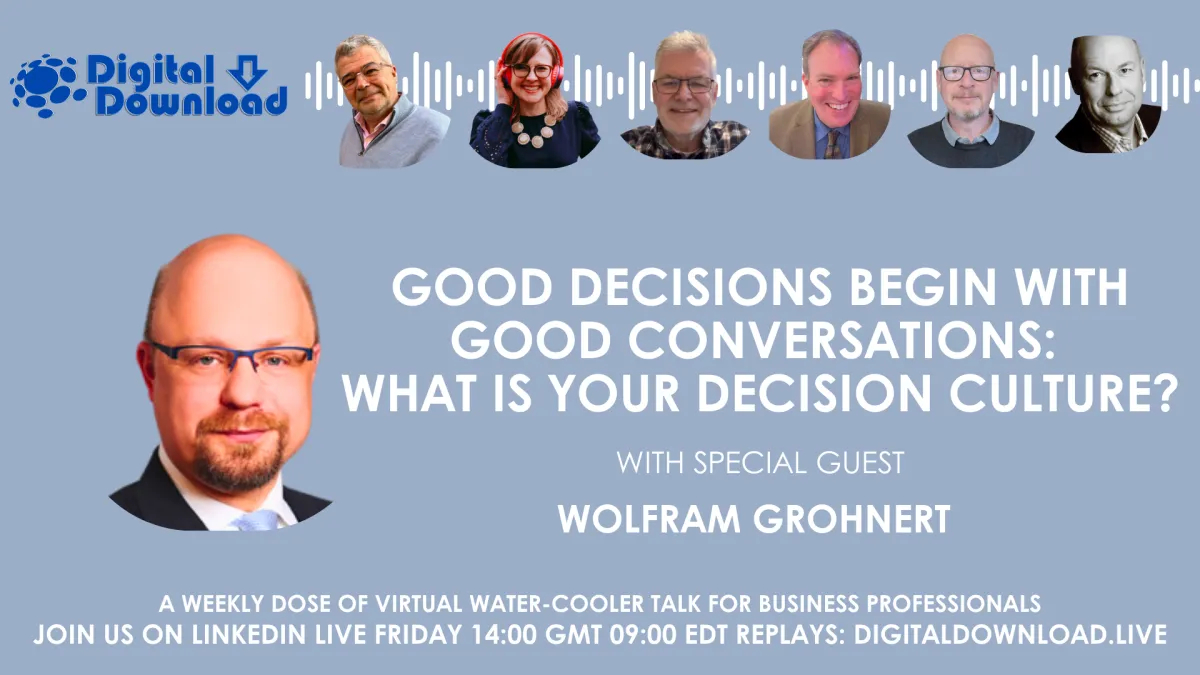
Good Decisions Begin with Good Conversations: What’s Your Decision Culture?
This week on The Digital Download, we are challenging the dangerous assumption that silence equals consent to focus on something critical: Decision Culture.
We all know that poor communication leads to bad decisions.
We are joined by Wolfram Grohnert, an Independent Advisor who works at the intersection of risk culture, civic design, and decision-making under pressure. After 30+ years in banking with giants like HSBC and J.P. Morgan , Wolfram now helps organizations build "transparent, behaviourally realistic decision architectures".
We will explore simple format shifts that help surface disagreement, protect thinking, and ensure you grow your next generation leaders, rather than see them leaving.
Join us as we discuss:
The Human Element: Why "good decisions begin with good conversations?"
Governance Innovation: How to align words, intent, and action to strengthen trust.
The Dialogue Deficit: Why traditional corporate communication often suppresses the truth?
As a Mediator: How "low-threshold methods" can make professional disagreement safer.
Risk Culture: Lessons from 30 years in banking on navigating financial risks and opportunities.
If you are interested in how to solve the "human problems" in your business, this is the episode for you.
We strive to make The Digital Download an interactive experience. Bring your questions. Bring your insights. Audience participation is keenly encouraged!
This week's Host was -
Bertrand Godillot, Founder and Managing Partner of Odysseus & Co, a proud DLA Ignite partner
Panelists included -
Tim Hughes, Co-founder and CEO of DLA Ignite
Adam Gray, Co-founder of DLA Ignite
Tracy Borreson, Founder and CEO of TLB Coaching & Events, a proud partner of DLA Ignite
Transcript of The Digital Download 2026-01-23
Bertrand Godillot [00:00:05]:
Good afternoon, good morning and good day wherever you may be joining us from. Welcome to another edition of the Digital Download, the longest running weekly business Talk show on LinkedIn Live, now globally syndicated on tuning radio through IBGR, the world's number one business talk news, news and strategy radio network. Today on the Digital Download, we are challenging the dangerous assumption that silence equals consent to focus on something critical. Decision culture. We all know that poor communication leads to bad decisions. And to help us with the discussion, we have a special guest, Wolfram Granard, an independent advisor who works at the intersection of risk culture, civic design and decision making under pressure. After 30 years with giants like HSBC and JP Morgan, Wolfram now helps organizations build transparent and realistic decisions architectures. But before we kick us, we kick off the discussion. Sorry, let's go around the set and introduce everyone. While we're doing this, why don't you in the audience reach out to a friend, ping them and have them join us. We strive to make the Digital Download an interactive experience and audience participation is highly encouraged. Tracy, would you like to kick us off please?
Adam Gray [00:01:34]:
Tracy, news flash. Perfect.
Bertrand Godillot [00:01:40]:
Oh no.
Tracy Borreson [00:01:41]:
It happened. That's my breaking news sound effect everybody. Just in case you're wondering what that was. Breaking news. Tracy Borison is joining us on the Digital Download today. I'm Tracy Boris and it's really early for me too and I haven't had any tea yet so like it's just silly, it's silliness. I AM founder of TLB Coaching Events which I actually fixed in my title today. Do you guys see that? It's not cut off.
Tracy Borreson [00:02:06]:
I finally figured that one out. A very proud partner of DLA and we are all about authentic marketing. So like I'm sure it will come up as part of the show because there's no way I get through an episode without talking about something authentic marketing. But it's really about like totally relevant in terms of good decisions. So I'm excited to bring that into the conversation today.
Bertrand Godillot [00:02:29]:
Okay. I am. Excellent. Excellent. Tim.
Tim Hughes [00:02:33]:
Yes, welcome. My name is Tim Hughes. I'm the co founder and CEO of DLA Ignite and famous for writing the book Social Selling Techniques to influence Buyers and Change Makers.
Bertrand Godillot [00:02:46]:
Okay, thank you so much, Adam.
Tracy Borreson [00:02:54]:
Adam's news is not as breaking. It's not that exciting.
Adam Gray [00:02:59]:
I'm Adam Gray. I'm Tim's business partner and co founder of BLA Ignite. And this seems like this is going to be quite a cerebral discussion and I'm quite looking forward to that. It's Going to be a different pace to some of the other shows we've had more recently. And the idea of a formal decision making architecture seems like something every organization should be thinking about.
Bertrand Godillot [00:03:25]:
Agreed. And myself, apart from the fact that, as my AI teammate says, I am a prisoner of my own brilliance. I am the founder and and managing partner of Odysseus & Co , a very proud DLA Ignite partner. So, as I said this week, we welcome Wolfram and we're going to talk about decision culture. Let's bring him up.
Wolfram Grohnert [00:03:52]:
Hi, everyone.
Tracy Borreson [00:03:53]:
Welcome, Wolfram.
Wolfram Grohnert [00:03:55]:
Thanks for having me. Yeah, my name is Wolfram Gronhard. As Bertrand said at the intro, I've worked for over 30 years in banking and helped clients navigate topics around risk management. More recently, I focused more on using some of that experience to help in other settings in sort of understanding how decisions are formed. And therefore, I thought this could be a useful discussion today.
Bertrand Godillot [00:04:22]:
Well, we were definitely looking forward to a great discussion with you, Wolfram, but let's start with a foundational question, because that's the rule. So why good decisions begin with good conversations from your perspective,
Wolfram Grohnert [00:04:38]:
I would say if you think about how we form decisions, and this is sort of, again, you know, my background in risk management speaking, you need data before you can identify and quantify risks. And if you think about a group of people that walked through the forests and they have one torchlight, then that's useful, better than being in the darkness. But if you have more than one torchlight, then it's likely you see more. And therefore I would say conversations. And I think Tracy said this last week in your session when she talked about the third brain. So when two brains interact, something else emerges. And therefore I would argue that if, if you have one dominant voice and the other voices aren't heard, so you have a bad conversation, you have a one directional communication, then the outcome is likely less good quality data.
Tracy Borreson [00:05:36]:
Well, this is making me think of like, I don't know if you call it torch tag or flashlight tag when your kids, when you like, all have the flashlights and you're trying to play it like tag, right? And so you got a whole bunch of people with a whole bunch of lights, which could be shining on useful stuff, but could also be kind of crazy and distracting. So also, is there, how do we connect to. I mean, I have my own perception of the answer to this question, but how do we connect to the meaningful data? Because I also think in a world where there's so much data now, we can be overly concerned about the collection of Data and not how that data is playing into actually making a good decision.
Wolfram Grohnert [00:06:20]:
So if I can paraphrase that, what you're addressing is basically what is data and what is noise, Right?
Tracy Borreson [00:06:27]:
Yes.
Wolfram Grohnert [00:06:28]:
If everyone gets a megaphone and everyone keeps shouting and no one is listening, then it's very noisy, but not really helpful. Right.
Tracy Borreson [00:06:36]:
Right.
Wolfram Grohnert [00:06:38]:
Now I would say that is probably the sort of, the underlying theme around decision making and communication that I've observed over many, many different settings is that, yes, of course, if everyone speaks at the same time, then it becomes a very noisy affair and it's difficult to digest the information. But I would say that I've seen more commonly that you have the phenomenon that there's one dominant flashlight which tends to be the senior voice in the room, and that basically says, let me show you. And at that point I would say, I mean, obviously, you know, if you have a sports club or, or a sort of family gathering, then the noisy torchlight fest, you know, is, is easily achieved. But I would say in more formal settings, the danger is more around silence because once you have a dominant flashlight pointing down the alleyway, then, you know, the junior voice I can switch off may say, you know, let's. Let's leave the flashlight in the pocket because pointing somewhere else doesn't really feel like it's adding much.
Bertrand Godillot [00:07:52]:
And I think you shared that also. Well, from that very unfortunately, silence is often misperceived as, as consent. And that is leading to a lot of, I would say, well, ultimately bad decisions because you, you don't get your voice heard. So, I mean, apart from the, the cultural difference that we have all probably experienced between north and south, anything that, at least in Europe, anything that you, that you would comment on this.
Wolfram Grohnert [00:08:39]:
Yes. I think, you know, if we go back to Plato that he postulated that in philosophical discourse, silence typically should be construed as consent. And that is fair if it's a discussion that is on a level playing field. So if everyone in the room has the same status, then it's. It may feel like wasting time to go around and saying, you know, do you agree? Do you agree? Do you agree? But that changes if you have different status participants in a room. And if you then say, you know, I didn't hear any comments, therefore I guess I'm right, is a different calibration, is a different decision. And the funny thing is, if you sort of, if you go back with, across discussions with many people, what I find very informative many times was that when people start to open up because they feel it's the safe space. They suddenly tell you things, what they really think, if you like.
Wolfram Grohnert [00:09:41]:
Now the, the interesting lesson in that to me is, well, if, if we're in a safe space and you suddenly tell me how you really think, well, how likely is it that in a normal setting where you have high pressure decisions to be made, let's say in a committee, how likely is it that that same posture will be assumed by someone in the room that isn't sharing the committee? And that's when things can become expensive because you don't hear about blind spots or misperceptions or you don't get data that you should actually use for the information for the decision that you're trying to make.
Adam Gray [00:10:18]:
So do you find that. So you described it as the flashlights point pointing down the alley and you've got the bright flashlight which is from the senior person. So do you find that most decision making processes fall into that trap where I'm in charge, therefore we're going to do what I say? And if that is the case, does this affect decisions around what organizations buy as well? Because we've spent a huge amount of time learning about the complexity of buying teams and how important it is to, to get everybody in the buying team on side because we've got 15 people in the buying team for a large tech purchase or whatever the story is, it's like, do we need to bother? Because the, the person that's in charge is the person that's leading it. So as long as we get them on side, everyone else will just be quiet.
Wolfram Grohnert [00:11:17]:
I wouldn't go as insofar as to say, you know, that's the majority of how committees or groups of people form. But I would say that I've seen it time and time again that in high stakes environments and that's often subject to who is chairing those committees or groups of people that have to form decisions. And I would say one observation that I've made is that sort of smaller companies that are run by founders, that sometimes those individuals are more attuned to actually trying to read the room. But if you go into larger organizations, then there seems to be a certain habit of managers living under the impression that they have to be the most vocal, that they have to steer the group. And what I find, you know, is, is, should be a conscious choice. And I'm not sure that it always is. A conscious choice is if you go back to, to Kahneman and, and thinking fast and slow, if the most senior person in the room comes in, opens the Meeting presents their preferred solution, then that's what Kahneman would call priming the room. And at that point, having a different point of view for anyone else in the room becomes expensive because we as human beings, we try to survive, whether that's biological survival or, or professional survival.
Wolfram Grohnert [00:12:47]:
So making a uncomfortable comment or, or making or presenting a differing view is something that, if the boss has already spoken, that's a costly proposition. That's a risky behavior. We could call that, you know, a potentially career limiting move if you speak out of tune. And, and the question that I have to your point, Adam, is I would say if you have these sort of traditionally run committees, then yes, if you convince the person that ultimately makes the decision, then, you know, trying to bring everyone else in that team on board may help later on in then applying whatever you're selling them, because obviously that is then also typically a distributed effort of a firm, not a single person. But in terms of the decision making process, if you have such a traditional committee on the other side, then probably the most effective way is to, to win that person over and make sure that that person is primed in a way that is helpful to you.
Tracy Borreson [00:13:53]:
I think there's an interesting thing that's coming up here for me in terms of like, I think there's a classic expectation of leadership that the leader figures stuff out and tells us what to do and then we do stuff, right? So when we are operating under that principle, then it's very easy for someone to come in and like, here's a flashlight. You guys were looking for a flashlight right here.
Adam Gray [00:14:17]:
Let's go.
Tracy Borreson [00:14:17]:
This is gonna be great. And that ties into then like the culture of the organization because you get junior employees who come in like, not even believing they have a light match, let alone a flashlight, right? So we create this belief that this is where the ideas are, the ideas exist in leadership. And therefore, like, we need to depend on leadership to generate the ideas. I think one of the things we're seeing in this environment of like, fairly consistent change and increased certainty than uncertainty than we maybe have seen in the past, at least in my lifetime, is that leaders don't always know what to do now, right? So we're moving into this scenario where we kind of need to ask the people, but then we're also operating under this historic way of, of being in leadership where like, I come with all the answers. And so now I'm, I potentially am coming to the room and being like, hey, so we need to figure this out. And I had this idea, but what ideas do you have? And I could be legitimately curious about what ideas I have, but we're still operating in that like old operating system. And so are there any. I'd love everybody's thoughts on this, but throw it at you first.
Tracy Borreson [00:15:39]:
Wolfram was like, what are some ways that we can like start to make that shift? If we realize, okay, this is the decision making architecture that we have maybe by default, and we don't want that anymore, how do we like start to shift to a different way when maybe the other people in the room don't even think they brought a match?
Wolfram Grohnert [00:15:58]:
Yeah, that's a very fair point. And it is also important, I would say, that there is consistency. So, you know, having suddenly a meeting where you sort of upend all the sort of muscle memory rules of the organization is not going to work. But, but as you said in your example, if, if, if you're a manager and you want your group's input because you say, you know, it's too vast an area to cover, there are some areas where I lack the expertise or the know how. So therefore I want to encourage people to speak up, then I would say one very subtle but very helpful method could just be to say, well, I come in, I, I say what we want to discuss, but then I flip the order of the people in the room speaking and I actually make sure that the most junior, most most recent joining member of the team gets to speak first. Now again, I said consistency because if you do that as a one off, then you will still end up, after five minutes of deafening silence, you will still have ending, priming the room. Right? But if it becomes a thing, if it becomes a theme, that every single time that's how we roll, then it does, I would say it does five things over time. The first thing is because it's now a sort of acquired practice that the most junior person in the room speaks first.
Wolfram Grohnert [00:17:30]:
What you actually have just done is you've internalized the training program for the next generation of leaders because normally they would probably for the first two years not say a single word, maybe, you know, take the notes and drink some coffee and listen and trying to adapt to the organizational culture. But because they are now being put in the spotlight, and not in a spotlight in terms of being then obviously belittled if they get something wrong. But they, they practice on the job, they practice in a real environment where decisions matter and they can actually get a sense of agency. I can bring stuff to the table. So that's hugely valuable. I would say the second Element is that the person that was in that position last year probably still has a very vivid memory of how awkward that felt.
Tim Hughes [00:18:23]:
Right.
Wolfram Grohnert [00:18:23]:
So it's, it would be rather natural that that person maybe later on then says, well, you know, Tracy, I know this felt really odd, but actually you did really well. And here one or two tips and, and suddenly, boom, you have your in house mentoring program that just grows naturally out of committees. No need to have a formal HR process to find mentors and mentees. No, it becomes part of how the organization grows and develops over time. The third element is that you suddenly listen to the entire room because people realize that you're serious about this. This isn't just a sort of any other business final point in the agenda. This is a genuine data gathering exercise. I want to hear what your experience is.
Wolfram Grohnert [00:19:09]:
I want to get the full breadth of the organization that is in that room. I want to harvest the combined diverse intellect of the group. And therefore I'm serious and I will listen. And if you need a minute longer, that's fair. And then the penultimate point is because you've listened to the entire room and you've aggregated all that information on which you then form the opinion and make a decision, suddenly the committee owns the decision. Whereas in the previous setting, if you meet someone who was in a committee that I sometimes call committee in name only, C, I and O. If you speak to someone out of those committees, they will typically say if they're challenged on the decision or you know how it works, the senior guy came in and we approved what they wanted to do. Whereas now it was a decision by the committee after deliberation and suddenly that person will defend the decision because under the given circumstances, it's the best decision we could come to.
Adam Gray [00:20:20]:
I get.
Bertrand Godillot [00:20:21]:
Sorry, Adam.
Adam Gray [00:20:23]:
Yeah, I just wanted to follow on from that description. I get that what you described is a fantastic step forward for most organizations. And this is the thing, you're an expert at this. You describe it and it's like, duh. Well, obviously that's what we need to do as an organization in my experience, which will be, is limited in terms of being in decision making processes for large strategic direction changes within organizations. It's like what you're talking about is the absolute opposite of what normally happens in my experience, you know, and, and it seems obvious, it seems very clear, it seems very collaborative. It seems like you're, you're, as you said, trying to, to take all of the diverse opinions and intellects together and meld them into something that makes sense for Everybody, so they own it and is the best decision for the organization. However, well, Bertrand's in charge, therefore he's going to get his way.
Adam Gray [00:21:29]:
Ultimately. Is, is, is that normally still the thing that happens? Do, do we find that, that businesses actually do embrace this thinking, the right thinking, or do we find that they're still stuck in the old fashioned way of doing things?
Wolfram Grohnert [00:21:44]:
There was a LinkedIn comment which sort of chimed with that in terms of, you know, decision making processes need to be adaptable and flexible. And I would, you know, what I'm proposing here is just a gentle shift in grammar in how we communicate with each other, just an alternative model. I'm not saying that that's a cure all that's going to work in every single situation, right? If you move into really high stakes situations, you know, you have an emergency, then you have a organization that has a structure for a reason and then people have to make decisions under pressure in very tight time frames. And then frankly having a gathering for an hour or two discussing what to do may not be feasible.
Tim Hughes [00:22:34]:
But so to take Paul Thornton's message, because some people don't are just listening. So Paul Thornton said, don't leaders need to be flexible and adaptable and use a variety of decision making approaches? One approach never works in all situations.
Tracy Borreson [00:22:57]:
And I think one of the things that I, I find this to be very interesting in like the world we are living in today. Let's get meta philosophical for a second. Is that so often and maybe this is because there's so much information. Like information a hundred years ago was a much more difficult to get than information is today. Now we have different problems. Whether it's that trustworthy information or not trustworthy information, it's not the point I'm trying to make. But in a world where there's so much information, I feel like we've reverted from a human being perspective to like someone tell me what to do, right? And when we talk about things like decision making, leadership, authenticity, even like selling and marketing and all of these things, there there's not like one answer. There's not one way for a leader to come into all rooms and be equally successful in all rooms.
Tracy Borreson [00:23:58]:
And I think sometimes we get a little caught up in the fact that like what's like I need a one thing and that's not a thing that's going to work in all scenarios. And like really what? We don't need a one thing, we need a thing that might work sometimes. And if you hear that option and you're like, oh, I Could try that, right? I could like, or maybe even like, you've always had that intention, but you have a really outspoken. I've had this scenario where I've had, like a really outspoken senior sales leader in the room. And, like, they're just the ones that jump on things first. And so, like, you're like, oh, maybe I'll just say, we're gonna go in rotation today and start with this person. And it feels like really low hanging fruit. So when you're like, exploring ideas.
Tracy Borreson [00:24:51]:
So if, if you came to the show today because you're like, oh, good decisions. Be good with good conversations. How can I create good conversations? This is an opportunity to try something, right? And if you try it and it doesn't work, that doesn't mean you're bad or you are like a bad leader or any of those things. Just means, like, that thing didn't work for you. We'll probably talk about more options throughout the show and any other piece of content probably has more ideas. But I think it's really important to, like, take all of this with a grain of salt and, like, try it on and say, like, would I do that? And if you would do that, then great. And if you wouldn't, that's fine. But that also plays into your own individual adaptability.
Tracy Borreson [00:25:31]:
And, and adaptability is another. Is a thing like authenticity. It doesn't look the same on every person, right? Like, here's how you can be the most adaptable human. That's a robot. It's not human. So I think that, like, all of these things, we need to get excited about creating a repertoire, right? A repertoire of things we can do and things we can try. And when you start to build that and you try on the things that work. And I remember being in this room, I was doing a focus group, we had people in the room and nobody wanted to talk.
Tracy Borreson [00:26:06]:
And I had all these questions, right? These prompt questions. And I went through a few and like, no one. I was getting nothing, right? And I was like, okay, well, I could continue to go through the prompt questions I have, or I can try something else. And I like. And it was funny because one of the participants asked me about it after, and he was like, how did you do that? And I was like, what? He's like, you turned the room around. Like nobody wanted to participate. And then by the time we were finished, everyone was like, so excited about having another conversation. I'm like, because my intention was to get this out of the room, I had an idea of how to do that.
Tracy Borreson [00:26:45]:
That didn't work. So I tried a whole. I just threw things at the room and I'm like, oh, see which one of these things sticks? And eventually something did. And then I went with that and I ran with that and I'm like, this is the thing that will work in this space. Having that repertoire of things allows us to do that. So I just want to like, just want to take a moment and encourage people to like, build their good decision, good conversation repertoire and not think like, there's one question I can ask that will always create a good conversation. Not a thing.
Tim Hughes [00:27:19]:
So, so Wolfram, when you're in a meeting and a meeting is basically having a conversation about which is to come to some level of outcome, what, what do you recommend in terms of the way that people vote on that and the way that people come to the conclusion?
Wolfram Grohnert [00:27:41]:
Well, as I said, I find, you know, that in certain situations trying this sort of inverse speaking logic can be really powerful because it gives permission to light up your little torch or you know, light your match and bring your bit to the table. And as Tracy said, you know, this is part of a repertoire. This is not a one, one tool that fixes everything. It's just a different methodology. And I find that many companies are still stuck in this more traditional way of the senior first and primes the room. So I would say that is helpful. And then one other thing that I also found can lower the boundaries of disagreeing with people because I mean, nowadays, you know, in social media, people get canceled because they misspoke for half a sentence. And that to me feels understandable from a human perspective, but it's really damaging.
Wolfram Grohnert [00:28:44]:
So therefore one element could be that you just say, well, let's just opt for a set of three colored cards, you know, red for there was a boundary that was crossed. I just don't agree with this. The second one is I'm not yet on board. I, I need more context. So slow down, give me more context. Or just a simple green card to say, okay, I'm on message, you know, we can continue. Because what that does is it gives everyone in the room the same, the same sort of quality of non verbal communication. It lowers the temperature of the room.
Wolfram Grohnert [00:29:21]:
It doesn't become a sort of verbal battle and it just makes the process slightly more deliberate and measurable.
Tim Hughes [00:29:34]:
There's a great comment there from Marvin Schmidt.
Bertrand Godillot [00:29:37]:
Yes, another one before.
Tim Hughes [00:29:40]:
I know the feeling Tracy described very well. What would you say is a good way to translate it into digital space? When participants have their cameras switched off and so On. I mean, you know, you've seen the situation where you go onto a call and half the people are just AIs doing translations, and the other half of the camera switched off.
Tracy Borreson [00:30:02]:
My AI shows up in places it's not even invited to, and I'm not there. It's weird. I think it. I think this camera switched off thing is. Is a complex component of virtual meetings. And I'd love to hear your thoughts on this, Wolfram. I mean, I think there's. I'm gonna jump in with just one thing, because this is what I do on the show is if we feel like maybe.
Tracy Borreson [00:30:33]:
I mean. So my experience of cameras off is that there's like a disconnection, right?
Bertrand Godillot [00:30:38]:
Right.
Tracy Borreson [00:30:38]:
Like, there's a. Something that is creating a greater opportunity for misalignment. Right. I can't see your face. I don't know if you're doing something else, right? Like, are you interested in attending this meeting? But then I think it's also. I think this is a thing, too, where we need to, like, roll it back a level, right? Like, one, why do people think they can show up here, not on camera? Like, do you not want to talk to your people? Like, so let's talk about that. Because I do think, I would say, in my experience anyway, a lot of times when people have their cameras off, it's because, one, they either think they didn't need to be at this meeting, and there's a really high likelihood that that is true, or two, they think that they don't. They're not part of the conversation.
Tracy Borreson [00:31:25]:
Right. That they're just there to consume the conversation and not to participate in the conversation. So I think that that is, again, there are things that can enable that in a more productive way, but also that we can use this as information to say, like, okay, maybe there's something we need to do before the meeting that encourages people to say, like, if you've been invited to this meeting, we care about your perspective and we want to hear it. We want to see it in your eyes. So that's why you're invited. And let's not invite people to meetings where they just need to listen to the recording. Right? Like, the. Like, we're gonna record this.
Tracy Borreson [00:32:04]:
You're send your note taker if you want, right? Like, and then get it in your inbox. But, like, that's all you need from this. You just need the notes, right? And just, again, like, get really honest about ourselves. Like, what is someone's role? And let's help make it clear to them that this is their role. I want to hear what you have to say.
Wolfram Grohnert [00:32:25]:
Yeah, I would agree with that. It's. It's obviously, you know, there's a very wide range of formats in. In video sessions, and if it's predominantly one person giving content to be consumed, then being very strict in saying you have to switch on your camera may be slightly off message. Right. But if it is a collaborative session, then still, you know, there could, in my view, and. And there's this great line that is sometimes misattributed to. To a former basketball player who said, you know, be.
Wolfram Grohnert [00:33:02]:
Be curious, less judgmental. I think that the danger is, you know, if. If. If the camera is switched off, if we rush to a conclusion, that creates a certain atmosphere in the room, too. So if we. If we say, you know, you've switched off your camera, therefore, obviously you don't care. Well, that may be a misconception.
Bertrand Godillot [00:33:27]:
Adam.
Tim Hughes [00:33:31]:
Gearhart's made an interesting comment. He said, I would say just say hello to every person without the camera on each single one by name. Maybe this helps.
Bertrand Godillot [00:33:44]:
And it does.
Tracy Borreson [00:33:45]:
I do that in my networking rooms, and I think it makes a big impact on people. I do it on my lives, too, and I say hello to everybody by their name or thank them for coming. But also, I just want to throw in here there is a gender difference in terms of what a female believes is ready for the camera and what a male believes is ready for the camera. And so I think it's. I mean, as much as we're trying to break that down, and there's a lot of us that are trying to break that down from the female point of view, I think it's something that's really important, important to consider, especially in when you have senior women who are calling in from home or people who have kids at home, right? Like these types of things. There's. I mean, even working from home now, you got like cats walk across the thing and turn the camera off, right? So I think they're. There's like an understanding and a permission that says, like, hey, if you need to have your camera off, have your camera off.
Tracy Borreson [00:34:48]:
And also, like, you've been invited to this meeting because I care that you're at this meeting. And I think there's a lot of big corporate meetings where a lot of people invited, and it really doesn't matter if you're there.
Tim Hughes [00:35:02]:
So my mate of mine got reported to HR because he was having meetings and his cat used to get onto the table, and then his cat turned round and all the people could see was the cat's palm. And he actually got reported to HR for that. I don't know if that's.
Tracy Borreson [00:35:24]:
Cats, man. Cats love the, like, electronics. So you gotta watch out.
Adam Gray [00:35:31]:
I think, from the. The camera on perspective. You know, often if I'm doing a webinar or whatever, I say to everybody, please turn your cameras on, because it can get very lonely here and, you know, to try to make it more engaging. But, But I, I never join. Even if it's a webinar with 100 people on it, I never join it and don't have my camera on ever, because I just think it's profoundly rude. You know, it's. It's.
Tim Hughes [00:35:58]:
It's like, you know, sorry, you're an old person.
Tracy Borreson [00:36:02]:
Yeah, I am.
Bertrand Godillot [00:36:03]:
But.
Adam Gray [00:36:03]:
But it's like, you know, you're. You're speaking on your webinar and I'm. I'm there reading my book.
Tim Hughes [00:36:09]:
Yeah, you come on and you talk about Elvis Presley and. Well, okay, don't you.
Adam Gray [00:36:16]:
But yeah, I get, I get your point, Tracy. You know, it's like, clearly, I think this is camera ready. You. You, on the other hand, probably don't.
Tracy Borreson [00:36:25]:
I mean, the point is that you don't think about it and I think about it, right? So it's like, like a mental calorie thing. But I, I want to use this example because I was on this. I had signed up for this, like, lean in Girls leadership, like, overview thing, right? And I'm like, oh, this might be cool. Maybe we can bring it to the. The baseball team. And so I logged into it and I was totally had other work stuff to do, right? And I assumed that this was going to be just like an info session so that I could do it at the same time, so. Except it was not that. It was, like, super interactive.
Tracy Borreson [00:37:02]:
And so I was like, ooh, okay, I do want to participate in that, but I also need to do this. So I, like, switched my camera on and off, but my camera on means, like, okay, I'm ready to not just listen, because I can listen with my camera off, but now I'm ready to, like, participate in a conversation because my camera is on. So I think, again, like, there's lots of different ways that different people could, like, use camera off, camera on. And I think even just having the conversation back to good conversations, right? Like, what does this mean for you? Right? And what does this mean for our organization and how can we communicate digitally to each other that we aren't prepared to participate in a conversation, right? Now, a conversation involves a conversation, not just listening, right? So, like, if you're here to participate in the conversation, how do I know that you are ready for that?
Wolfram Grohnert [00:38:00]:
And I would also say that. Sorry, Tim. I would also say that, you know, in light of that, if you have a virtual session, then if you use or try, you know, the, the idea of flipping the order around, you make it automatically more interactive, and then it becomes logical to switch on your camera because you're speaking. Whereas if you stick to a traditional form of senior voice, comes in, says, any other business or any further ideas or comments, and you're going, well, actually, that's a risky strategy. I'd rather keep my mouth shut. Then I would say it's less likely that cameras get switched on in the sort of traditional hierarchical structure of speaking.
Bertrand Godillot [00:38:45]:
So, Wolfram, you gave a few pretty good tips, I have to say, for the ones that would love to change the way they organize their decision committees as the chair. But what if you are part of this committee and your chair is actually using the good old, you know, we'll do what I say. How do you re. How do you re. How do you reverse this?
Wolfram Grohnert [00:39:15]:
Well, I think. And then there was. There was a comment by. By Marcia earlier on LinkedIn where she said, you know, it's partially to do with what you have experienced, the prior organizational change experience.
Tim Hughes [00:39:28]:
Can I read that out?
Bertrand Godillot [00:39:30]:
Yes, Tim.
Tim Hughes [00:39:31]:
Marcia Robinson said prior organizational change experience is very instructive. People will make sense of what they see, hear, and feel. They will act accordingly. They know what they've seen before. Leaders have to ask that, acknowledge how employee aptitudes have been shaped and commit to reorientating the culture moving forward.
Wolfram Grohnert [00:39:55]:
And I think that's. From my perspective, that is a very fair comment. And this is also why, as Adam said earlier, you know, once you think about this subtle change of just flipping the order of how people speak and contribute, it's. It's sort of difficult to unsee the, the power of, of that in, in the right setting. And I would say, because this isn't something we normally do, and people that want to get managerial responsibility and, and leadership roles, they see how the organization has evolved before them and they copy behavior of other leaders. And therefore, if. If this idea of inverting the order of speaking never comes up, then it's. It's down to someone to offer that insight or for.
Wolfram Grohnert [00:40:49]:
For a leader to try that by themselves. And, and therefore, yes, absolutely. If. If. As. As Tracy said, if it's not part of your repertoire because you haven't seen it. You haven't lived that experience, then you know, it's a bit like, I heard a quote yesterday that said journalism is the first draft of history. And that was quite a nice quote.
Wolfram Grohnert [00:41:14]:
And then I thought, well, if journalism is the first draft of history, what about all the voices that go silent because they don't get reported? Doesn't that mean we keep repeating the same mistake again and again and again?
Tracy Borreson [00:41:30]:
Oh, clearly it does based on history. But I also like to. This is making me think of a time Bertrand. So, like, in my very first job ever working in this like, big marketing department, I'm a like junior event coordinator. And we had this advertising meeting once a week, the big executive boardroom. And every meeting the same people would sit in the same places and the juniors would stand against the walls and the seaters would sit in the seats. And I think there maybe there's a like, little bit of stupidity or naivety that comes in here, but also bravery. So there was one day I was like, I'm gonna sit.
Wolfram Grohnert [00:42:20]:
I.
Tracy Borreson [00:42:20]:
And I sat in one of the chairs and the person who normally sat there came and like, stood behind me and didn't even say anything, just like looking at me, waiting for me to move. And I turned around and I was like, it's get out of your comfort zone day. Everybody is gonna switch seats like 100 expecting that that person was going to tell me to move and they were going to sit there. Except they didn't. They went and sat in a different spot. And then every person sat in a different place and the leader didn't have a chair and they stood at the front of the room. And I was like, oh, I mean, sure, I. I could.
Tracy Borreson [00:43:01]:
I mean, to me, in that scenario, the worst thing, like, I was like, I don't think I'm going to get fired for this. The worst thing, I'm going to just like smack my hand and go, stand in your spot. Right. But it like, opened the door to like a whole thing. So then once a month we had get out of your comfort zone day and everybody switched seats. Right. So I think as a, a junior, sometimes when you can like, tap into something that you'd like to see in a space or in a conversation and you bring it to the table and like, I mean, there's some environments where like, okay, maybe that will get you fired, but I would think in most environments you're going to get a slap on the hand. You're gonna, you're boss is going to take you into office, be like you can't do that again, like, don't be stupid.
Tracy Borreson [00:43:50]:
There's. I'm a big fan of the ask for forgiveness and not for permission. And so like when you try that and is what seemingly a safe way, I think there is space for that. And I think that not enough junior people give themselves the space for that to just try, try and get your voice heard. Sometimes you'll get reprimanded.
Adam Gray [00:44:16]:
Oh well, I think, I think there's a bigger issue there, isn't there, which is most people feel that they don't, their voice doesn't have any value. So you know, we see, we see that in interactions within the corporate environment, but we see that in what people post on social as well. You know, overwhelmingly the posts that get, get published on LinkedIn are resharing of in quotes, approved posts. Not because the approved posts are better, because clearly by their performance they're not better, they're worse. But the reason is that I'm not an expert, I don't have anything to say. I'm not a writer. You know what happens if people laugh at me, all of those things and it's an empowerment issue. And I think that what Wolfram said at the beginning about, you know, you have the pyramid with the leader at the top and the workers at the bottom and you turn it upside down and you basically say, well, we're going to start with what's your opinion? Because actually the very worst that can happen is that your opinion gets forgotten.
Adam Gray [00:45:13]:
The best that can happen is your opinion is fresh and different from the perspective of the other people that have already gone native within the organization and can't now think outside of that particular box, that all of a sudden you're getting fresh thinking which at the very least challenges the assumptions and at the very best avoids a terribly costly mistake.
Wolfram Grohnert [00:45:35]:
Exactly. And to Bertrand's question earlier, in terms of, you know, how do you, how do you operate in an environment where you have a traditional senior person that wants to prime the room when they come in? Because that's what they always have done and it, so far it has worked. Again, you know, that is a potentially self imposing silence. You know, how, how do you approach that subject? Can you find a discussion with that person to just broach the idea and outline it slowly and deliberately to show what the benefits could be? Or do you say, well, if the organization isn't ready for this at all, then maybe there are other organizations that are ready for this already doing this in certain scenarios. So I'm not saying, you know, as, as, as Tracy also said earlier, you know, this clearly this isn't a cure all for every situation. And there clearly will be, will be managers or heads of departments that feel uncomfortable with this. And then that's also the, the fifth benefit that so far I didn't disclose which is basically the most senior person that chairs the meeting ultimately is accountable for the decision. Right.
Wolfram Grohnert [00:47:00]:
So that cost to that person is real. Because irrespective of whether you ask the room or you just impose what you want to do it, ultimately yes, there was a committee that decided, but is ultimately your, your title is, is next to the signature and your signature is there on the page.
Bertrand Godillot [00:47:20]:
And from that perspective, well, from, I'm pretty sure that you have, you know, being 30 years into giants in banking, you must have some more stories to share with us because if we can't convince, maybe we, I mean if we can't convince on the, the approach, maybe we can witness some of the, the disasters that have happened due to that approach.
Wolfram Grohnert [00:47:49]:
Well, as I said, you know, if, if you have one person coming in priming the room and saying that's how we do it, then there can be at times also be an element of, of insecurity by the manager. Because if, if you flip the order of contributions, aren't you giving up a sense of power and control? You know, couldn't this become a debating society that finds no solution whatsoever and wouldn't that be a disaster? Clearly, yes, that is a real risk. But I would, I would counter that by saying, well, you still get to synthesize, you still manage the room. Actually in synthesizing at the end and forming a proposal for the committee to decide upon, you can actually also mirror some expressions that were used by other people in the room which may improve the buy in of the team to go with the decision.
Bertrand Godillot [00:48:49]:
And let's, let's be honest, maybe it can also change your ideas. That is the ultimate goal. Right, so. Or at least raising the bar in the way you are looking at the overall problem.
Tracy Borreson [00:49:05]:
So yeah, I think for me that brings up the like, why are we here as a committee? Is it so that I can solve your problem or is it so that we can solve a problem? And there's, I wanted to ask you Wolfram about like the role of curiosity because again, I think if we come in and our belief and, or the structure is focused around the leader creates the solution and what this is about is communicating and, or convincing a community committee to go and do a thing versus we have a problem, we've Put this committee together to figure out how to do that. The reason you're on the committee is because everybody has a unique perspective or experience or point of view that's valuable to us figuring out a thing. And so, like, I want to know what that is, right? Like from the leading the room perspective, what is the role of curiosity in generating these meaningful conversations?
Wolfram Grohnert [00:50:09]:
I would say again, if. If you think you know all the answers and you're the smartest person in the room and therefore you want to dominate the environment, then that can work for a long time. But as you said earlier, Tracy, you know, we're living in times where many things are changing. Certain things are getting thrown out of the window at a frightening speed, frankly. And, and therefore, even with tons of experience, it is likely that you will encounter situations where something new shows up that you haven't seen before. And if, if you're keen to ensure that you can demonstrate that you know everything, then that's risky. Curiosity is, is a potential helpful calibration to ensure that you keep listening and not just communicating by speaking, but also by actually listening and listening in a way that we have done today, which gives the other person time to speak their mind and actually use that time to listen to those messages rather than already forming my own retort in my mind, which means I'm not listening.
Bertrand Godillot [00:51:22]:
Stay hungry, stay foolish, said the. The artist. All right, Wolfram, this has been great. Thank you so much. Where can we find you? Where can we learn more?
Wolfram Grohnert [00:51:35]:
The easiest way to find me is really on LinkedIn. You see my name here (https://www.linkedin.com/in/wolfram-grohnert-49101a61/) in the, in the session and on my profile is up on LinkedIn.
Bertrand Godillot [00:51:41]:
Okay, excellent. Well, I think it's time now for me to do the thing which is to share our QR code, hopefully, Because we now have a newsletter. So, you know, if you're interested, if you want to know more about the upcoming episodes, the insights from the show just can flash the QR code or Visit us at DigitalDownload.live/newsletter. Well, on behalf of the panelists, to our audience, and to olfram of course, thank you very much for joining today and we're looking forward to our next episode next week. Thank you very much. Bye bye.
Tim Hughes [00:52:29]:
Thanks, Wolf.
Tracy Borreson [00:52:30]:
Thanks everyone.
Tim Hughes [00:52:30]:
Really appreciate it.
Bertrand Godillot [00:52:32]:
Thank you.
#RiskCulture #AI #DecisionMaking #CorporateGovernance #Banking #FutureOfWork #LinkedInLive #Podcast